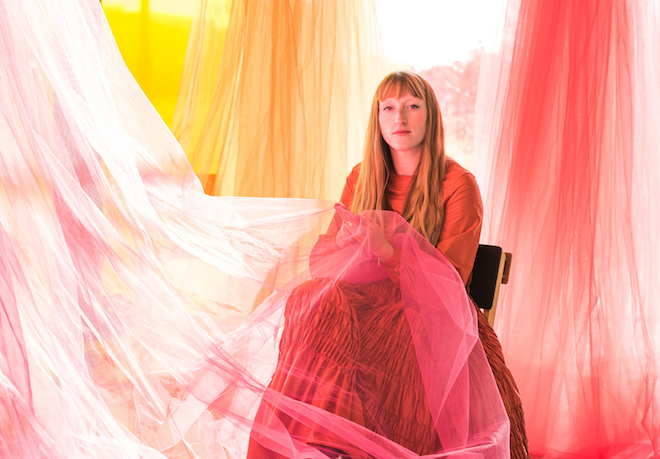
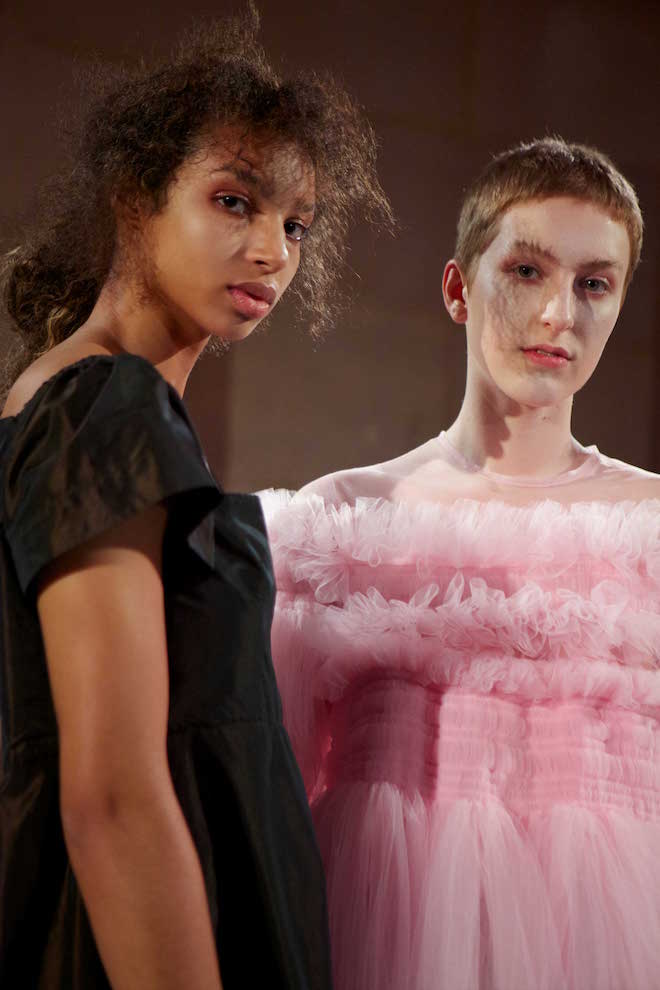
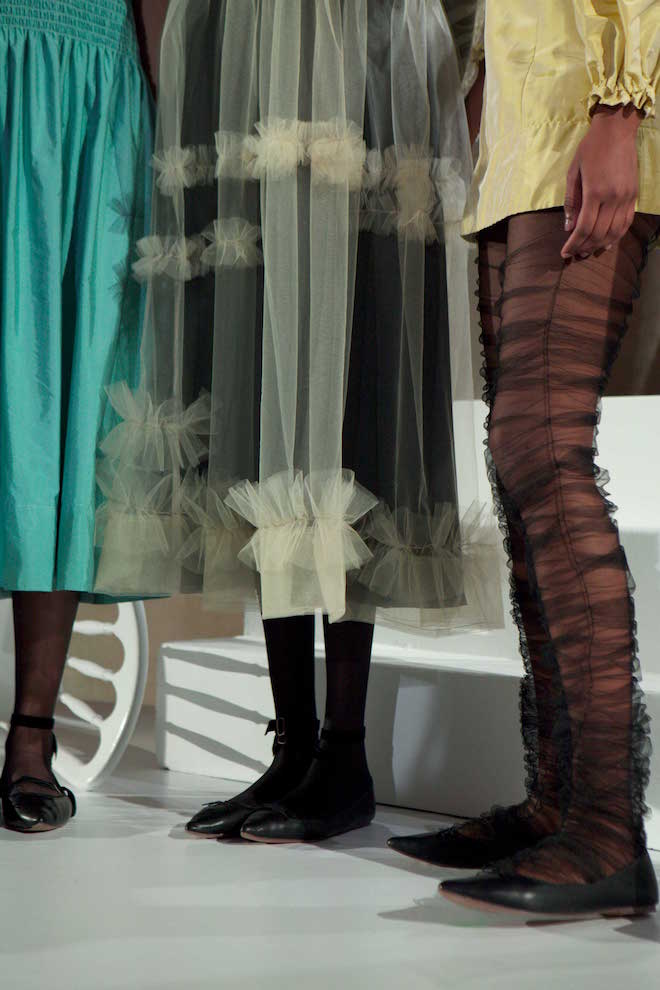
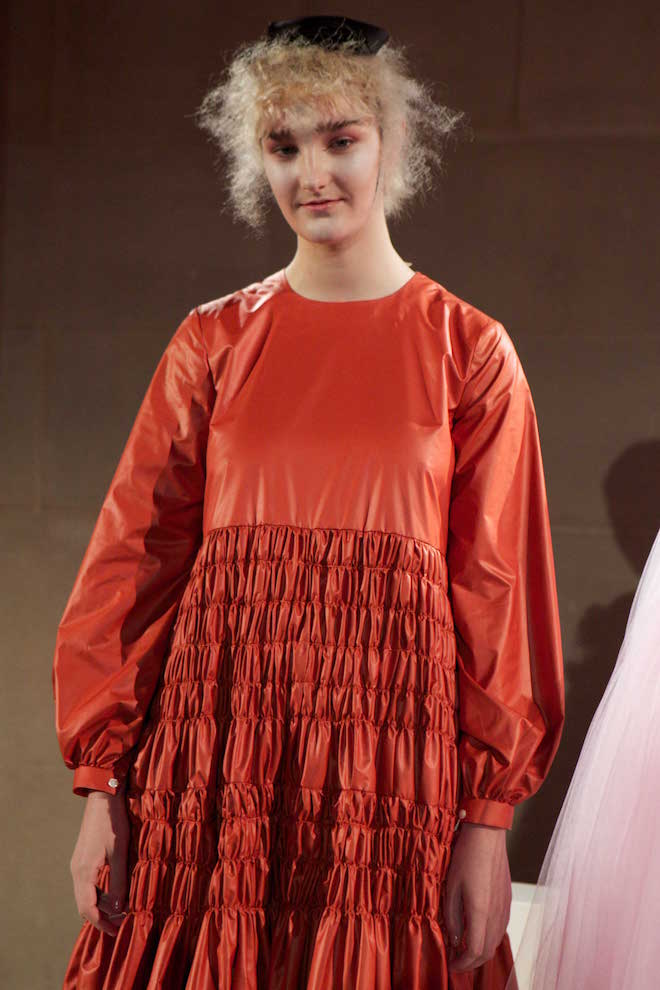
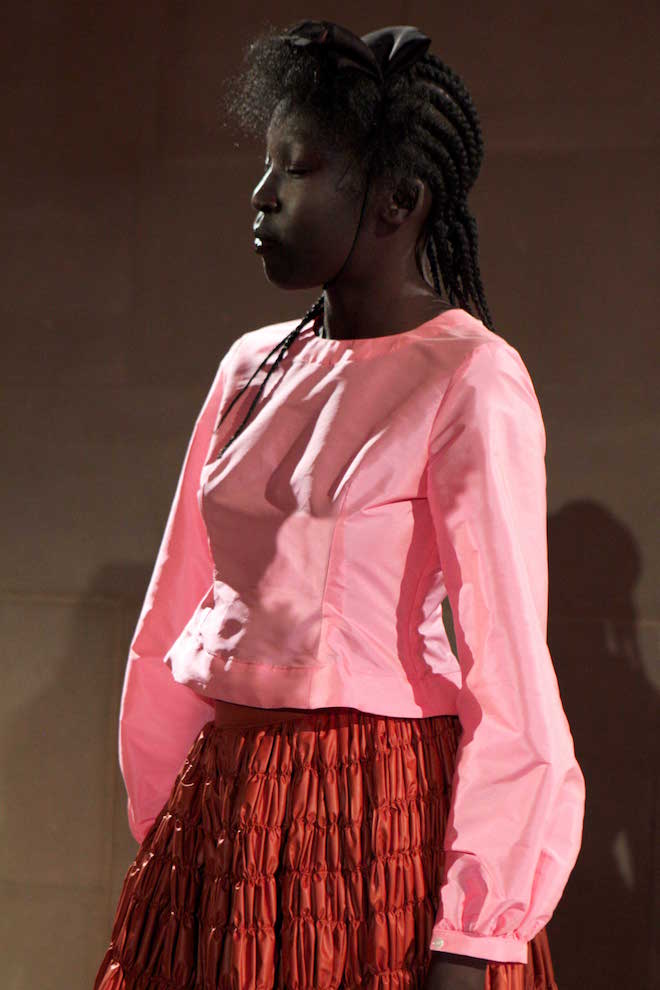
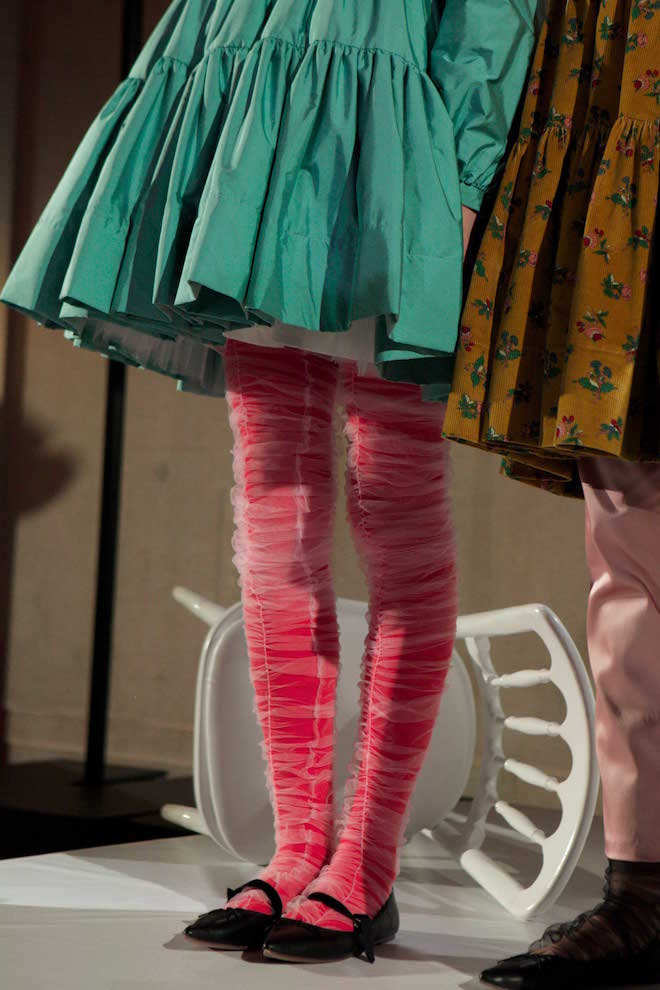
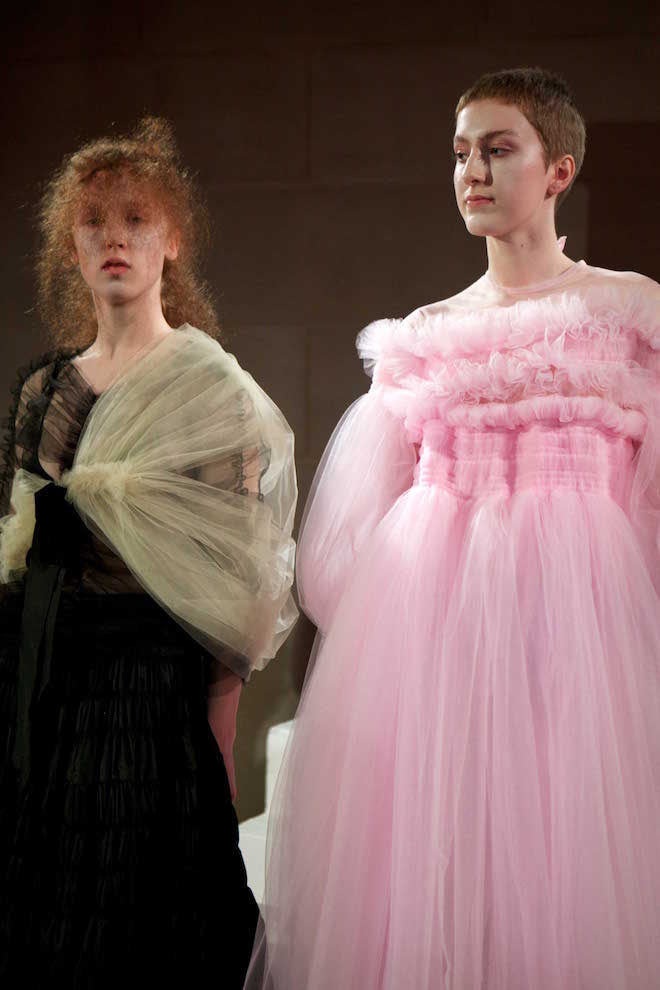
British talent and emerging designer Molly Goddard has established a strong signature aesthetic thanks to her collections of romantic, voluminous tulle dresses. In her first art partnership, the designer has paired up with NOW Gallery in Greenwich Peninsula to create an immersive exhibition in which visitors are invited to explore her design ethos within a creative gallery space.
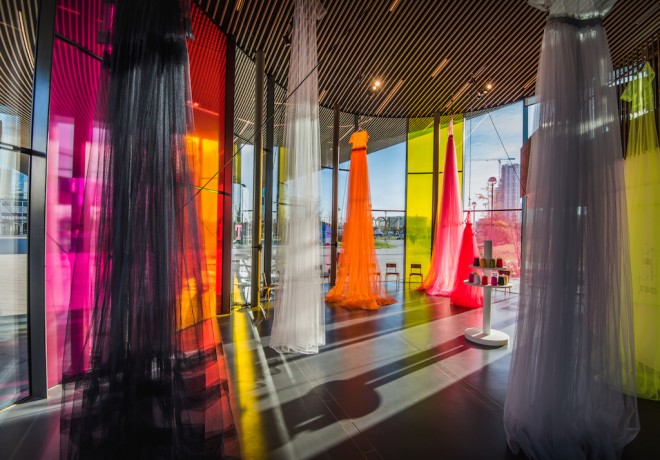
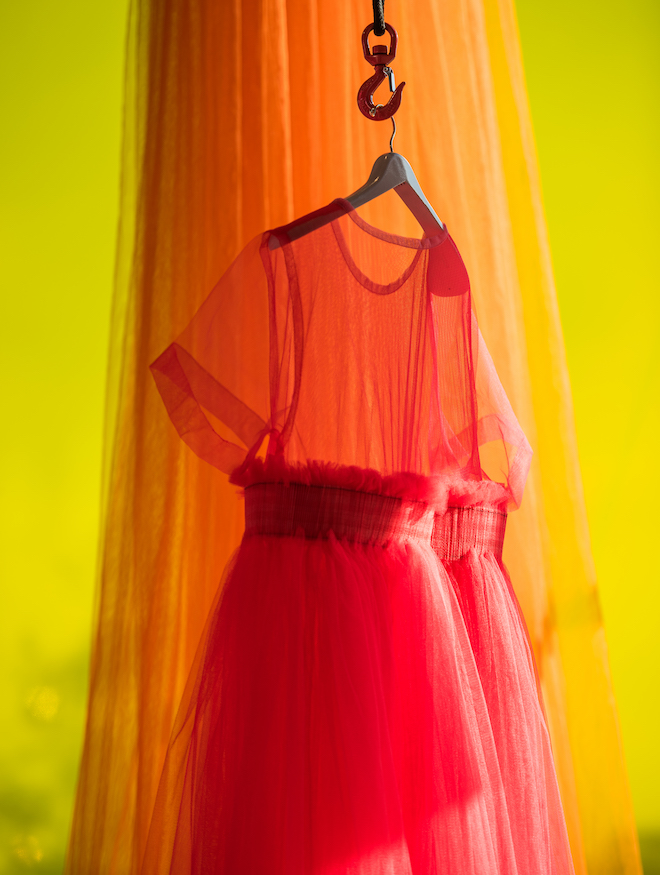
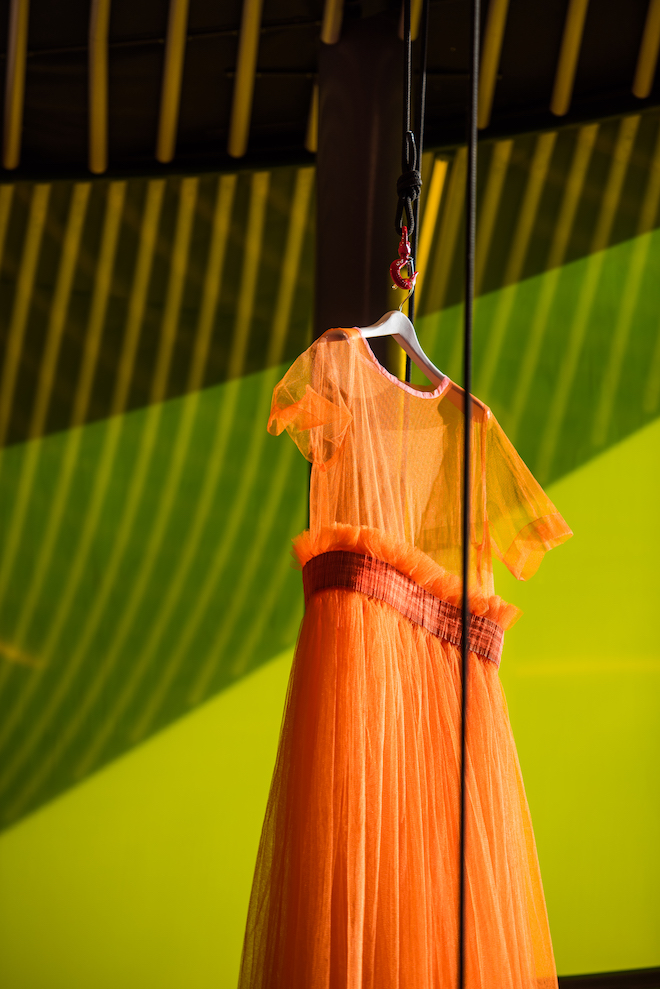
The installation sees Goddard’s creations rendered in exaggerated forms: six tulle dresses made from 20-30 feet long reams of material hang throughout the space. The presentation invites a reimagining of Goddard’s work, and allows the craftsmanship behind the brand to take centre stage.
As with Goddard’s previous London Fashion Week presentations, the new exhibition at NOW Gallery is participatory, and visitors will be able to sew shapes and patterns of their choice directly onto the hanging dresses. There will even be videos for first-time embroiders.
Speaking about the exhibition, Molly Goddard said: “I am so excited to be able to really celebrate craft technique in such an extreme visual way, making oversize, non precious interactive pieces is key to what I love and what the brand aims to represent. I can’t wait to see the stories which will be told through embroidery and to witness what skills people have or manage to discover when visiting the exhibition.”
The Central Saint Martin’s graduate, Gotal Ryam creates clothing that is at the intersection of fashion and art, RTW and couture. Having realised her dream of becoming a designer, she was brought to London from Paris and hasn’t looked back since. Having launched her e-shop this week, we catch up with this fashion designer to watch.
Tell us about how you started in the industry?
Following my move from Paris to London, I ended up in Soho where my interest in fashion peaked. My desire to draw beautiful garments led me to Central Saint Martins where I studied fashion drawing; finally last year I decided to launch my own collection.
How would you describe your design aesthetic?
I would describe my design aesthetic as Pret à Couture, a mix between Pret à Porter and Haute Couture.
You describe your line as a mix of fashion and art. As an emerging designer which designers and artists do you look up?
The modern and independent woman with a taste for fashion who is equally at ease in trainers as well as in highend pieces.
Tell us about your AW16 collection, what was the inspiration?
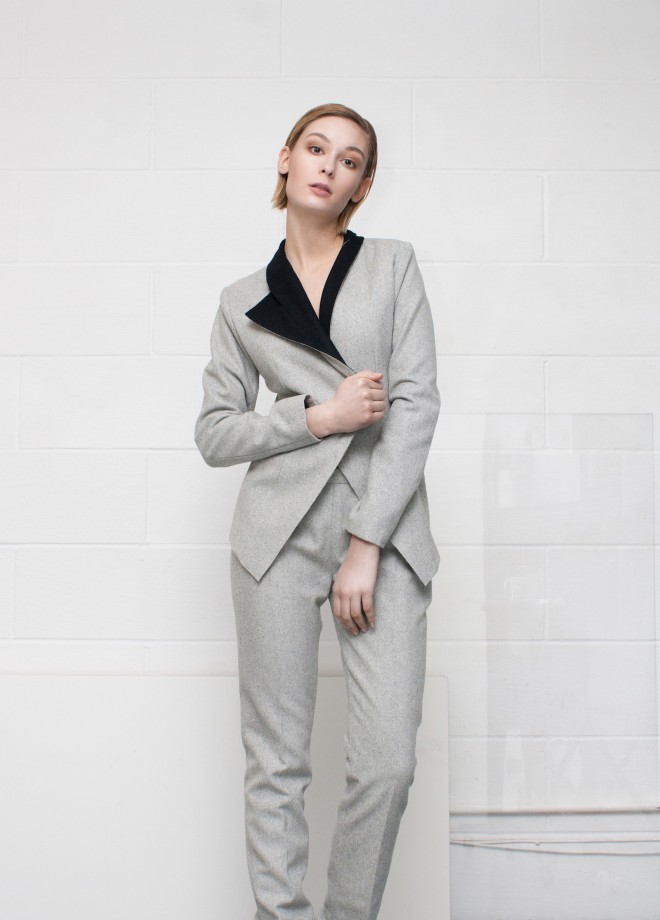
The collection is called Geometric shades from RBK it has been inspired by the geometric aspects of Origami. This collection is made entirely of wool. It is the first collection that I wish to dedicate to my mother who has given me a taste for fashion and who embodies timeless style (RBK stands for Rebecca, my mother’s name).
Which is your favourite piece in the line?
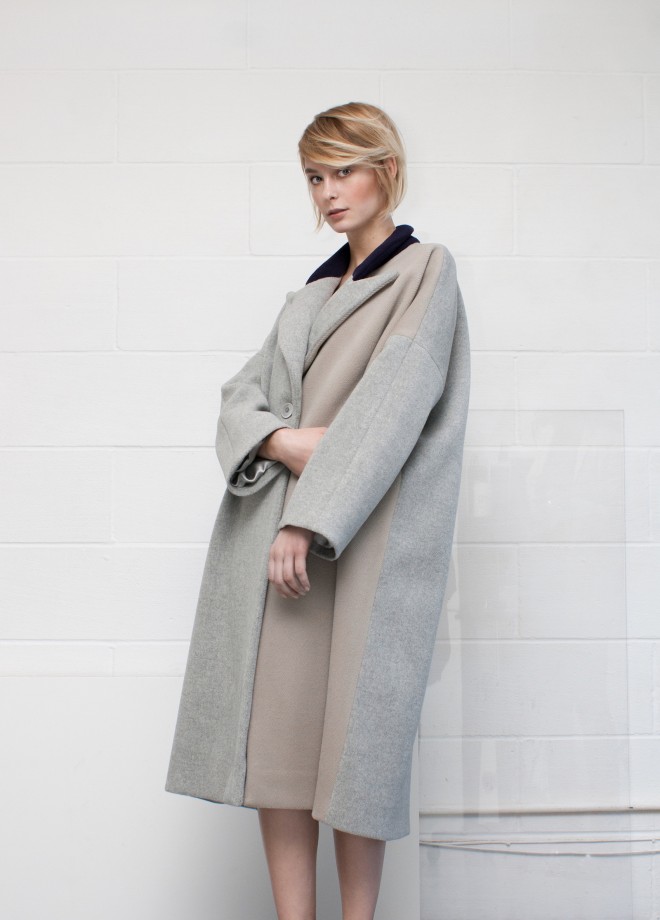
The coat, Khamta – it is essentially a piece that I created by asking myself, what coat would I like to wear this season. It represents the various aspects of my personality – both boyish and quirky. Its design is a patchwork – a mixture that I believe represents the person that I am today.
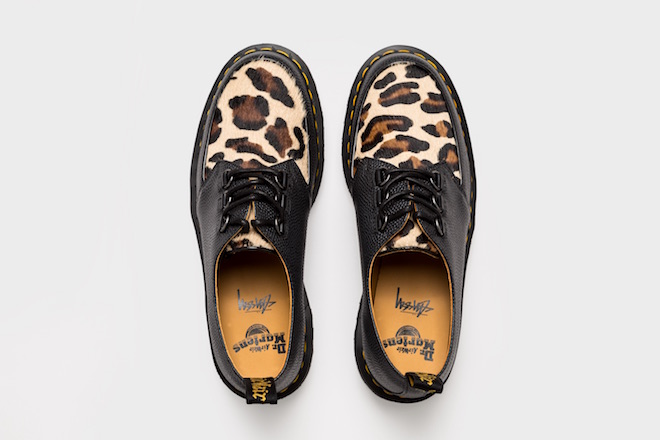
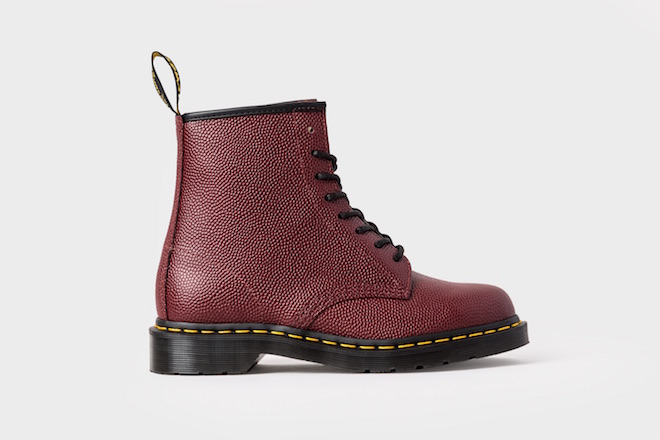
Famed for their innate understanding and reflection of youth culture, it’s no surprise that Dr. Martens have teamed up with cult streetwear brand Stüssy to release a new capsule collection. Not only are both brands emblematic of rebellion and the underground scene, but they both also emphasise quality and clothes made to last.
Available in stores now, the collaboration sees classic Dr. Martens silhouettes remixed with signature Stussy vibes: think cheetah print panels, pebble grain textured leather uppers and a mega combination of independent spirit. Get ’em while you can.
Photographer and filmmaker Joost Vandebrug does with apparent ease what many struggle with for years: he let’s his intuition guide his art. But not just his art, also his passion, his productivity and ultimately – his success.
He is a man that wears many hats, but each of them seem to fit just fine. A Dutch art director, turned fashion photographer, who then became a documentary photographer and filmmaker, music video director and now kids’ clothing designer – he appears to weave between creative practices seamlessly.
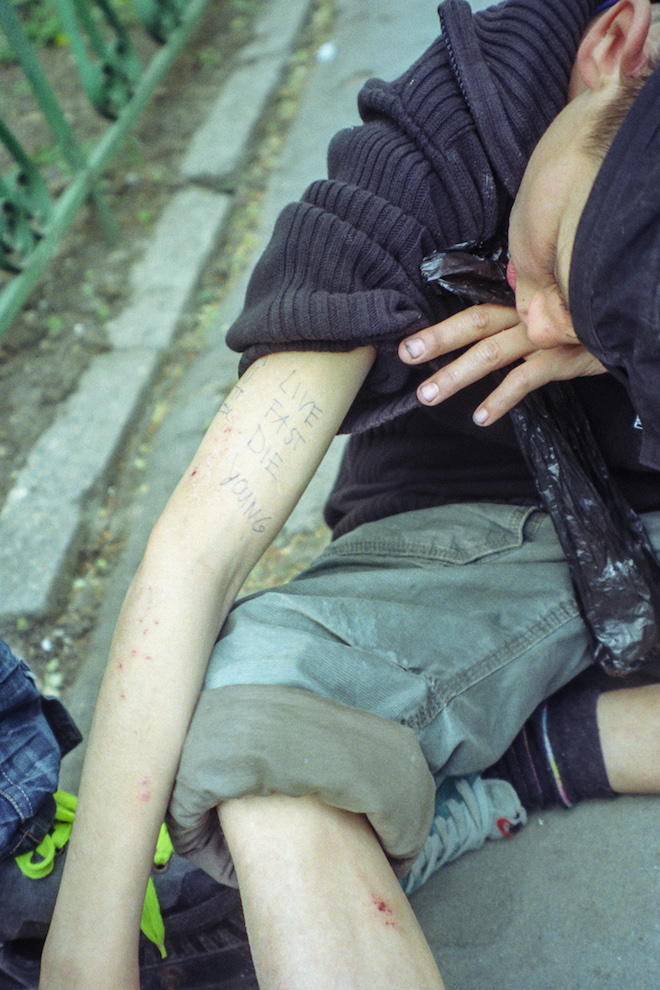
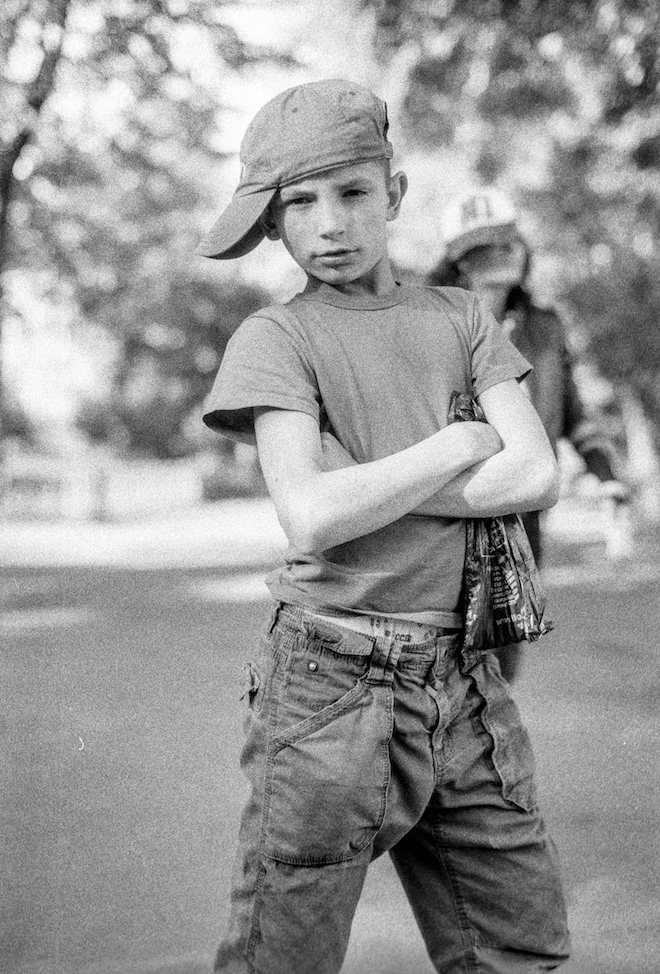
All images from Cinci Lei by Joost Vandebrug
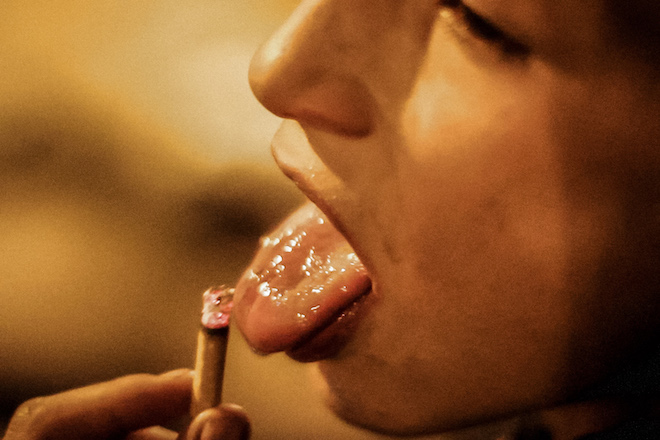
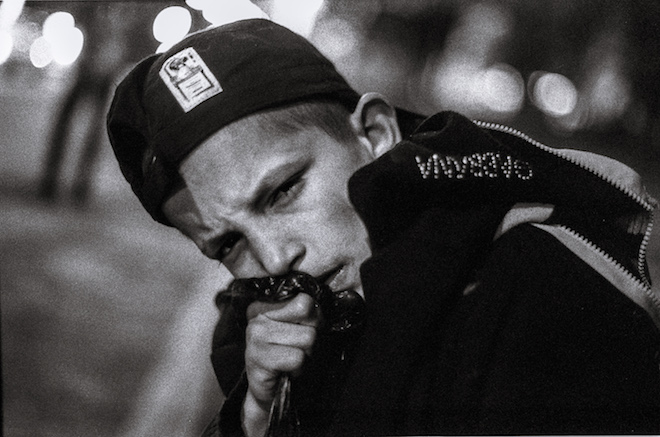
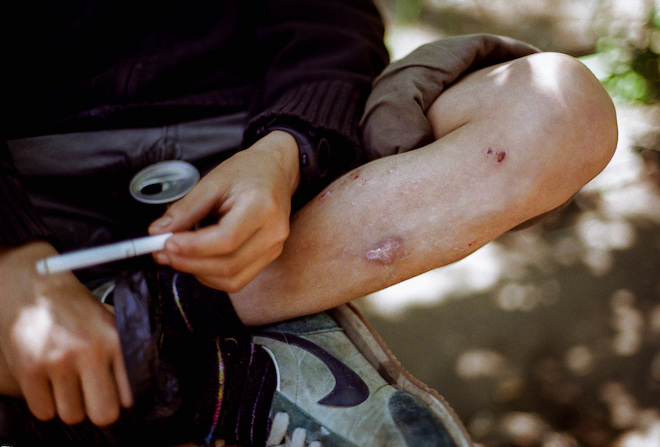
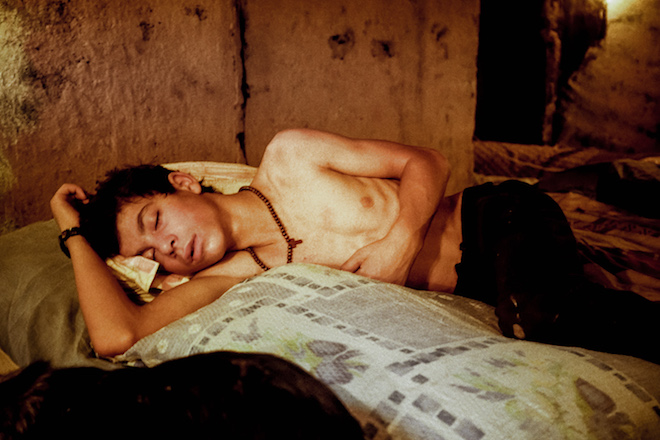
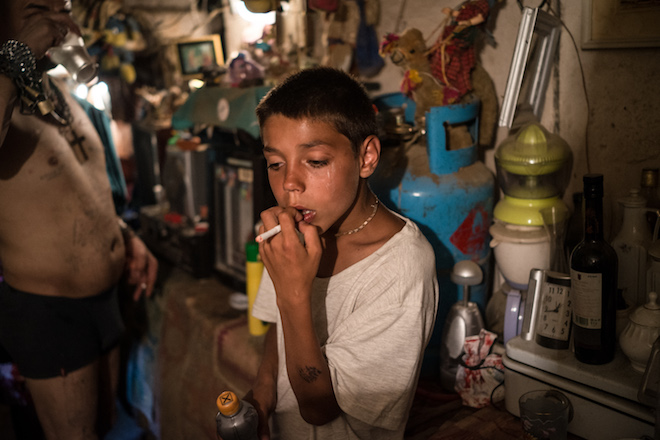
One of Joost’s most successful projects to date – which is still ongoing – is the Lost Boys series. For half a decade he has been following and documenting the lives of a gang of children who call the streets and tunnels of post-communist Bucharest their home. Over 6,000 photographs turned into a book, Cinci Lei, (which he gutsily got off the ground thanks to a Kickstarter campaign) and more than 120 hours of footage is becoming film-shaped as we speak.
Here, we catch up with Joost to find out how – and why – one man makes all that happen.
Firstly, when and why did you realise that you wanted to make pictures and films?
Although my mum and dad are both photographers, I never really considered it as an option while growing up. I was too busy playing in punk bands and wanting to become a rock star. I guess when that failed, I enrolled into art school, but even there I hardy ever worked through the medium of photography and film. It was only after my internship with Erwin Olaf and a year break from Amsterdam (where I lived at the time), that I came back and made a somewhat conscious decision to ‘be a photographer’.
All images from Cinci Lei by Joost Vandebrug
You’re described as both a photographer and filmmaker – how does your approach to each differ, if at all? And if you could only proceed with one of them for the remainder of your career, which would it be and why? My approach in both film and photography is virtually the same, very intuitive. But lets take my Lost Boys series as an example: I have followed this group of street children and their leader Bruce Lee for over five years, and last year I published a book. In the book I have laid out the pictures, carefully of course, protecting the protagonists, and telling the story of how I see the kids, and what it was like for me being with them for all this time. Though choices are predominately made on visual aesthetic.
Now that we are making a feature documentary about the same group, there is much less that I can – and want – to leave to be interpreted by the viewer. I am compelled for it to be an honest, real and correct document of their lives. Although it will still be a poetic film, the choices that I make are not just from a visual perspective but above all they have to drive the story forwards. The devices available to tell the story are also on a completely different level. And although because of my use of small camera’s for example, which resulted in me being an unadulterated part of the story, the film is in the hands of the protagonists. Which is very exciting, but also difficult as I want to protect the protagonists at the same time.
All images from Cinci Lei by Joost Vandebrug
Can you describe your first serious photographic and film projects, respectively? Can you recall what were you trying to convey with them? Quite early on, in 2007, I was offered a solo exhibition in FOAM Amsterdam (the photography museum). The exhibition was during fashion week, so they wanted me to make a fashion connection in the work. This work became my first step to combine fashion and documentary. And still today I love to shoot fashion on real people. This can be a documentary project, but also a portrait series with a great artist or musician.
How do you think your work has progressed over the years? On all levels I got calmer. I used to rush from project to project, making huge leaps from personal work to commercial work. I guess it was important to experiment, so it wasn’t all bad, though nowadays its all come together. My commercial work goes hand in hand with my personal work and I allow myself to dive into my projects much deeper.
All images from Cinci Lei by Joost Vandebrug
What kind of journeys does your work take you on? The Lost Boys project opened a whole new world. I am visiting and documenting the lives of young, aberrant and sometimes lost youths everywhere I go. And also, now that I have set up an NGO for the protagonists of the book and film, I am visiting many befriended charities and organisations. It is like an ongoing research and very inspiring to visit all these places where other NGO’s are dealing with similar issues as I went through with the Lost Boys.
Where would you love to shoot, that you haven’t already? If I think of a place, I usually try and go pretty quickly. But, apart from those kind of research trips, I always go back for longer times to follow up on the people that I have met. Documenting them over longer periods of time. I have no interest in shooting little stories all over the place for the sake of it.
All images from Cinci Lei by Joost Vandebrug
How did you segue into music videos? Was it something you’d always wanted to do? The great thing about making music videos is to collaborate with great musicians. So its important for me to feel a strong connection with the artist. My work has always had a connection with music, so once i started using video as a technique, it made sense to shoot music videos.
Is there a music video that you wish you’d shot? The first that springs to mind is Pink Floyd, Another Brick In The Wall.
All images from Cinci Lei by Joost Vandebrug
What are you working on right now and in the year ahead? The biggest ongoing project is of course the feature documentary about Bruce lee and the Lost boys. I have found an amazing supporting team at Grain media who are very dedicated to making this a beautiful film. Its in very safe hands with Katie Bryer (she edited the Oscar-nominated documentary Virunga) who is working on the film full time, so I am able to walk in and out the editing room and thus work on my regular photography and film work as well.
Also, my husband [Tom Eerebout] and I have just launched a kids’ wear label, Jumping Dog which is super exciting. All the pieces are inspired on adventure and interactiveness with the wearer, but best of all with the profits we are 100% funding the Cinci Lei project.
To find out more about Cinci Lei, Joost’s documentary or Jumping Dog visit joostvandebrug.com
All images from Cinci Lei by Joost Vandebrug – buy it HERE
They say you should never stop learning. Irrespective of age and experience, the theory is: there’s always room to grow, and subsequently, improve. And that seems to be the ethos behind the new Mastered series, which connects some of the creative industry’s biggest names with a network of knowledge-hungry self-starters.
From Tim Blanks to Nick Knight, Val Garlands and Fraser Cooke – who will mentor specific courses in writing, photography, make-up and streetwear, respectively – the Mastered initiative bills itself as an online talent program, which aims to connect those looking to take their career to the next level, with the people capable of doing just that. Thanks to its online platform, it is education on a global scale, and offers access to some of the greatest minds, mentors and all-important contacts books of some of the various industry’s superstars.
One of the most interesting courses on offer, is the aforementioned streetwear program, who recently held a series of panelled-events in London, Berlin (with New York and Tokyo next on the list) – connecting industry experts with those passionate about, and working within, streetwear. It is also one of the only programs still accepting applications for places. So, with that in mind, we had a chat and took some photos with London panelist Carri Munden – in-between her working with Skepta on his new video – to find out what streetwear means to her.
OK firstly, can you tell us exactly what your involvement in the Mastered project is?
Mastered invited me to be on the panel for the London launch alongside influencers from Cottweiler to Gary Aspden. I will also be part of the Streetwear: Mastered programme, giving feedback as an expert to the brands participating.
How would you describe the other people involved as mentors – and why are they important within the realm of streetwear? Fraser Cooke is someone who has universal respect across streetwear, fashion and creative industries. He is also someone who has been something of a mentor to me. He wisdom is incredible and he’s calm and kind.
What do you think the term streetwear means now? How has it changed – if at all – over the years? For me streetwear is style – it is connected to but not defined by fashion. It is above all connected to culture.
What is your earliest memory of streetwear? As a teenager I never fitted into a particular subculture but I was drawn to brands, whether than was Stussy (cult for me growing up), Kappa or even a Metallica logo. I don’t think I was even conscious that they were brands but I was aware of their differences and what they signified.
What was it that drew you to it? I like graphics so I was always attracted to streetwear. I also love music and streetwear is always connected to music. I didn’t listen to Hip Hop, I only learnt about streetwear’s connection to Hip Hop when I moved to London. I grew up on rave, jungle and metal. Stussy for me was part of rave culture but also connected me to the skater boys I always fancied but who thought I was too weird or too chavvy (lol).
Historically, it was considered perhaps a more democratic way of being able to express yourself – be it politically or socially – through your clothing. Do you think that holds true today?
Yes I agree and disagree. I do not care about fashion I care about human connections and style. Style – what you wear and most importantly how you wear it – will never be erased. Humans will dress themselves in whatever they can access and it will alway be about personal expression, communication and status. What has changed now is how we communicate – i.e. the internet and social media. Clothing is still crucial but is now just a part of a constructed identity of “who you are” or more importantly who you want others to think you are.
Why do you think Mastered chose you to be involved in the project? I hope because I have an individual voice. I think I’m in quite a unique position as a creative who has worked across high fashion, sportswear and streetwear; and I didn’t want to draw focus to it but other people have been mentioning it to me, but yes I am a woman…
Are there more women involved in streetwear than people realise? Or is it still a predominantly male-centric field? There are a lot of women in streetwear actually, but I would change that to there are a lot of women in sportswear, in both Nike or Adidas for example there are incredible woman at all levels right to the very top. I have noticed this less in streetwear and I not sure why but as I mentioned in the panel discussions at the London Mastered event, there is something about the very nature of streetwear that is both very formulaic and very masculine – its obsession with one up man ship, whether that is a limited edition collectable piece or a detail on a jacket or a reference in a graphic that only an insider would recognise.
Streetwear is also a culture that has been inextricably linked with music in the past…again, is it still? And if so, are there any particular artists that you feel inspired by – or can see a lot of inspiration being drawn from – right now? The last year I have been working with Skepta, his style is so British / european and so personal to him, it has been exciting for me seeing the influence of that globally. And absolutely artists like Kanye, A$AP Rocky – to be honest they have unprecedented influence when it comes to streetwear and style. It is powerful. We discussed this a lot at the panel discussion – how streetwear and fashion have changed and how they have and can influence each other. Artists like Kanye or Rocky are crucial in this discussion. But for me a lot of – at least within Hip Hop – artists’ connections with clothing or brands goes back to the one-upmanship I mentioned. I like weirdos – artists for whom style is a pure extension of the music and there are no boundaries or definitions when it comes to creativity.
How do you think something like Mastered benefits the people taking part in it? It’s absolutely unique in that you would never have access to these people outside of this program. It’s also unique in because it is online is accessible to any one in the world. This is powerful to me, as I really think to be progressive we need to think outside of these same cites and centres of culture and industry.
Do you think it still rings true – to an extent – that it’s about who you know not what you know? Yes absolutely your network is key, but it is not everything because if you have access to incredible people or connections it is nothing with out something to bring to them. Hard work and most importantly good, unique work is what will get you success.
What are you currently working on? I am not doing collections or showing seasonly with Cassette Playa – I love designing clothes but it will be for other people or I will do collaborations or limited edition drops. I am enjoying being creative in other ways – I’m currently working on creative direction, styling and graphic projects.
To find out more about Streetwear: Mastered and the other courses on offer, visit mastered.com.
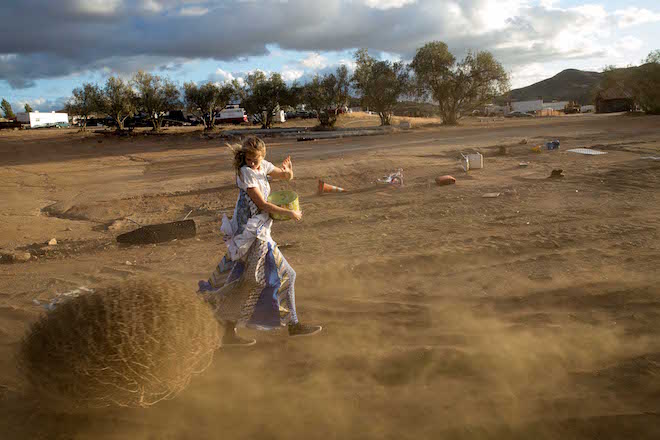
For spring summer 2016, Humberto Leon and Carol Lim – creative directors of Kenzo – have chosen the medium of film to produce their wares, with the 10-minute short: Snowbird. Written and directed by Sean Baker – who is still riding the wave of his critically acclaimed Tangerine, which is described as “a dramatic slapstick slice of life of two Los Angeles trans women” – the entire film was shot in what is becoming his usual style: on an iPhone.
Set in the eclectic expanse of ‘Slab City’, in the Californian Sonoran desert, the short shows Theo (played by Lee) delivering pieces of homemade cake to different residents of the unique community. Described as “a Mecca for eccentrics living off of the grid”, Slab City is touted as “a conglomeration of domestic structures cobbled together with all manner of material.”
As opposed to a glossy, all-star ensemble cast proffering a slick and stylised fashion film, as is so often the case, Kenzo and Sean Baker’s take is an altogether real (many of the cast are genuine residents of Slab City) representation of clothes in situ, which “eschews the glitz and glamour of fashion.”
This is yet another string Abbey Lee can add to her acting bow, after a successful role in Mad Max: Fury Road saw her receive much praise last year. Watch Snowbird in its entirety below, and shop the new season collection when it drops at kenzo.com.
Suave, salient and immeasurably slick London Collections: Men certainly epitomized the it in British Fashion this season. Over four days, the AW16 collections unfolded to reveal a line up of bold, clever and thoughtful designs that will have sartorial hounds and innocent laymen baying for blood in the months to come. Overall there was a sense of confidence and attitude: a thoroughly British, slightly grungy and often playful aesthetic which could afford to be irreverent because it was so smart. The collections were many and the quality was high though stand-out designers included Matthew Miller, CMMN SWDN, Alex Mullins, Craig Green and J W Anderson, who’s designs managed to make gold-toothed A$AP Rocky’s attendance at the show feel underwhelming in comparison.
The Aesthetic
One noticeable trend was focus on the elements and the natural world. Craig Green delivered an acclaimed collection once again. This time he wove his signature sculptural forms closer onto the body with the theme of protection as the inspiration. Buttons and ties were used to beautiful effect, embodying a sense of vulnerability against the elements. This, combined with the natural tones of mossy greens and terracotta hues, rendered Green’s AW16 collection both romantic and ethereal. Emblazoned with a similar mandate, Christopher Raeburn turned to the wild, with a Mongolian inspired collection. Models walked with oversized bum bags, patterned sweatshirts and extreme parka coats, worn open with stand-out rucksacks. Also of note were the highly covetable and timeless bombers mixed against some gigantic shredded ponchos. At Cottweiler, the duo looked to the natural world as well. Inspired by a youtube fetish that involves wading through mud whilst fully clothed, the collection featured high waisted waterproof trousers alongside neutral bomber jackets.
A military thread also ran throughout LCM, embodying the duality of male identity. The duo at Casely-Hayford shook up standard outwear thanks to a re-imagining of military uniforms. Under the title Irregimental Youth, the collection spanned eras, from the ’60s through to skinheads and ’90s rave culture. Long, khaki jackets were adorned with patch-work denim whilst others were split at the back, creating a lizard-like tail that, though perhaps impractical for the commute, was genuinely imaginative and forward-thinking. Notable mention should also go to the vibrant colour scheme inspired by psychedelic images of the Beatles’ Sergeant Pepper album. Turquoise jackets and acid bright suits ensured that Casely-Hayford kids will always bring the party. Over at McQueen, Sarah Burton created a signaturely baroque collection, showing expertly tailored red jackets embroidered with black beads. On Monday, Xander Zhou lent a glam spin to the same theme with a wide-shouldered, cropped jacket.
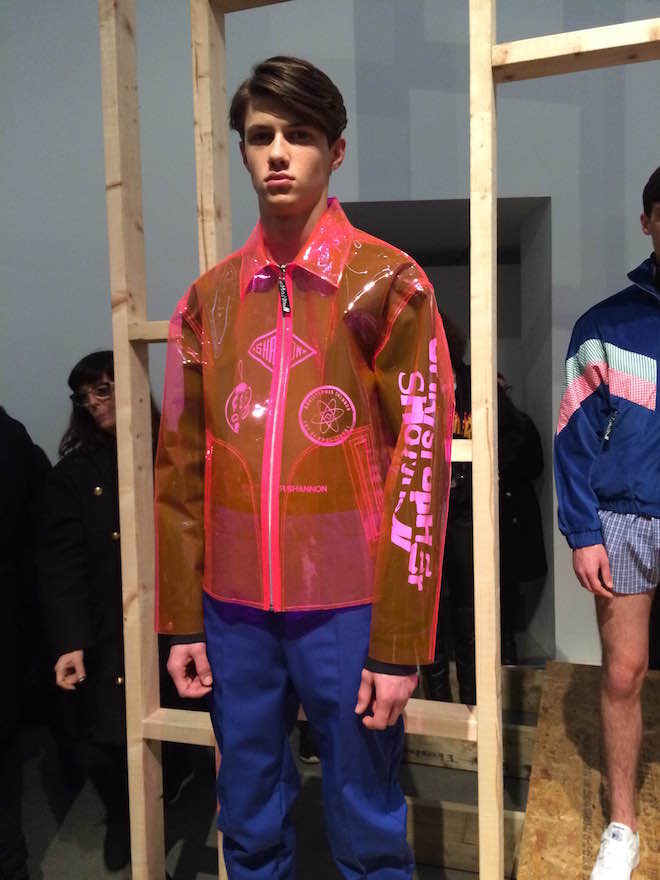
Christopher Shannon AW16
The Influences
At Christopher Shannon, the designer took inspiration from suburban ’80s Liverpool, updating the aesthetic and creating a new set of local heroes for 2016. The collection was awash with bright colours. Highlights were the oversized vinyl jackets in plastic pink, crisp, pastel boxer shorts and high neck anoracks with zip detail. The design duo at CMMN SWDN, Emma Hedlund and Saif Baker, drew on feelings from the late ’70s and early ’80s to create a collection around the title Domus. Looking to the warm, comforting feelings associated with ones own home, the pair contrasted the retro influences with modern fits. Key pieces included a pony skin jacket, an orange suede jacket with a signature ‘c’ tag in tortoiseshell on the pocket, and a mid-length leather piece that had audiences weak at the knees. As ever with CMMN, the cuts were dexterous, with silhouettes spliced together in unexpected ways. The high waist, high neck combinations made a particular impression.
Matthew Miller’s much talked about collection elucidated ideas of Nouveau Riche, stripping the term of it’s old meaning and associating it with the ”cultural capital” of his generation. Cropped box jackets were layered over longer out—wear with pieces pulled together by thin straps at the waist. It was a challenging collection, one that drew on the old to traipse over it with new. The stand out design was the Caravaggio ’David and Goliath’ print jackets and shirts which not only embodied his theme but added a heightened sense of unease to the overall aesthetic. As at Agi & Sam, Miller walked both male and female models, compounding the idea that gender-less fashion is the future.
If some designers spent this season searching through history, J W Anderson bucked trends and embraced the pace and power of change. His AW16 show was a melding pot of ideas, influences and aesthetics, underpinned by a re-invention of casual-wear. Highlights included polka dot faux furs, cropped white knit trousers with button detail and silk printed suits. The recurring motif was that of a snail, a cartoonish and ironic nod to the fast-paced fashion world. A cartoon cat from the 1920s also made a recurring appearance. It was an energetic collection, both dark and playful, which will define how men dress for seasons to come.
Although still in its relative infancy when compared with some of the other international fashion weeks, London Collections: Men – or LC:M for speed and ease – is rapidly gaining momentum. And a highlight of this season was Twin favourite Paul Smith, who lived up to his iconic British status and served up a playful slice of eccentric nostalgia.
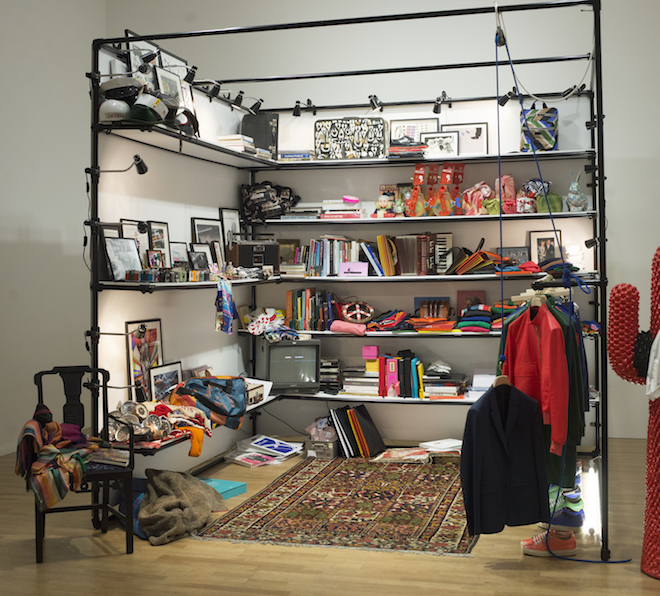
Casting his magpie eye back to 1970, when he opened his first shop, the designer presented his autumn winter 2016 wares in an exact replica of his original three metres by three metres store. In among a riot of charming bric-a-brac lay joyous prints influenced by a pile of cycling jerseys, a bold new bag inspired by the Argentine tango, as well as an array of his seasonally expected – and universally appreciated – tailoring. He even smacked the detailing from the facade of his Mayfair outpost on a selection of leather goods.
This season’s offering was staged at none other than the Pace London gallery, which has continuously served as inspiration for Paul throughout the years. Currently home to work from the like of British triumvirate John Hoyland, Anthony Caro and Kenneth Noland – it was yet another source for the acclaimed British designer to draw inspiration from.
Fashion is a business that can very often take itself a tad too seriously, so thank the stars for people like Paul Smith, who know that a sense of humour – and the ability to find inspiration in absolutely anything – are the ultimate palette cleanser.
If there’s one thing we’ll never tire of, it’s a great coffee table tome. And the latest offering from fashion journalist and fashion photography specialist Jérôme Gautier – Dior: New Looks – is the perfect kind of thing to lose yourself in on a wintry Sunday afternoon.
Since 1947, when Christian Dior first showcased the irreversibly influential ‘new look’, the house of Dior has been at the forefront of revolutionary design prowess, and this book chronicles some of the most beautiful moments of that time-spanning journey, resulting in a satisfyingly dense catalogue of breathtaking couture and iconic imagery.
From Irving Penn to Peter Lindbergh, Richard Avedon, Helmut Newton, Willy Vanderperre, Mario Testino and Patrick Demarchelier to name but a few – the list of revered photographers with work nestled between these pages is endless.
Given the recently announced departure of the brilliant Raf Simons from the house, this book comes at the ideal time. It is a chance to marvel at all that has come before, and appreciate the sheer amount of history that the new artistic director will have to shoulder in the future.
Peter Lindbergh, 2012; Christian Dior Haute Couture by Raf Simons, AW12
Dior: New Looks by Jérôme Gautier (Thames & Hudson) is out now.
To mark the drop of their Resort collection this week, Etre Cecile have released a series of tongue-in-cheek 15 second mini films, playing on the label’s French (or lack thereof) heritage. Featuring a number of the brand’s key faces – from Tallulah Harlech to Laura Bailey and Pandora Skykes – as well as bright young things brought in through street casting, it is a playful way to celebrate yet more of their cool girl clothes hitting the shelves.
Founded by Yasmin Sewell, Jemma Dyas and Kyle Robinson, Etre Cecile has fast become a staple for women seeking a little je ne sais quois on a daily basis, thanks to their witty T-shirts, riotous prints and general fashion tomfoolery. And here, Yasmin tells Twin a little about this latest project:
“We wanted to bring together our diverse mix of Cecile girls in this film series, the french language theme thing is just our ongoing joke that well….we’re not really french at all! We street cast most of the girls mixed in with some well known faces who have been amazing ambassadors since Day One. We’ve never wanted to take ourselves too seriously as Etre Cecile was created so we could have easy fashion pieces you can feel unpretentious…but impactful in. Just like all our girls…” – Yasmin Sewell
Watch Tallulah Harlech flex her French skills in one of the videos below, and check out this link to see more. The best news of all? All of these pieces are out just in time for Christmas, and have gone straight to the top of our wish lists.
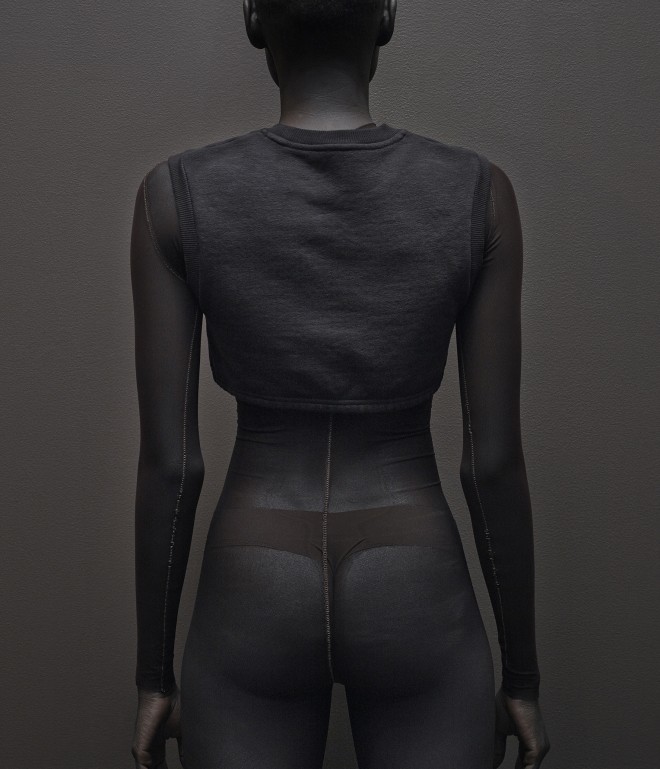
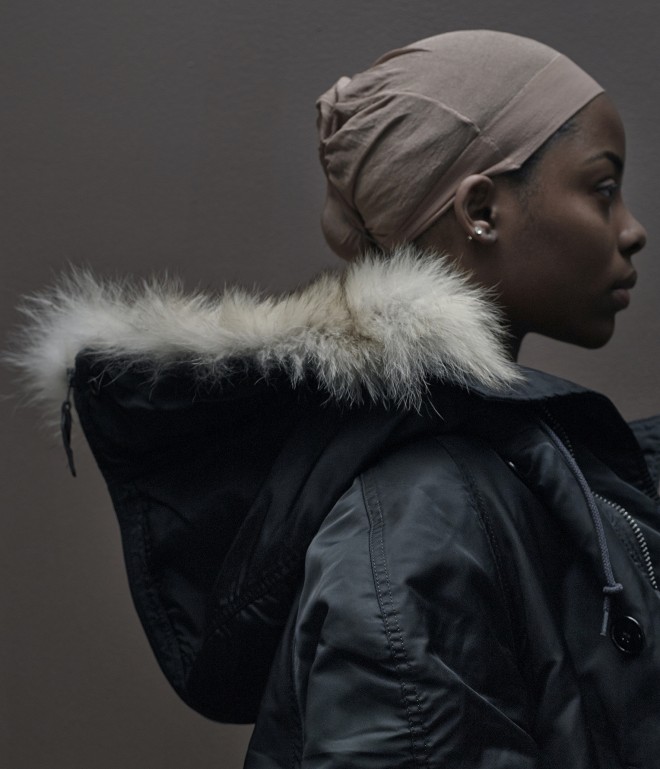
“This is a challenge to where fashion is currently—a new feminine ideal,” says Kanye West, as his first adidas Originals collection – Yeezy Season 1 – launches around the world on 29th October.
Comprised of both voluminous and second-skin like proportions – the former generally on top, and the latter below – West reiterates the practicality he had in mind with these pieces, describing the easily interchangeable capsule collection as “solutions-based” and akin to Lego. Ultimately, he has, quite literally, aimed to create a series of uniform building blocks, from which his customers can construct a daily identity. “I don’t want the clothes to be the life,” he stresses. “I want the clothes to help the life.”
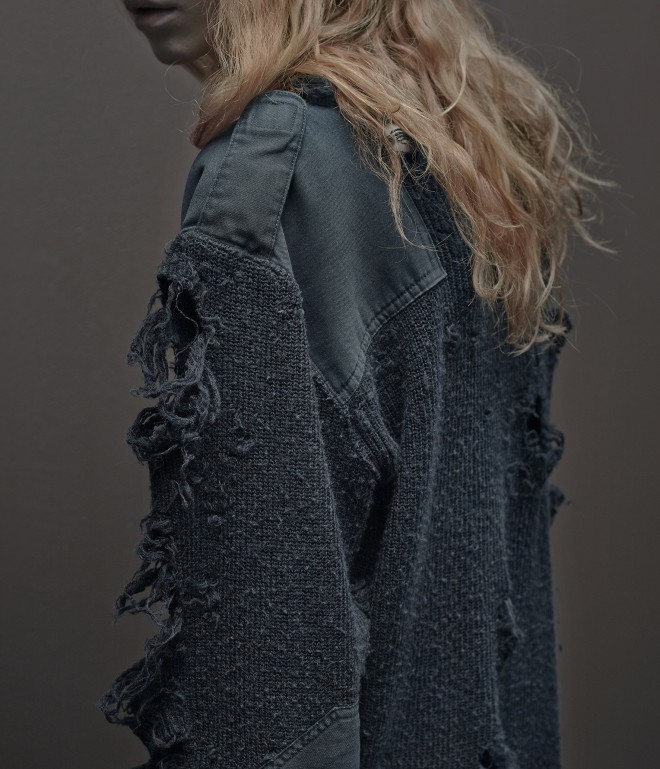
So what of the garments themselves? They are undoubtedly useful, bar perhaps the aforementioned body-suits, which although editorially striking, may be a little more tricksy to work into any typical circumstance that initially springs to mind. The inky, generously hooded shearling parkas are instantly desirable, as are the gnarled army surplus knits and cotton tanks in that perfect shade of smokey anthracite. But it’s the unisex, outsized sweaters, beautifully constructed yet rough around the edges, that you could really see yourself wearing forever.
West has been clever. He has put just enough of himself into this collaboration – hero pieces such as the camo separates and drop shouldered bomber jackets smack of recognition with “West: the brand” – to make it aspirational, yet left the collection canvas-like in it’s quality, so that customers can see themselves in it too, without having to try too hard.
The decision to have a mass release of the collaboration, as opposed to a staggered global drop seems an obvious one, especially when you consider the transient purposes West had in mind when designing. “I wanted something that felt like New York or Paris or Tokyo or Santa Barbara or Chicago—a worldliness and an ease.”
Rounding off the collection are a number of new footwear releases, the highly anticipated Yeezy Boosts 750 and 350 as well as the Yeezy 950 boots for men and platform snow boots for women. Roll on winter.
adidas Originals by Kanye West – Yeezy Season 1 is in stores now. Prices start from $130.
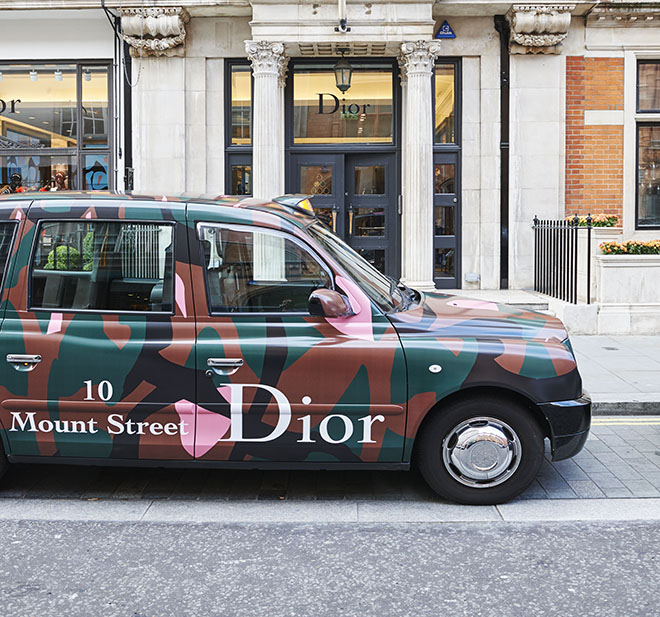
If the draw of Roksanda and Celine wasn’t already pulling you by the coat hem towards London’s Mount Street, then perhaps the irresistible lure of fleeting fancy might do the trick. Last week, Christian Dior opened a rather permanent-looking pop-up on the well-heeled avenue, to satisfy and intrigue both regular and window shoppers alike, while work is completed on their Bond Street London flagship.
As one would expect, Raf Simons riffed on the lineage of the great fashion house for the aesthetic of the premises. While nodding to their historic 30 Avenue Montaigne with the shop’s clean, grand Victorian exterior, inside he thrusts customers into a forward thinking, contemporary space of mirrors (by Hubert Le Gall), floor to ceiling digital screens and eye wateringly cool furniture, such as the Nuage table by Guy De Rougemont and a beautiful sofa by Vladimir Kagan.
On said digital screens, is a recurring loop of Simons’ a/w 2015 twisting and distorting animal print – more abstract camouflage than straight-up cheetah. Again, it is a fitting tribute to the past – Dior is said to have ‘invented’ animal print in 1947 – with the smart touch of the brand’s new, new look.
With autumn/winter’s ready-to-wear, accessories, footwear and leather goods linings shelves and hanging deliciously from racks, eager to be slipped on in the pink (of course) changing rooms at the centre of the store – this is a temporary treasure trove worth pillaging. And despite the abundance of camo, when strolling through Mayfair you’ve little chance of overlooking this momentary gem. Please ensure sure that you don’t.
The late Louise Wilson (course director of Central Saint Martin’s Fashion MA) once said in relation to her students, “They should be bringing me a book or something that I haven’t seen, not like some obscure chant book by Dominican monks, but an image of the way they see the world.”
For LA based artist and photographer Tasya van Ree, the way in which she sees the world is something every young dreamer could draw inspiration from – with a vision which explores the inner workings of the human spirit, the human form, landscapes, nature and animals – her work is a visual and emotional journey translating deeper connections with the intelligence and beauty that exists all around us.
With such an engaging creative sensibility, it’s no surprise she’s been propelled into the public eye as everyone’s latest art crush, resulting in solo exhibitions in LA, New York, and Paris – Girl power yet again challenging the exclusionary structures which frame the industry for female artists.
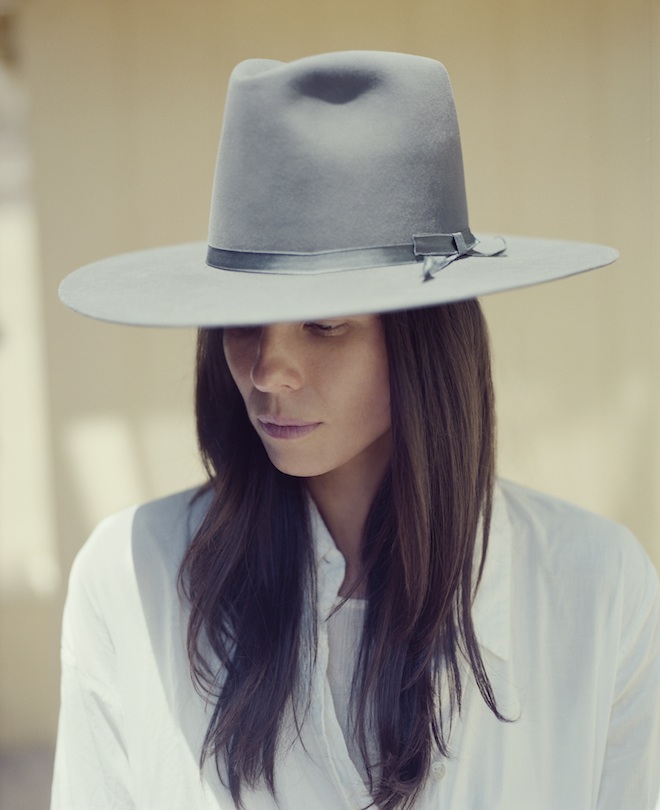
With her unique and often sartorial style, her affinity for hats has also not gone unnoticed, which is why iconic US brand Stetson invited her to collaborate with them for their 150th-anniversary.
“Tasya van Ree is an ideal collaborator for Stetson”, says Izumi Kajimoto, the brand’s Chief Executive Officer. “She looks strong, empowered, and captivating in her hats, which is something that also comes across in her extensive body of work. Stetson has always been a part of contemporary culture and we’re excited to continue to work with artists whose visions relate to our brand.”
Taking one of Stetson’s vintage felted styles as a blank canvas, van Ree called upon her artistic flair to create a unique design for the brand – dubbed “The Signature”, the hat is an effortlessly stylish and structured piece of modern minimalism – in itself, a work of art.
We caught up with van Ree to find out more about the collaboration with one of fashion’s most enduring brands, and her plans for the future.
So tell me how you got involved with Stetson for this project?
I’ve worn a vintage Stetson for years and have been photographed in it quite a few times in the social media realm. Through that exposure we began a dialogue and soon after, the collaboration was born.
And what was the inspiration behind your hat design?
Horses. I wanted to design a piece of art that reflected their intelligence and also that captured the beauty of their philosophical language of power, their sensuous lines and their majestic sense of spirituality and danger.
What was the creative process like for you?
Combining the world of fashion and the natural world was quite seamless. They both operate on the same level. It was just a matter of finding the moment through sketches where the influence of an emotional state of mind connected to an image of artistic appeal. It was a process, and after a good amount of time “The Signature” hat was drawn out and created.
So does it feel like you’re officially an ambassador for hats now?
“Ambassador” sounds really formal, I just really like wearing hats!
Hats are an extension of ones self, the minute you put one on, it becomes a living part of you – what is the quality that makes the hat come to life for you?
There is a harmony between my physical appearance and my internal existence. My hat is the conductor that creates this relationship.
So would you ever go all out and do an ‘Isabella Blow’ then, and wear something outlandish, just to move away from your signature comfort zone?
I’ll do anything once!
The English have an inbuilt understanding of the peculiarities of life and that’s often expressed through fashion – living in LA, how would you describe the dress codes there?
Objective.
What about defining your own style?
Half Japanese / half Dutch.
Yes, I can see how you’ve shifted towards a more conceptual approach in your style vocabulary. So do you think you’ll move on to other fashion collaborations in the future? Absolutely. I’ve fallen in love with the collaboration process. I’m open and would love to join forces with other creative minds in all forms, whether it’s in fashion, art, music, etc.
Let’s talk more about art and photography – I read recently that over 50 new galleries have opened in the last two years in LA. It’s always been a cultural mecca for creativity, but it must be cool to see the city now really embracing and shaping art?
Art is elemental in the progression of a culture’s evolution. I’m really interested to see what profound changes LA will make as the art world becomes more and more pronounced here.
And has there also been a shift towards those galleries supporting and exhibiting work by more female artists?
I feel as if they have. I’ve been going to more openings and shows that are exhibiting female artists. Much more than in the past.
Are you planning any new exhibitions of your own work?
Yes, I have a photo exhibition with The Curator LA next month and also in Paris at the beginning of November. And later in the year / early next year, an artist residency show in Mexico.
So talking of exhibitions, Annie Leibovitz is returning to her project ‘Women’ and is now going to tour a show documenting portraits of 21st century females, to present how women’s roles are changing in a new feminist society.
Who would you personally like to see in that roll call?
Every woman in the world should be photographed for this project. Every one of them has a voice that is changing the world in which we live in on a daily basis.
“The Signature” by Tasya van Ree for Stetson style will be available from October 2015 at stetson.com. Photo credit: Anais & Dax anaisdax.com
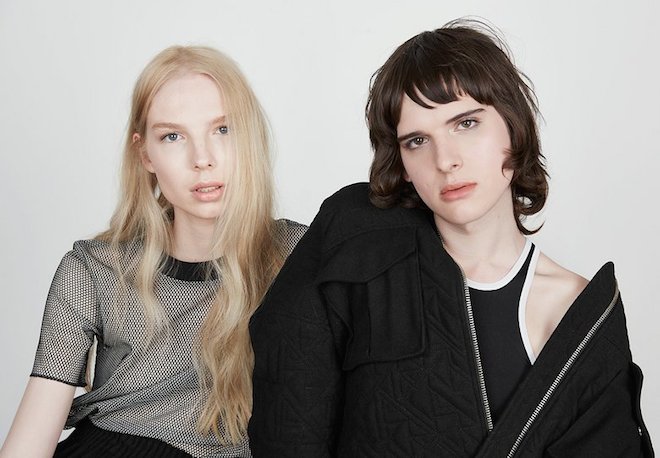
There’s no doubt that transgendered issues have been brought into the greater cultural conversation over the past year. While fashion has long toyed with gender fluidity and featured androgynous and trans models like Andreija Pejic in campaign imagery, no major brand has seemingly addressed gender non-conformity as much as H&M’s little sister, & Other Stories. Their new campaign not only stars trans models, Hari Nef and Valentijn De Hingh, but was produced by a predominantly trans crew, celebrating their artistry in front and behind the camera.
Representation and increased visibility is undoubtedly a good thing – it broadens perspectives and offers more opportunities for minorities to be included in a wider narrative. But there are only so much a few magazine covers and documentary specials can do, and in an industry that’s obsessed with newness – both falsely inviting and cruelly fickle – how do we make sure this isn’t another seasonal trend that disappears in six months. And in a time when the trans community still struggles with unemployment, discrimination and lack of opportunity, how much are we doing if the same creative teams get rehired to produce campaigns.
By hiring an all transgendered below-the-line talent including photographer Amos Mac (founder of Original Plumbing), stylist Love Bailey and makeup artist Nina Poon, & Other Stories empowers everyone involved to control the means of their own representation. The behind the scenes video is quick to highlight how the team bonded on set, which comes across in the campaign itself, showing the power of shared experiences. When talking to Dazed, Nef noted that prior collaborations in fashion hadn’t always entailed empathy and understanding but, “With a trans team however, it’s all there.” The campaign also raises an important question about ‘the gaze’, long associated with fashion imagery, & Other Stories asks whether, in this case, the cisgender gaze could change if a trans team produced the imagery.
Fashion dictates who does and does not get to participate in the world of luxury and beauty, but as Nef notes in the video, campaigns like this – and on a greater level, the Internet – have expanded and diversified fashion’s audience, who demand to be both represented and included. In the past year alone, Selfridges experimented with the Agender Project while a new online, unisex-only fashion platform, You Do You, launched this month promoting designers like Eckhaus Latta, Vejas and Timo Weiland, all of whom produce collections not tied to a gender binary. In the US, Target has promised to remove gender-based labels on toys, which hopefully signifies the industry is finally noticing the importance of empowering a diverse set of consumers – let’s just hope it doesn’t disappear in six months time.
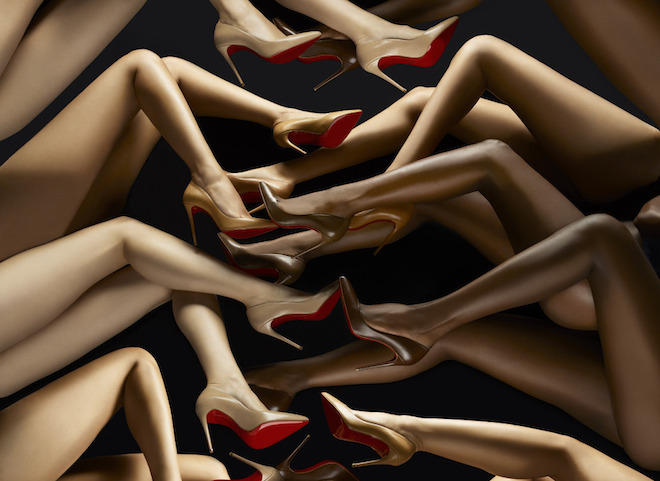
Christian Louboutin astutely commented that “nude is not a colour, it’s concept.”
This remark came as part of the reasons behind the extension of his acclaimed nude collection: it now includes five shades of nude, from fair to a rich chestnut, as well as two new shoe styles.
Louboutin is famously inspired by the female form, and originally created nude shoes to enhance the fluidity, versatility and allure of a woman’s body.
The two new, seasonal shoes styles will be Deepik and Dorissima, the former an open-toe with a waved heel, and the latter a timeless pump with a heart-shaped toe, with a thin heel.
The launch will be accompanied by a user-generated social media campaign – follow it using the tag #NudesForAll.
It’s time for a bed-in: barely-there slips in gingham, star and bouquet prints call for a lackadaisical style stance that’s best shown off in bed. Photographer Nick Dorey’s shoot featuring Vanessa Axente, filmed by Natalie Spitzer.


 PREVIOUS
 Twitter
 Tumblr
 YouTube
 Facebook
 Instagram
