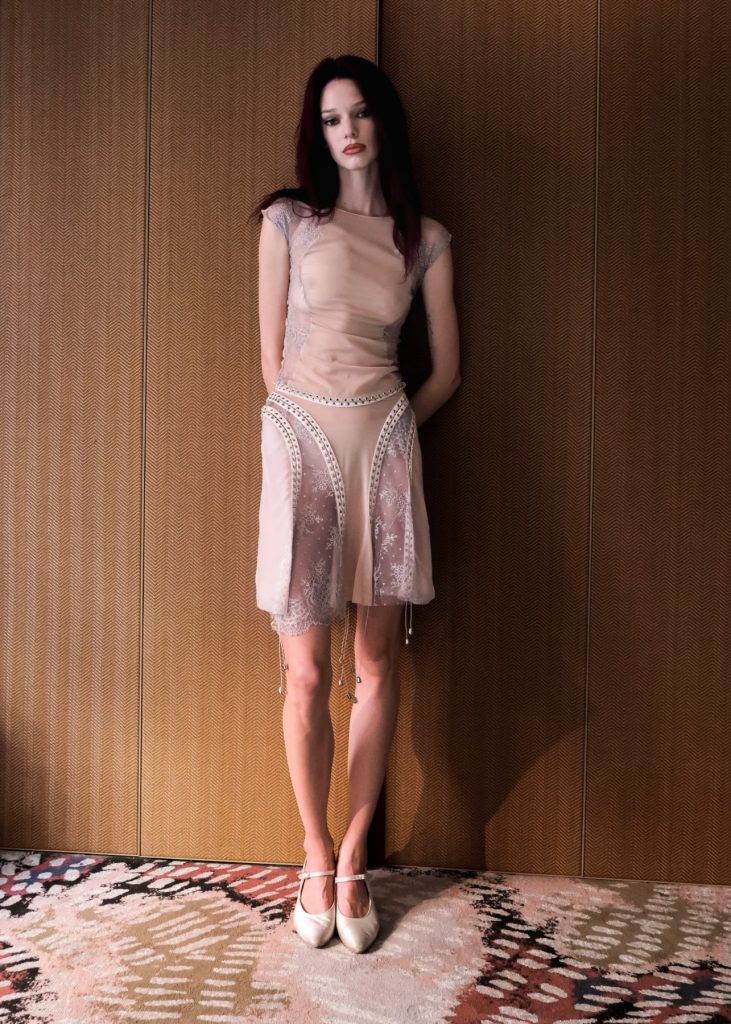
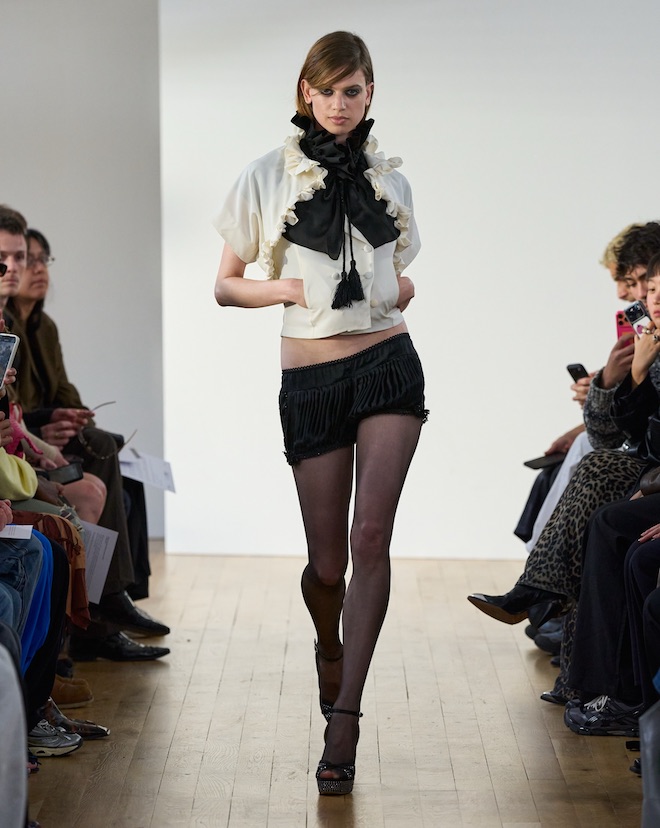
Gui Rosa, Spring/Summer 2027. Courtesy of Gui Rosa.
Gui Rosa
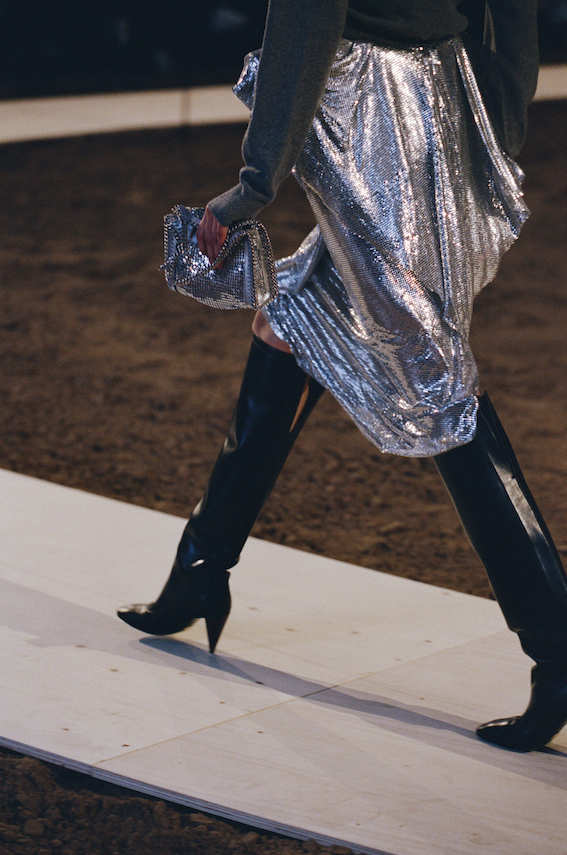
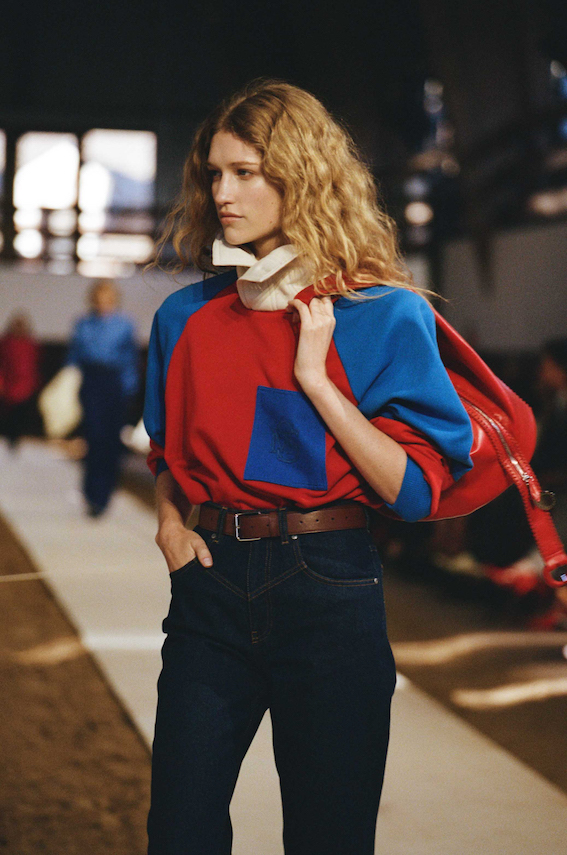
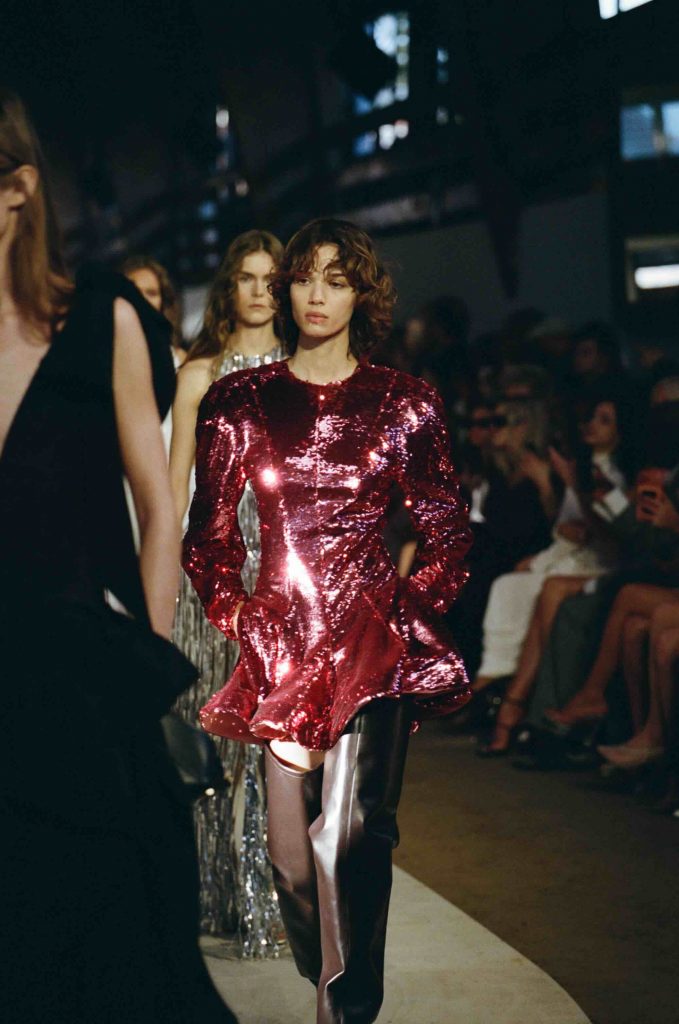
Easily the most fun a girl can have without taking her clothes off at LFW, Gui Rosa entered the boudoir of their Portuguese grandmother: a world of gossip, embroidery and television soaps. Traditional craft techniques were reworked into city pieces binding together leather, chiffon, cashmere and crochet in skilled constructions, as fun, camp and cutsie melodrama met a subversive, sexy party-girl twist.
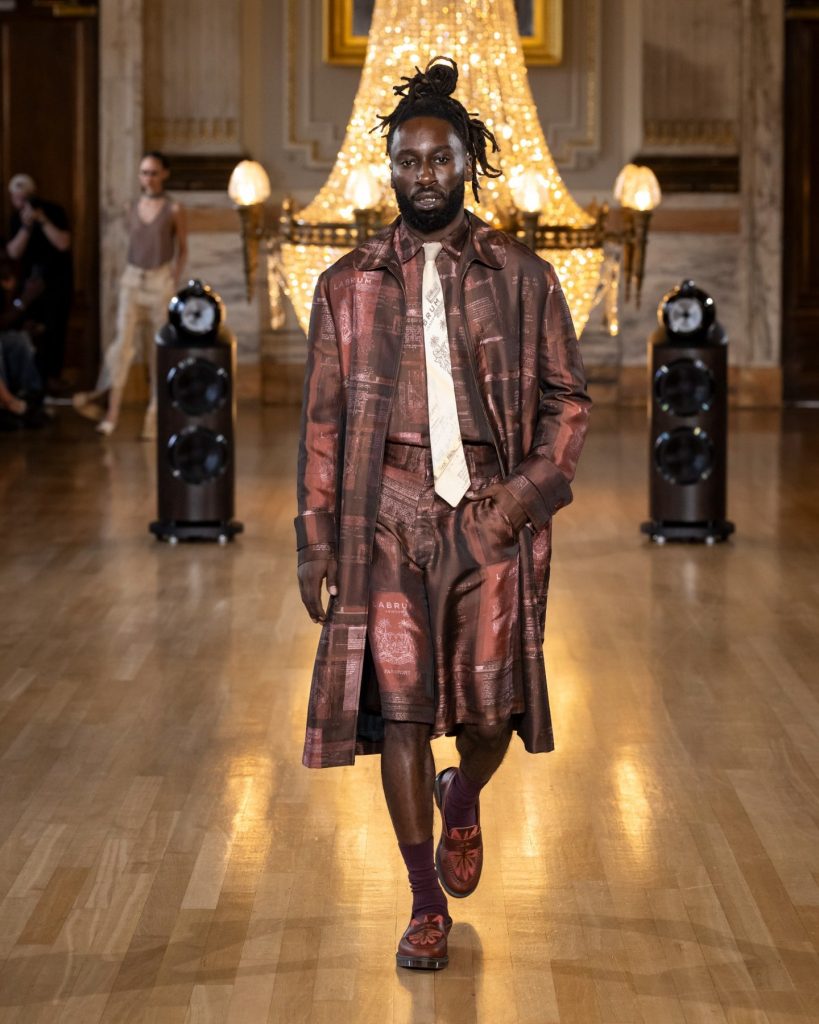
LABRUM, Spring/Summer 2027. Courtesy of LABRUM.
LABRUM
Hands of Osmosis is the final chapter of lauded designer LABRUM’s Osmosis trilogy, exploring the movement of culture across borders through craft. Rooted in the relationship between West Africa and Britain, the collection explores weaving, embroidery, leatherwork and beading, celebrating the knowledge passed from maker to maker. The cohesive collection also explored the shared language of making between West Africa, India and Britain through expert tailoring, weaving, leatherwork, embroidery and sculpture.
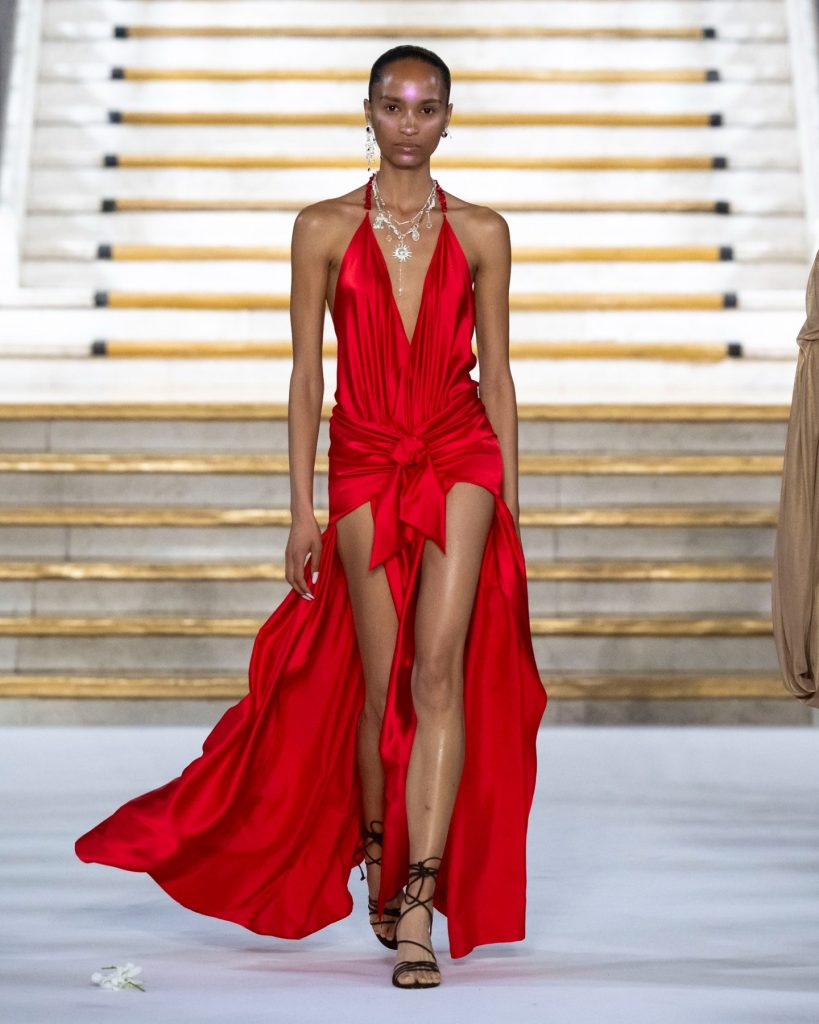
DI PETSA, Spring/Summer 2027. Courtesy of DI PETSA.
DI PETSA
Rapidly ascending star DI PETSA presented HOLY MILK, exploring the sacred roots, symbolism and ritual of motherhood and the connection between the body and the natural world. The collection considers motherhood as an ancient ritual and an intimate process of becoming. Milk represents the spiritual and erotic, layered into Goddess and motherhood inspirations. The signature translucency, draping and luminous looks shaped the vast and impressive collection, with the required wetlooks and the show stopping milk-bra fountain worn by Leigh-Anne Pinnock.
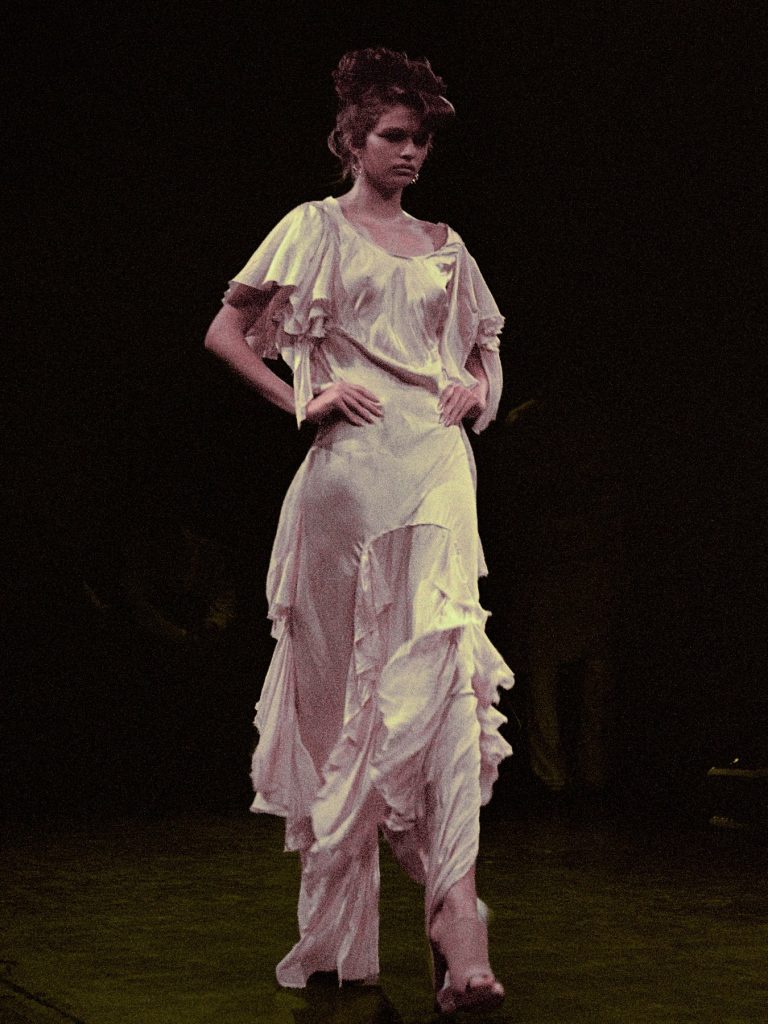
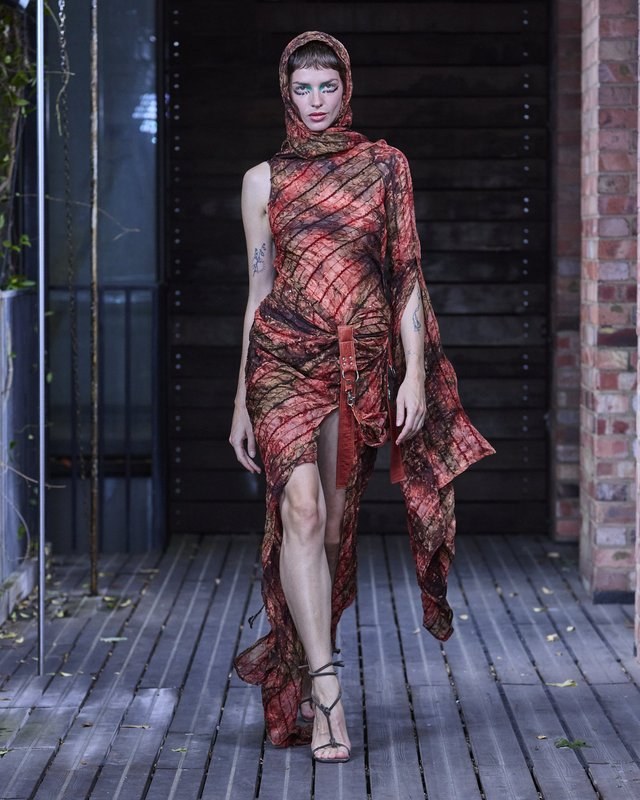
Paolo Carzana, Spring/Summer 2027. Courtesy of Paolo Carzana.
Paolo Carzana
A truly innovatove designer, Carzana describes the collection as a “Baptism of the house”, in which the natural hand dyed process and sophisticated draping sets the collection apart as a statement on sustainable and craft inspired luxury. The collection was inspired by a scene from Indiana Jones and the Last Crusade, where the choice between a decadent cup and a humble clay carpenter’s cup becomes a reflection on craft and creativity. Silk satins, hemp jerseys, organic cotton calico and bamboo satin were used across his menswear and womenswear, alongside considered knitwear, jersey, embroidery, appliqué and pleating.
Leo Prothmann, Spring/Summer 2027. Courtesy of Leo Prothmann.
Leo Prothmann
The up and coming designer with a cool crowd in tow, builds a world around ten of Ernst Ludwig Kirchner’s paintings, bringing the nightlife of early twentieth Century Berlin into London 2026. The collection centred on giving existing materials another life, including 50 kilograms of deadstock denim from a warehouse in Luton, surplus leather from Aston Martin interiors, printed and embroidered textiles and repurposed Rick Owens archive shoes. Masks made by Hedi Xandt bound together the ingenuity and industrial tone.
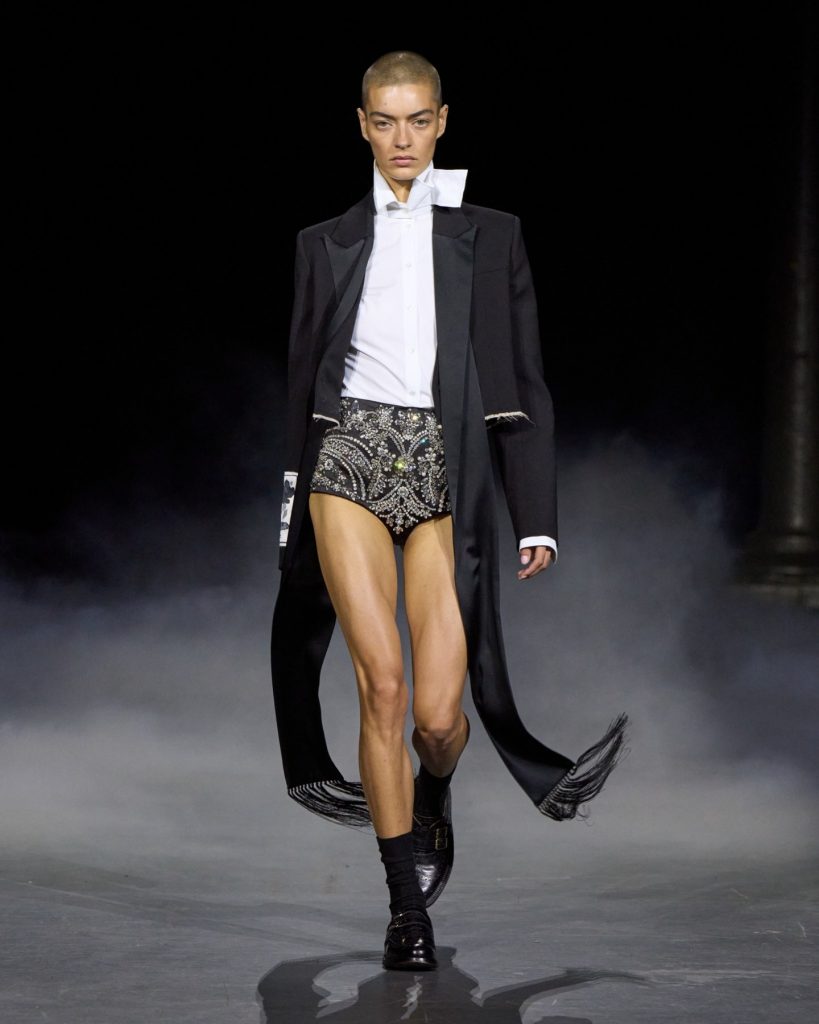
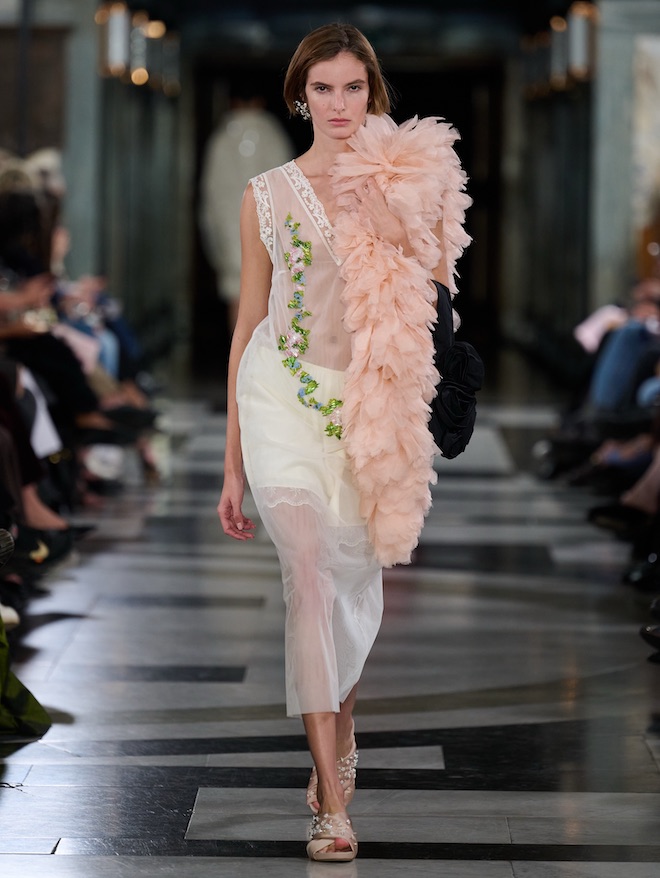
Erdem, Spring/Summer 2027. Courtesy of Erdem.
ERDEM
The widely acclaimed Erdem runway looked to the nineteen-twenties aerialist Barbette as inspiration for a show that epitomised the extraordinary creativity and craftmanship that underscores LFW. The performer transformed technical daring into an act of queering and illusion, ascending the trapeze as a woman and descending as a man, with all the costuming that entailed. Barbette became a sensation of the Parisian avant-garde and a muse to Jean Cocteau. Romantic gowns and couture tuxedos offset each other alongside the detailed high-level haute couture the brand has become known for.
Twin Picks: Ben Johnston’s Climate Action Week Mural
Keeping It Clean: Ben Johnston’s Energy
Words by Francesca Gavin
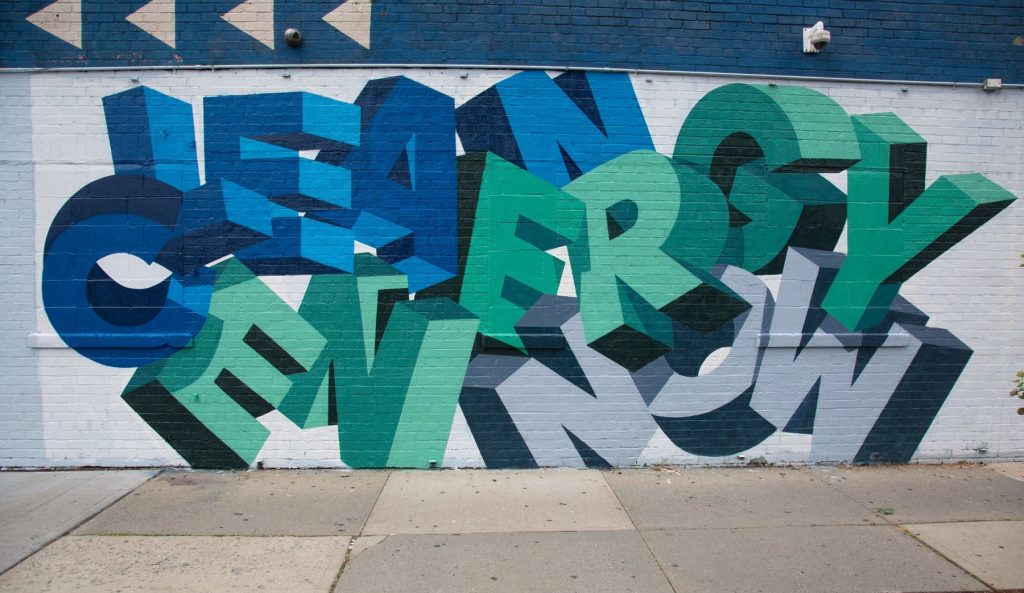
Ben Johnston, Clean Energy Now, New York, 2026. Courtesy of the artist.
Can are change how we feel and even vote? This idea is at the heart of the piece that artist Ben Johnston has just unveiled in NYC. His street work on the corner of 10 th Avenue and 24 th Street marks Climate Action Week, will be on show until October 1. Its aim is to make people think and echoes the approach clean energy non-profit Brightside. Here he talks about the message, the method and meaning.
Why did you feel the message Clean Energy Now was important?
It just felt very straightforward. We know we need to move towards clean energy, so it was really about just saying it clearly, without dressing it up too much. I liked that it was positive as well. But there’s obviously an urgency to it.
What do you find interesting about creating something like this in such a public location?
There’s so much going on visually in a city, especially somewhere like New York. You’re constantly seeing advertising, being told to buy something or look at something. I quite like putting something into that space that isn’t really selling you anything. It’s just there, and maybe you stop and think about it for a second.
Your work takes time to read and interpret. What do you like about that sense of speed?
I like that you don’t always get it straight away. You might see the shapes first, or just see it as an image, and then slowly start working out what the words are. I’ve always liked that. There’s that moment where it suddenly clicks and you realise what you’re actually looking at.
How has activism or action emerged in your work in a wider sense?
I’ve never really thought of myself as an activist artist. I’m interested in words, and in what happens when you put them somewhere very public, somewhere people can’t really ignore them. Obviously the words you choose can have a lot of weight. I think that part of the work has just developed quite naturally rather than being something I set out to do.
Do you feel art has the power to change minds?
I’m not sure a piece of art necessarily changes someone’s mind there and then. Maybe it can, but I don’t know. I think it’s more about making someone notice something. Maybe they think about something they hadn’t really considered before, or they remember it later. That’s probably enough for me.
Anything to add?
It was just really nice to get the chance to paint something like this in New York, especially during Climate Week, and to do it with Brightside.now. And the message itself doesn’t really need much explaining. Clean Energy Now.
@ben_johnston @artrbte @brightside.now
Twin Loves: LFW SS27 Highlights
Oscar OuyangSS27
CSM graduate Oscar Ouyang chose the sunlit upper floor of Rochelle, a former school in Shoreditch, to present a collection he described as one of “youthful romanticism”. Born in Beijing and based in London, Ouyang was thinking about the way we “assemble” our identities as we move from youth into adulthood. The collection captured that slightly awkward in between stage, when you are no longer a teenager, but not quite an adult either, raiding your parents’ wardrobes to get dressed for a night out.
There was a playful sense of nostalgia throughout. Tailoring looked perfectly proper from the front before opening unexpectedly at the back, polos were cut lower than expected and running shorts puffed out into exaggerated silhouettes. It felt youthful without being overly sweet, capturing that strange and fun period of figuring out who you want to be.
Simone RochaSS27
For SS27, Simone Rocha took over the Old Bailey with a collection inspired by the 1990 rediscovery of Caravaggio’s long lost The Taking of Christ, which had been hanging, misattributed, in a Dublin Jesuit house for more than 50 years.
Hand worked roses appeared across velvet and leather, while everyday pieces were elevated with more precious garments deliberately knocked out of shape. Silk organza slips hung loosely from the body, with twisted fabrics and imperfect silhouettes giving the collection a distinctly “touched” feel. This collection definitely found beauty in unexpected places.
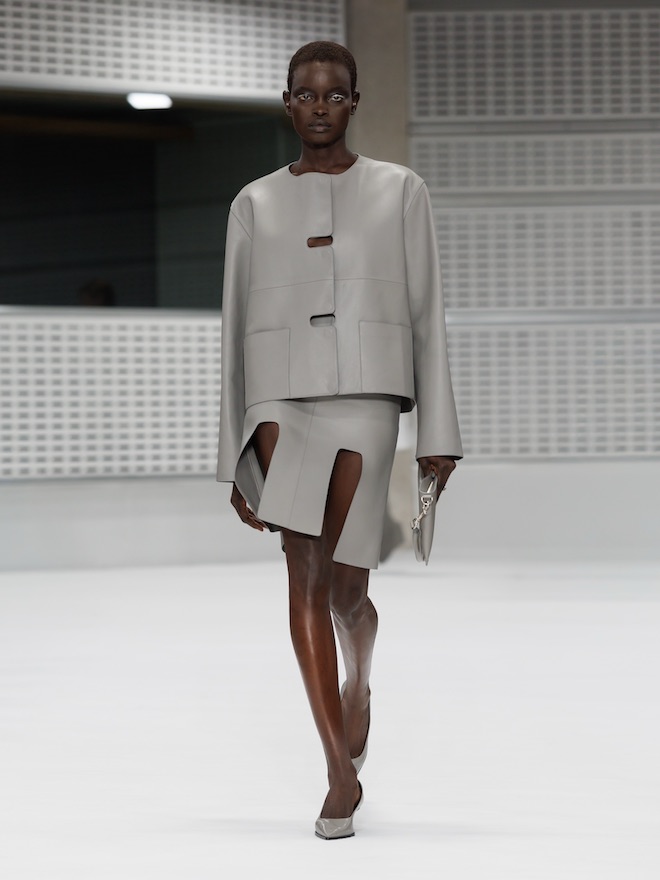
MulberrySS27
Mulberry’s SS27 collection marked a new chapter for Scottish designer Christopher Kane, who has taken over as creative director of the British heritage brand. Kane closed his own London label in 2023, making his return to runway much anticipated by the fashion world.
The collection leaned into clean lines, sharp edges and plenty of laser cut leather. Accessories played a major role too, with pared back, monochromatic looks allowing the bags to really take centre stage. There was something particularly satisfying about the contrast between the sharper, sculptural pieces and the softer movement of the collection. SS27 feels like a fresh start for Mulberry, and we’re excited to see where Kane takes the brand next.
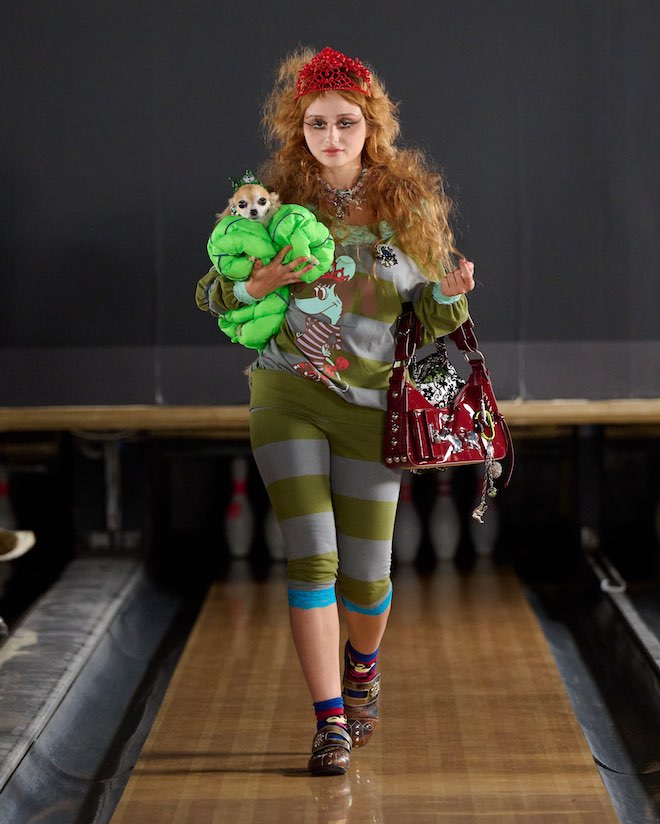
Chopova Lowena SS27
Emma Chopova and Laura Lowena are known for their riotous runway shows, often pairing playful sets with a cast that feels like a reflection of their own eclectic community. This season was no different, with even ex Sessions Arts Club chef Nil Mutluer making an appearance on the runway.
The collection leaned into a world of otherworldly characters, drawing on Slavic folklore alongside nymphs, water spirits, ghouls and vampires.
As ever, there was plenty of humour woven into the clothes. T-shirts featured pigeons, horses and slogans like “Help Me Chop Ova Lowena”, alongside illustrations of three knife wielding schoolgirls. It was chaotic, playful and unmistakably Chopova Lowena, exactly the kind of joyful weirdness that makes the brand such a highlight of London Fashion Week.
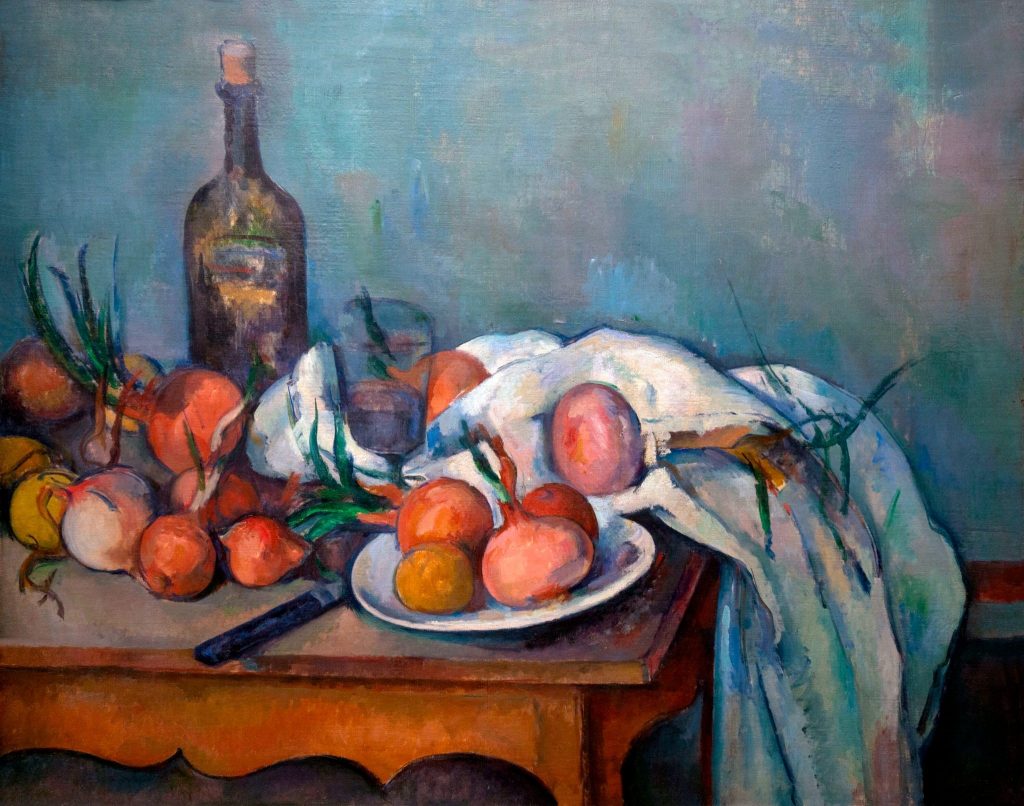
Twin Picks: The Still Life Cookbook
The Still Life Cookbook – Vegetarian Recipes Inspired by Great Paintings, gestalten, 2026. Photo: Peter Barritt / Alamy Stock Photo.
What happens when great paintings become recipes? The Still Life Cookbook – Vegetarian Recipes Inspired by Great Paintings brings together vegetarian recipes inspired by still-life masterpieces, exploring the longstanding relationship between food, art and the natural world. The book brings together the visual language of still life with contemporary vegetarian cooking, making subjects that have fascinated artists from the mosaics of ancient Rome to the present day accessible through food.
Written by London-based food writer Paola Gavin, with a foreword by Twin art editor Francesca Gavin, the book considers the historical significance of food in art and the ways in which ingredients have come to represent abundance, beauty and the ephemeral.
From the luxury associated with exotic produce in the eighteenth century to the spatial experiments of the late nineteenth-century avant-garde, the paintings featured in the book reflect changing relationships with food and nature.
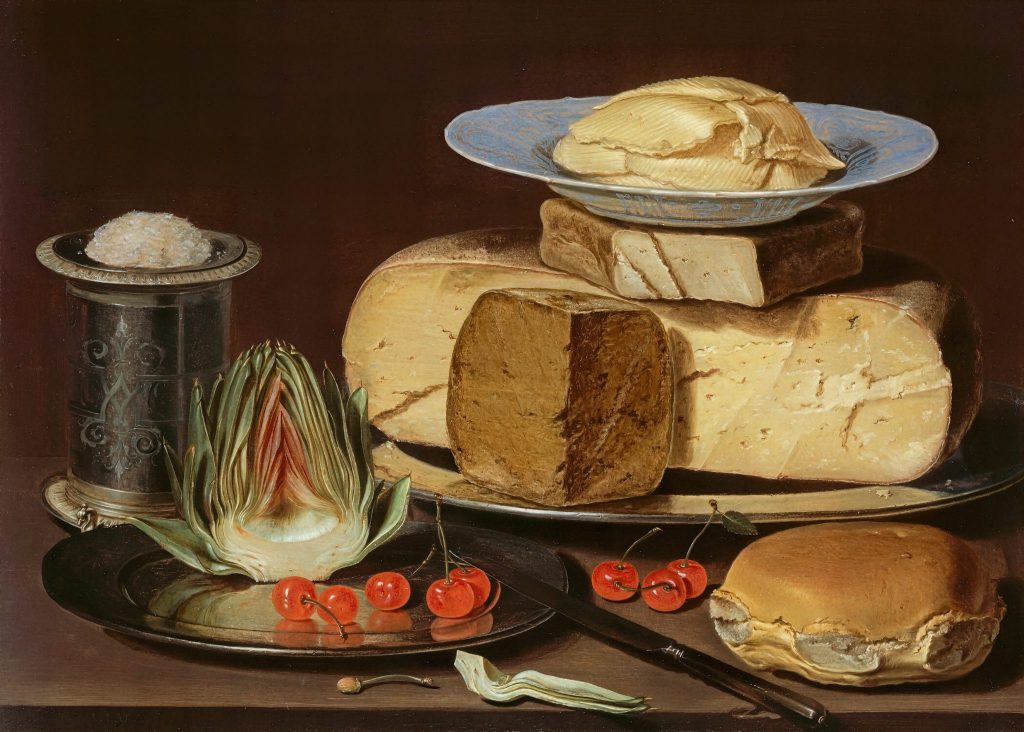
The Still Life Cookbook – Vegetarian Recipes Inspired by Great Paintings, gestalten, 2026. Photo: Carlo Bollo / Alamy Stock Photo.
One of the recipes featured is Asparagus with Zabaglione Sauce, inspired by Adriaen Coorte’s 1696 Still Life with Asparagus and Red Currants. Gavin reimagines the traditional Italian custard as a savoury Piedmontese version, combining whisked egg yolks, dry white wine and butter to create a frothy accompaniment for steamed asparagus.
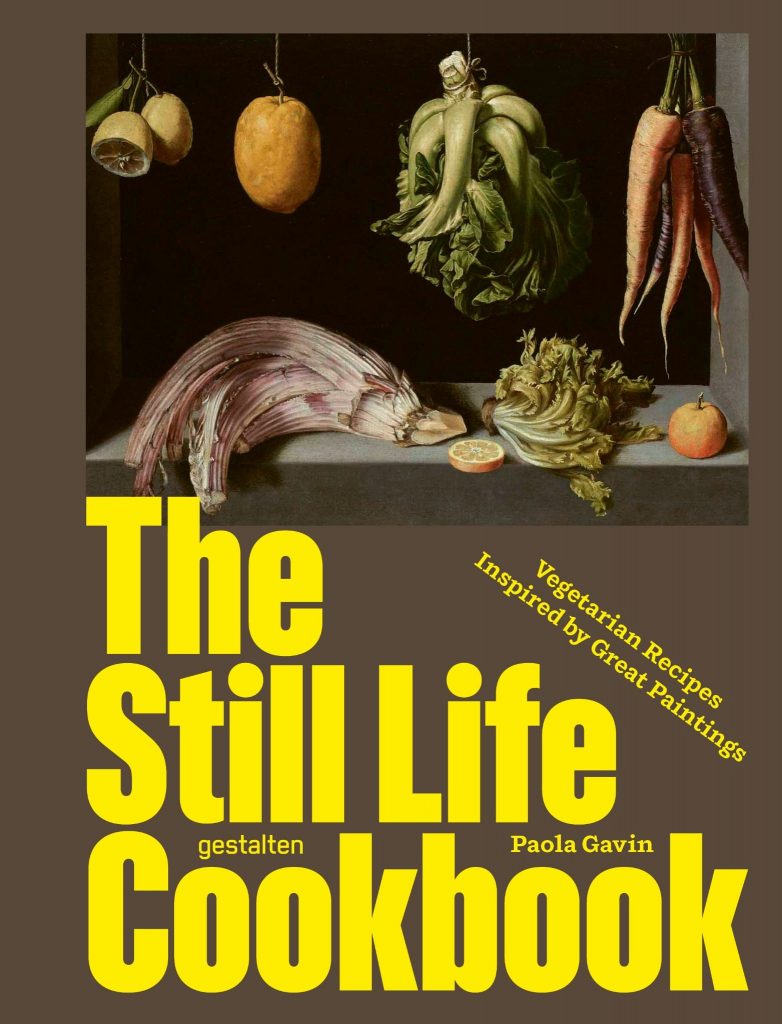
The Still Life Cookbook – Vegetarian Recipes Inspired by Great Paintings, Paola Gavin, gestalten, 2026. Cover image courtesy of gestalten.
The Still Life Cookbook explores the still life as a genre concerned with abundance, beauty, consumption and the passage of time, while offering recipes inspired by the works and culinary traditions represented within it.
The Still Life Cookbook – Vegetarian Recipes Inspired by Great Paintings Author: Paola Gavin Foreword: Francesca Gavin Publisher: gestalten
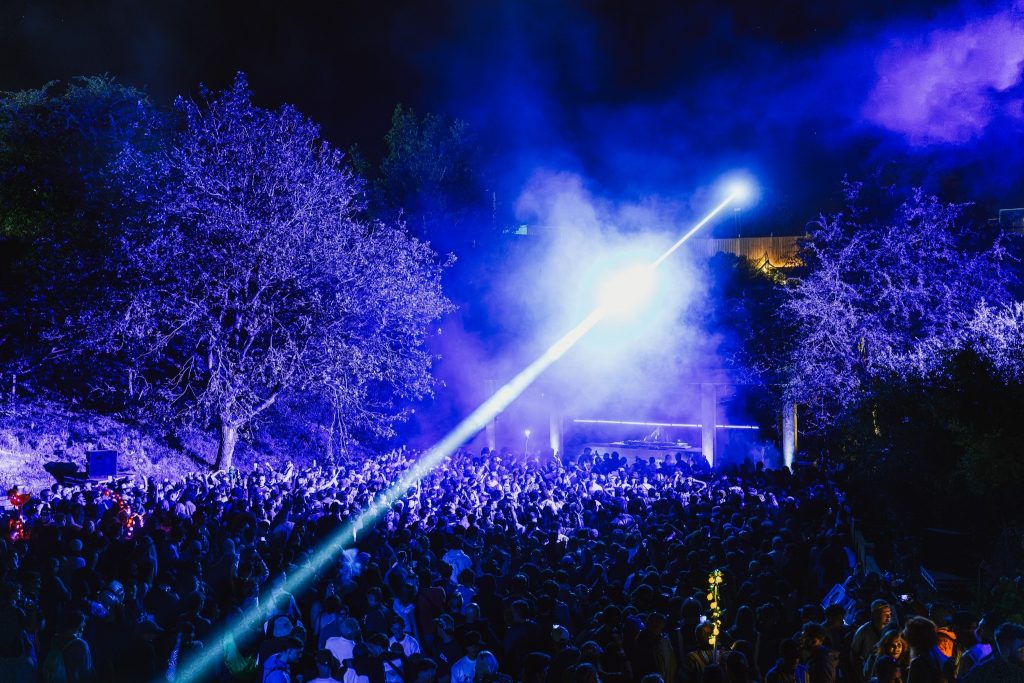
As festival season draws to a close, the tents are packed up for another year and the back-to-school of Virgo season starts to feel a bit too real, we reflect on some of our favourite summer moments. Houghton festival, famed for its “24 hour music” approach and little forest stages, returned to the grounds of Houghton Hall in Norfolk from 6–9 August, bringing together four days and nights of electronic music, visual art and performance across the estate which is known for its art and sculpure collection.
Founded and directed by artist and DJ Craig Richards, Houghton takes place amongst woodland, a lake and the estate’s sculpture park. This year’s visual arts programme included new commissions by Ryan Gander, Cella Collective and Mitre & Mondays, Henry Krokatsis, Nicole Gordon and Ke Peng, Call Super and Richards himself.
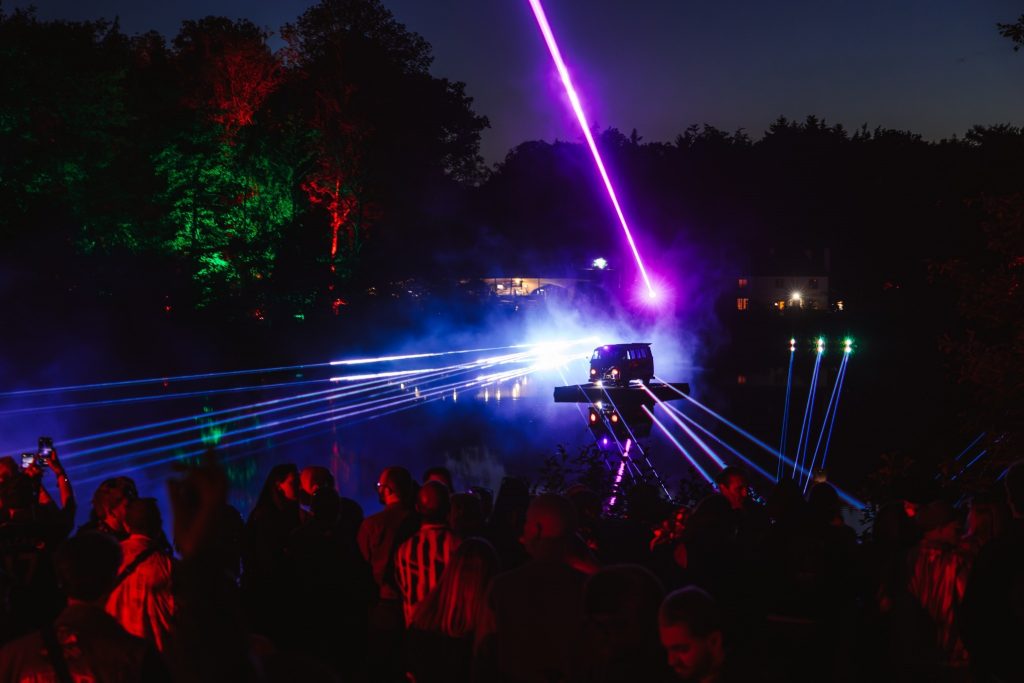
Returning to the festival was artist Chris Levine, whose installations Full Beam and Light is Love offered two stunning encounters with light, and created a centrepiece for revellers traversing the grounds.
Full Beam took over the main lake, centred around a surreal chrome-plated VW camper van first seen at Houghton in 2025. This year, the work took on a new continuous form, with a laser visible across the site and extending upwards into the sky. Hidden amongst the trees, Light is Love offered a more intimate experience, projecting images into the viewer’s peripheral vision.
For Levine, light is closely connected to consciousness. He has worked with lasers throughout his career, beginning with what he describes as a “love affair” with the medium after encountering his first small red laser dot as a child. “There’s something fundamentally beautiful about laser and that’s because it’s so pure,” he says. “It’s single frequencies of light and we don’t normally experience that.” Focusing on that signal can create a particular state of attention. “To put your attention onto it, to tune into it, can very quickly put you, the audience, into a meditative state. It’s a pure signal to focus on in an increasingly noisy and chaotic world.”
This shift makes Houghton an interesting context for Levine’s work. There was a time, he says, when his full-on lasers were another layer on top of everything at a festival, intended to “get you higher”. For a period, he dismissed festivals altogether, feeling there was too much noise and distraction for his work to function, but Houghton changed his mind: “Houghton has taught me that despite being in a 24-hour techno sound environment, I simply have to work it harder and up the sensory dials, so that one is awestruck and taken into the present moment, the space between thought where you are totally immersed in a sensation of beauty.”
His latest work with lasers has also pushed towards increasingly ambitious scales. While testing a laser for his installation Higher Power in Venice, the beam was spotted by the International Space Station. “It blows my mind that the artwork titled Higher Power is still propagating in space and increasing in size at the rate of 186,000 miles per second, as you read this,” he says. “Biggest is best right? Can an artwork get any bigger?!”
At Houghton, however, Levine’s focus is on something closer and more immediate: attention. In the middle of a festival shaped by music, movement and thousands of people, his work attempts to create what he calls “the space between thought”.
“It’s a meditative state,” he says, “and that’s a great place to be, wherever you are.”
Twin took a moment to chat to Chris about his work:
Artists have always worked with invisible forces like wind, gravity, magnetism and sound, but light is unique because it’s both the fastest thing we know and the condition through which we perceive reality itself. Do you ever feel you’re making artworks with reality rather than representations of it? Where, for you, is the boundary between sculpture, perception and consciousness?
For me it’s all about consciousness, and within that mind and matter are interrelated. Nikola Tesla said to think of reality in terms of frequency and vibration, and I subscribe to that in everything I do.
Whilst people come together to dance and explore altered states, and human experiences like joy, elation, movement and exhaustion, do you think your work creates altered states of consciousness? Is this something you hope it does?
Back in the day, I was involved in rave and used laser to create peak experience. Then I got into recovery and sought my highs in different ways. Here and now in 2026 I used laser very differently and my work is about taking my audience towards stillness…as a portal to the divine.
Can light teach us something about how we relate to each other?
Given that we are comprised of complex vibrational fields, electromagnetic, the same energy but at different octaves, different frequency ranges to visible light, relating can be an energy thing. We talk of someone giving good vibes, or the bad energy of another. To have some awareness or perspective of everything being to do with frequency and vibration might help us get along. Sounds crazy, but feels right.
Twin Loves: Sensual Nature at Stockwell House
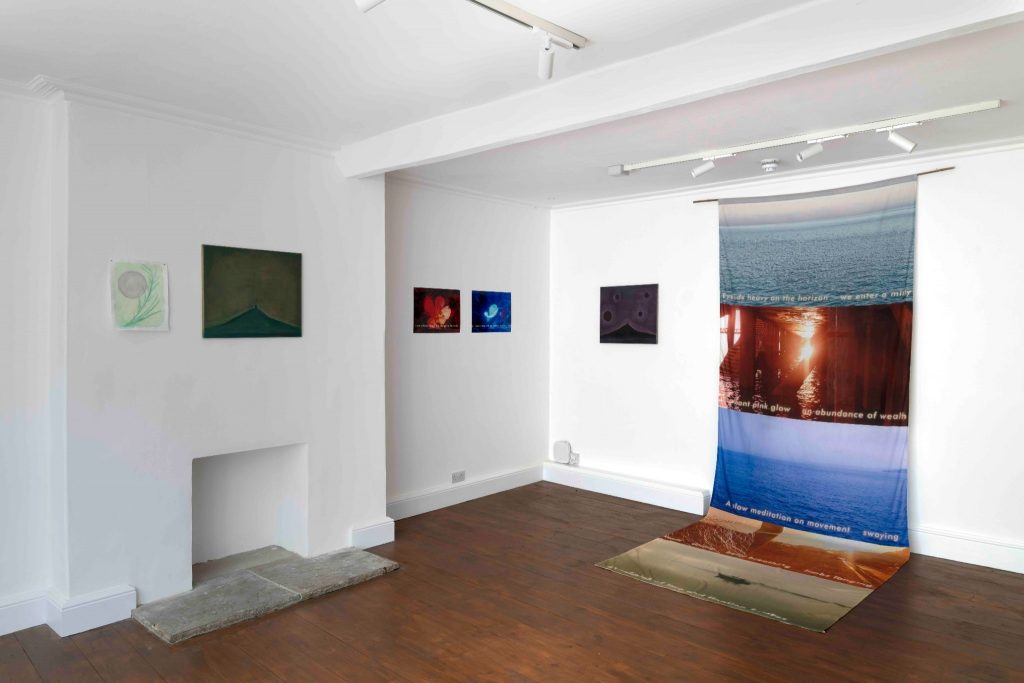
Installation view of Sensual Nature, Stockwell House, Bruton, 2026. Courtesy of the artist.
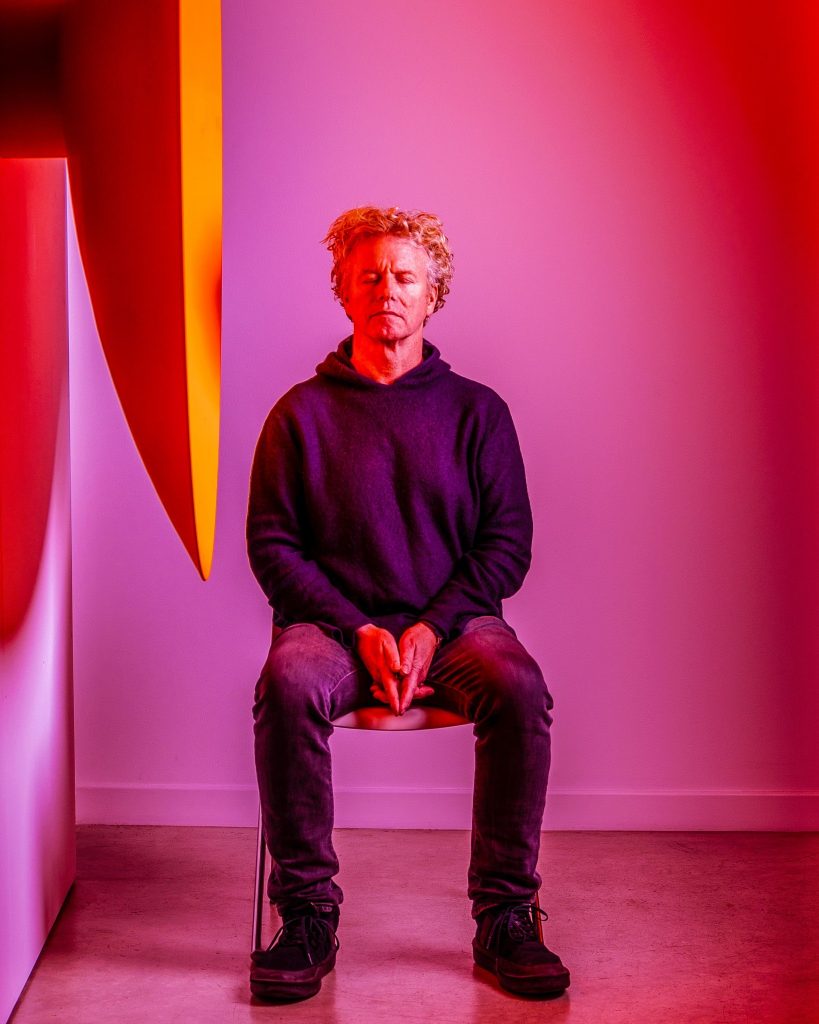
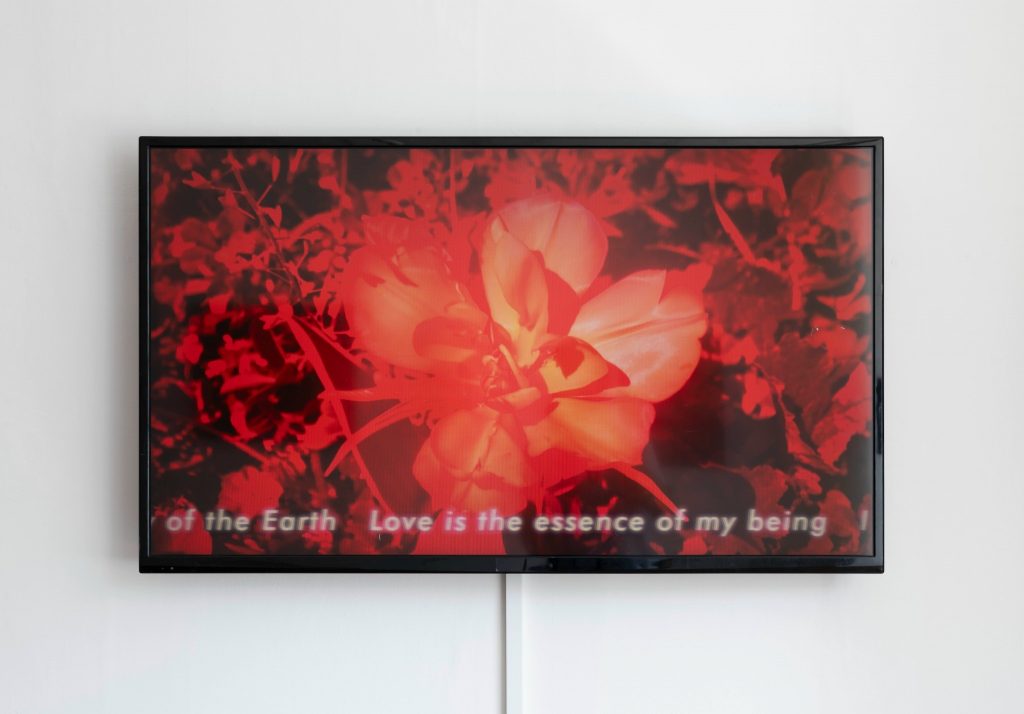
Jennifer Lewandowska’s Sensual Nature is on view at Stockwell House, Bruton, from 1–31 July 2026. The exhibition brings together film, painting, drawing and sound to explore the sensuality of the seasons, mysticism within the landscape and the healing qualities of plants.
Throughout the month, Lewandowska transforms the gallery and garden into environments for rest and reflection. Working with hypnotic sound, poetic moving image, and a new body of paintings and drawings, the exhibition invites visitors to slow down and engage more deeply with the natural world.
Love is the Essence, 2026. Film still. Courtesy of the artist.
Alongside the exhibition, Sensual Nature includes a programme of seasonal gatherings inspired by the elements; Earth, Fire, Air and Water. Through conversation, guided walks and shared sensory experiences, participants are encouraged to explore seasonality, place and connection.
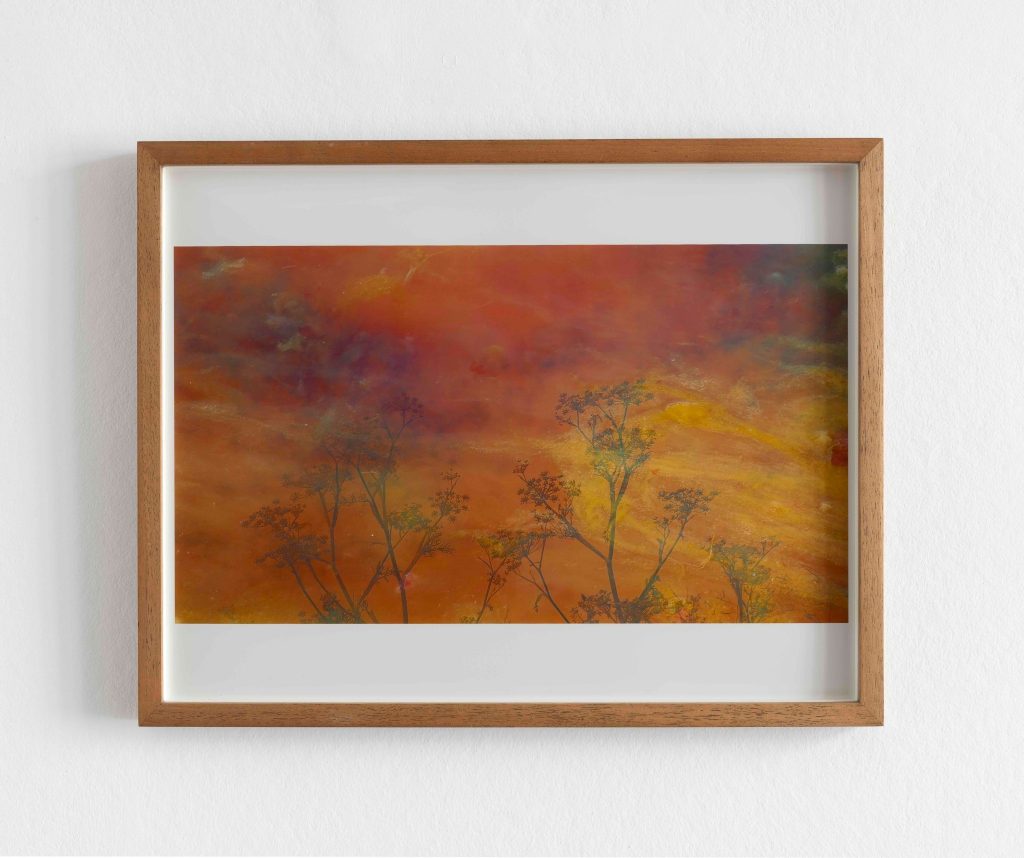
Fixed Constant Blazing, 2024. Courtesy of the artist.
Based between London and Somerset, Jennifer Lewandowska is a multidisciplinary artist whose practice explores the relationship between human existence and the natural world. She is Creative Director of Interstage at Glastonbury Festival and co-founded the artist-run gallery French Riviera in Bethnal Green in 2011.
Stockwell House is a space for creative exchange, collaboration and experimentation in Bruton, guided by Hauser & Wirth to support independent projects, research and exhibitions.
Jennifer Lewandowska: Sensual Nature 1–31 July 2026
Stockwell House 13 High Street Bruton Somerset BA10 0AB
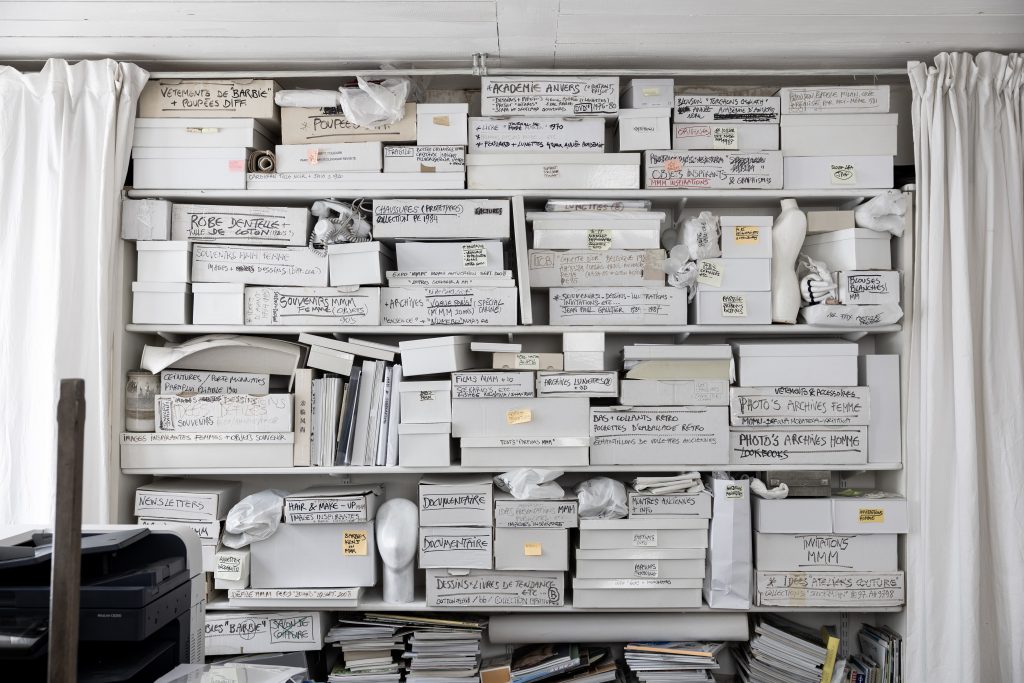
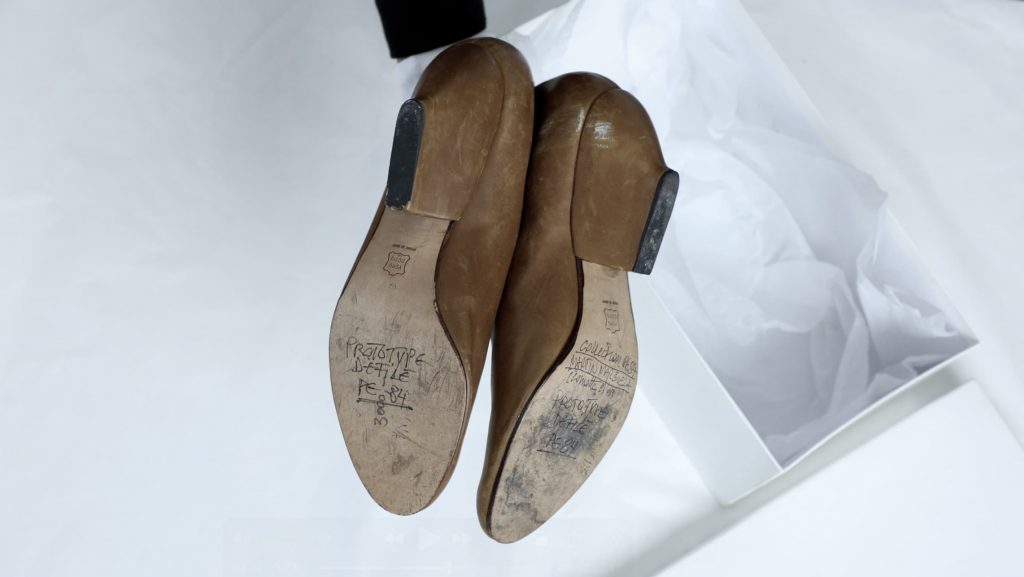
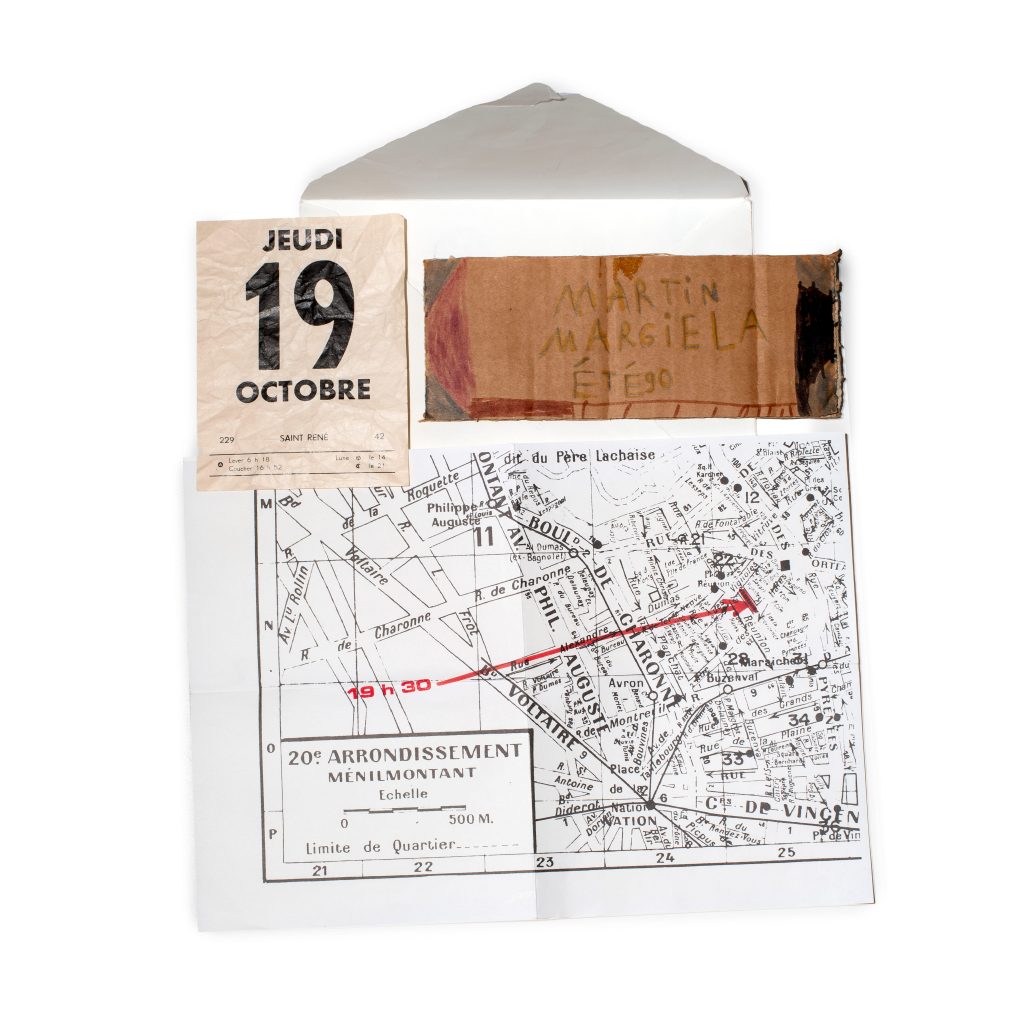
Martin Margiela has opened part of his personal archive for sale in collaboration with Maurice Auction and Kerry Taylor Auctions. The historic auction presented more than 200 lots spanning the designer’s career from 1984 to 2008, including photographs, drawings, objects and previously unseen works.
“After many years of moving archival material from place to place and subsequent loans for exhibitions, I felt it was time to let go of a part of my fashion memorabilia,” says Margiela. “After a long questioning, it was the idea of making happy several collectors and institutions that made me finally decide to send them into the world.”
The sale also includes the Hermès wardrobe of Margiela’s late mother, Léa Bouchet. Comprising garments, bags, accessories and shoes from his tenure at Hermès between 1997 and 2003, the collection offers a personal insight into this period of the designer’s career.
Curated by longtime friend Bob Verhelst, the accompanying exhibition presents many of the objects in an environment inspired by an early twentieth-century workshop. Most of the works on display had never previously been exhibited.
As announced by Margiela, a portion of the proceeds from the sale will be donated to an association dedicated to the fight against AIDS.
Twin Loves: Ashley Saville
Words by Wendela Rang
Ashley Saville in her Fleet Street Gallery. Courtesy of Jack Elliot Edwards
193 Fleet Street is full of surprises. It houses a tax lawyer, a shipping company, a hairdresser, even a speakeasy – and since May, the contemporary art gallery Ashley Saville, founded by, you guessed it, Ashley Saville.
Jason Shulman Moving Pictures installation view, Courtesy of Jack Elliot Edwards.
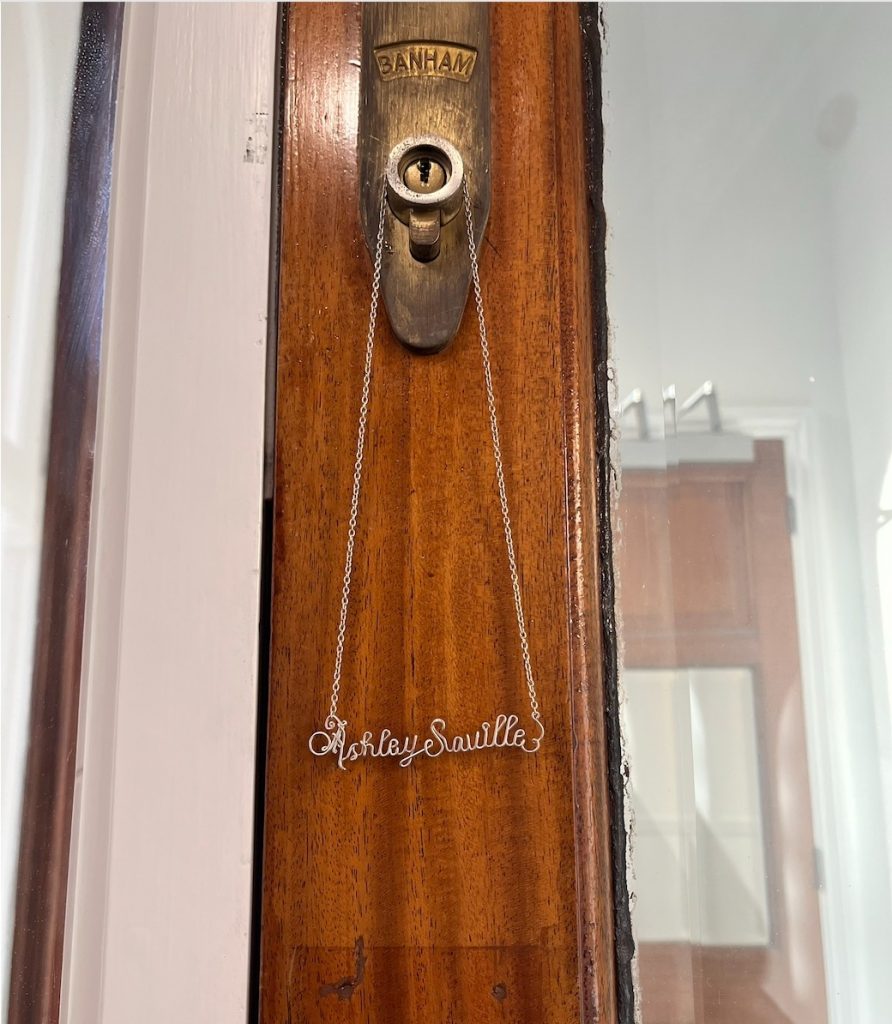
Up on the first floor, behind a wooden door bearing only a small silver pendant reading “Ashley Saville”, lies the snug yet airy gallery. Large windows fill the space with natural light, and there’s a warmth here that’s hard to put your finger on, but which meets you as you enter and stays with you when you leave. Not unlike Farringdon itself, a neighbourhood Saville was enchanted by for its architectural eclecticism: the whole chronology of London city in one place, blending futuristic highrises with centuries-old architecture.
The area reflects Saville’s own approach to arts and culture, and also programming: she describes it as “omnivorous”, pointing to an openness across disciplines and perspectives for upcoming shows. Her one rule? All artists shown must be London-based. “It feels more connected”, she says, noting that it helps close relationships to form, and allows her to be more involved along the way.
Jason Shulman Moving Pictures installation view, Courtesy of Jack Elliot Edwards.
Moving Pictures by artist Jason Shulman is Ashley Saville’s inaugural show, running until 4 July. In Shulman’s images, as across Farringdon itself, time seems to layer rather than move on, almost like a reminder that time rarely behaves itself. Spanning a decade of long-exposure photography, time is compressed into single images: a feature film collapsed into one frame, famous on-screen kisses captured from first touch to last – and with the same logic also male ejaculations. Elsewhere, the assassination of John F. Kennedy is depicted in a saturated lenticular, suspending that moment into eternal repetition. It’s tragic, romantic, and absurd all at once.
Entrance to Ashley Saville
Ashley Saville, 193 Fleet Street. Wednesday-Saturday 10am-6pm, and by appointment.
Twin Picks: Adrian Meško & (La)Horde
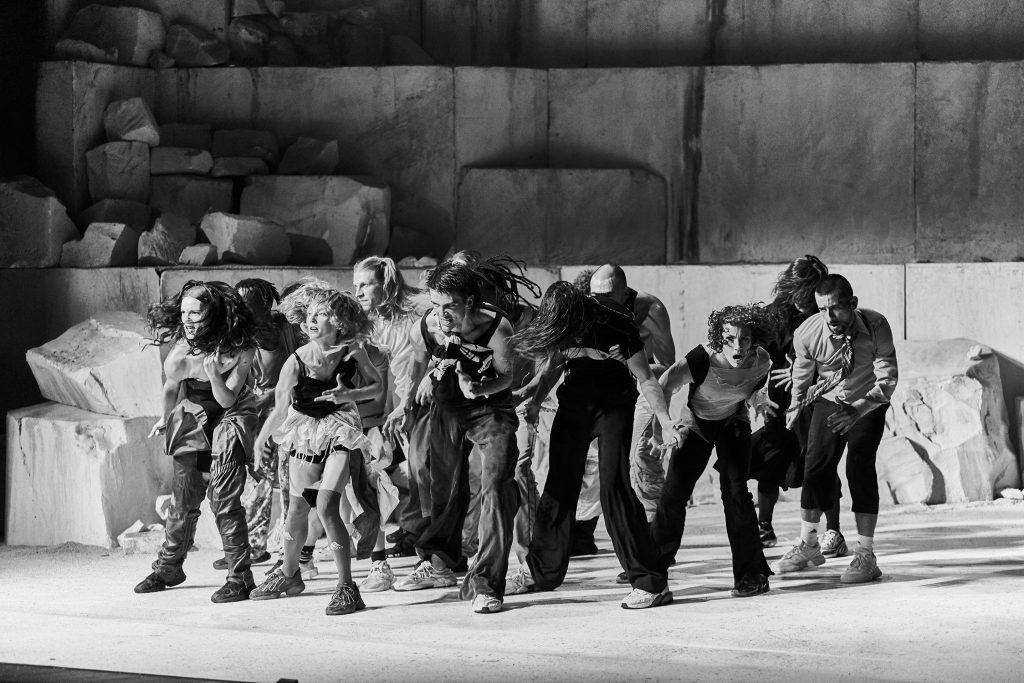
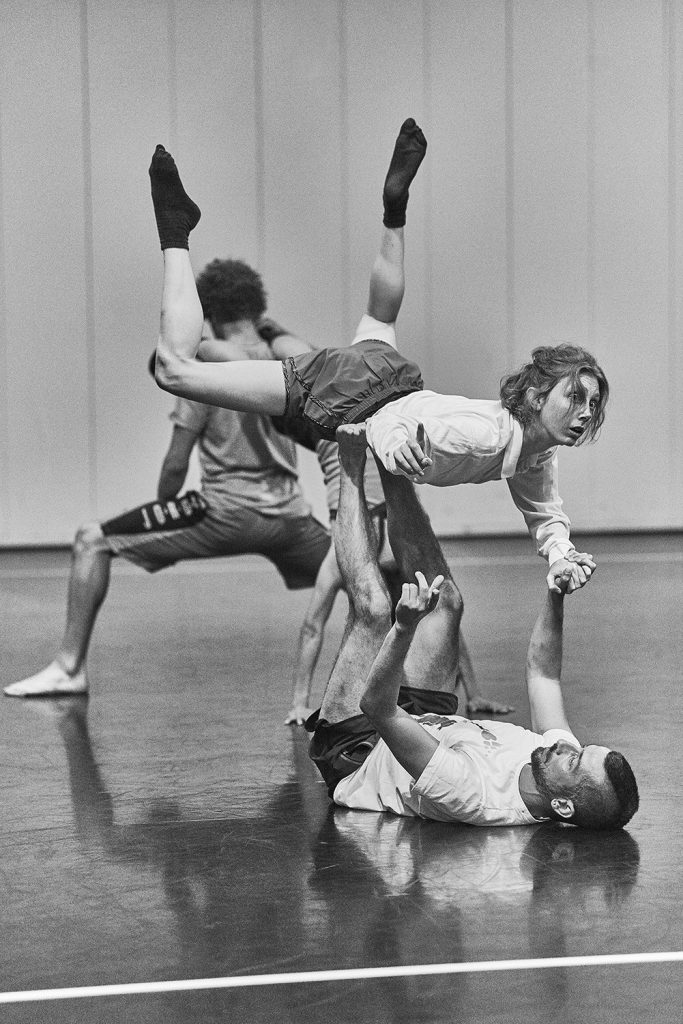
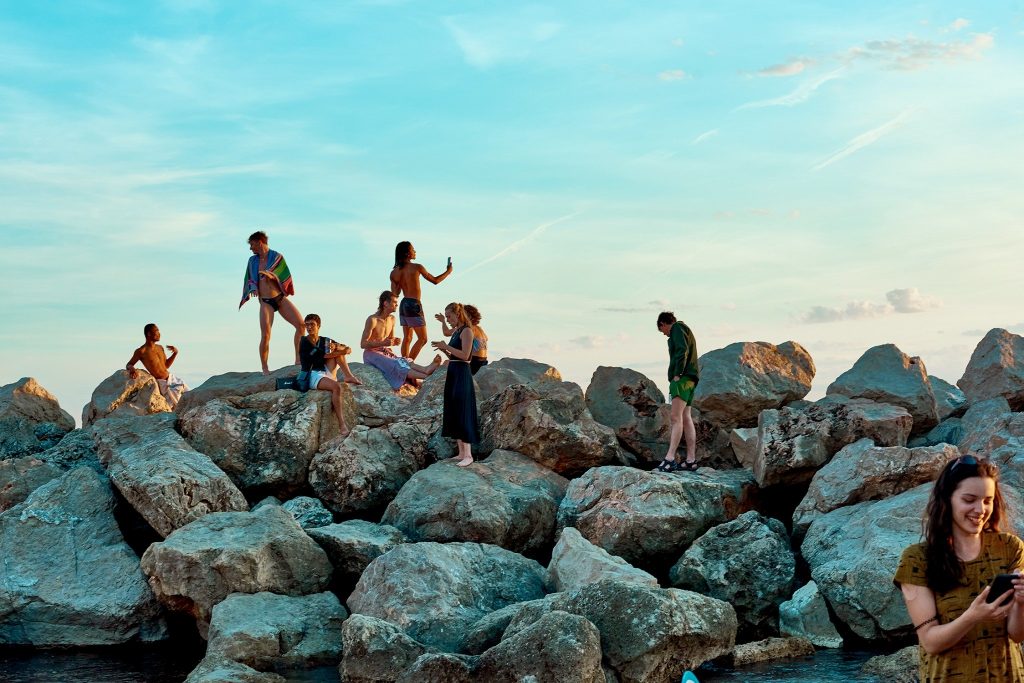
This summer, Australian photographer Adrian Meško turns his lens on one of contemporary culture’s most influential dance collectives. Presented at Kolektiv inside Le Corbusier’s iconic Cité Radieuse in ever trendy Marseille, the exhibition offers an intimate portrait of (La)Horde: the boundary-pushing trio who have transformed Ballet National de Marseille into a global platform for movement, identity and collective expression. Fresh from their epic take over of London’s Southbank centre last year, the company move from strength to strength.
Founded by Marine Brutti, Jonathan Debrouwer and Arthur Harel, (La)Horde have spent the past decade redefining contemporary dance, moving fluidly between performance, film, fashion and popular culture. Their work explores how bodies gather, communicate and resist, creating a visual language rooted in queerness, community and freedom.
Embedded with the collective during the pandemic, Meško documented rehearsals, private rituals and everyday moments beyond the stage. The resulting photographs reveal the physical and emotional intimacy behind the choreography, capturing dancers in states of vulnerability, connection and transformation.
Le Corbusier’s iconic Unité d’Habitation is the celebrated modernist “machine for living”, which here provides a powerful backdrop for a project concerned with the relationship between bodies and built environments: movement unfolds against concrete grids and communal spaces, highlighting the tension between individuality and collective belonging.
Alongside large-scale photographs, the exhibition includes moving-image works and Meško’s handmade publication La.Horde. Opening during the Rencontres d’Arles season, the project celebrates a collective whose vision of dance has become a powerful manifesto for diversity, queerness and contemporary cultural exchange.
Adrian Meško: (La)Horde at Kolektiv, Cité Radieuse, Marseille: 10 July – 24 October 2026
We at TWIN, know that fashion has blood and brains and pizzazz, but it also has its own idiosyncrasies, as just one example it’s always been a law unto itself as far as the seasons are concerned. Deliveries of clothes clash with the seasons in real time, and just as one season is being delivered, the next is being launched on the runways. The recent cruise collections extend fashion seasons as news, as do international fashion weeks in locations as far apart as Australia or Spain. Today magazines like TWIN view trans seasonal dressing and layering as important for most of us, since unpredictable weather is global, and travel is part of many people’s daily lives. Mixing the seasons is about more than simply carrying an umbrella, it’s about seasonal blurring.
It’s also true that in the same way we mix winter and summer, we mix day and night, where a sparkling skirt may be teamed with a chunky sweater or a severe tailored jacket may slip over a romantic blouse. It’s all about breaking the rules, about questioning the old ways and bringing a fresh attitude to fashion, to pique the observers interest, to reinvent the wardrobe.
As you turn the pages of this issue of TWIN you’ll note how our creative teams not only switch between the seasons but also between stories. It’s the range of narratives that take us from variations on the sporty, to sophisticated late night dinners, from strolling around the city in easy pieces, to close up looks at covetable jewellery. Its about each issue being a series of juxtapositions, layering the stories and ideas like a delicious mille feuille gateau.
Between the covers of each issue we think about the range of stories from urban indoors to rustic country, from the art of reading to the art in a gallery. TWIN thinks and plans carefully how to offer interest and that old fashioned word “ variety” every time the publication is offered to its readers. It’s about where fashion and what we wear sits in relation to art, interiors, the world around us. It all requires constant updating, fresh attitudes, analysis of where we are, and also where we are heading. New designers, new artists, new names and new ways of creating from earring’s to shoes, from a painting to furniture.
This is our 34th issue of TWIN and we continue to search, report, create and offer exciting narratives across a broad creative field. So, turn the pages, be surprised, read carefully, return to check the credits, and invest time in seeing our spectrum of stories. Above all, enjoy the entire issue as we continue to offer, through our amazing contributors, what is classically always referred to as “food for thought”.
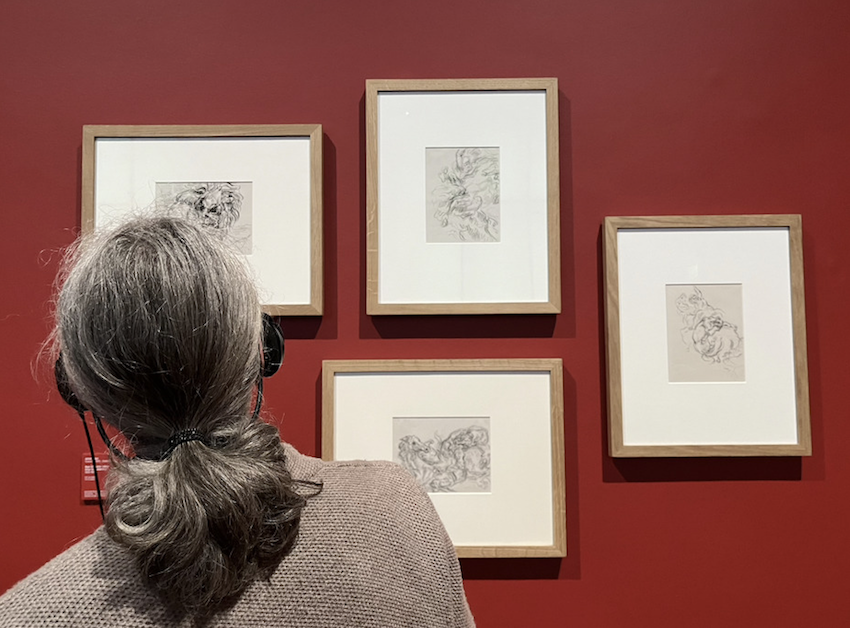
View of stencil drawings by James Ensor. Clockwise from left: After Delacroix: Lion; After Delacroix: Arab Horseman Attacked by a Lion; After Delacroix: Study of the Lion Hunt ; After Delacroix: Lion Hunt (all 1885-1886)
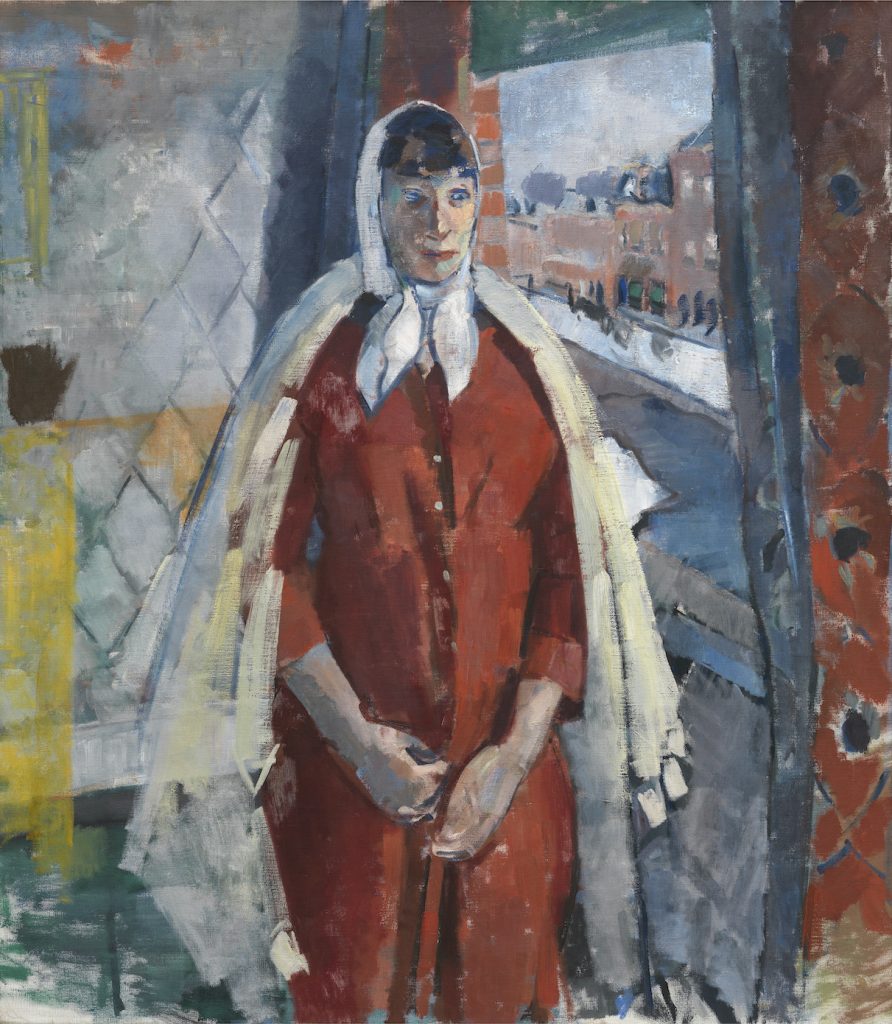
Some paintings you look at. Others, you can almost hear. With its new exhibition A Red that Sings – on show until 30 August – the Royal Museum of Fine Arts Antwerp is asking visitors to do exactly that: listen.
A Red that Sings brings together the “Big Three” Belgian colourists James Ensor, Rik Wouters, and Jules Schmalzigaug – painters who at the turn of the twentieth century broke from the soft tones of Impressionism and pushed colour into starker territories, seeking to mirror or evoke the qualities of sound in their work.
Rik Wouters, Woman at the Window (1915), oil on canvas. Photo: Hugo Maertens, Royal Museum of Fine Arts Antwerp – Collection Flemish Community (public domain)
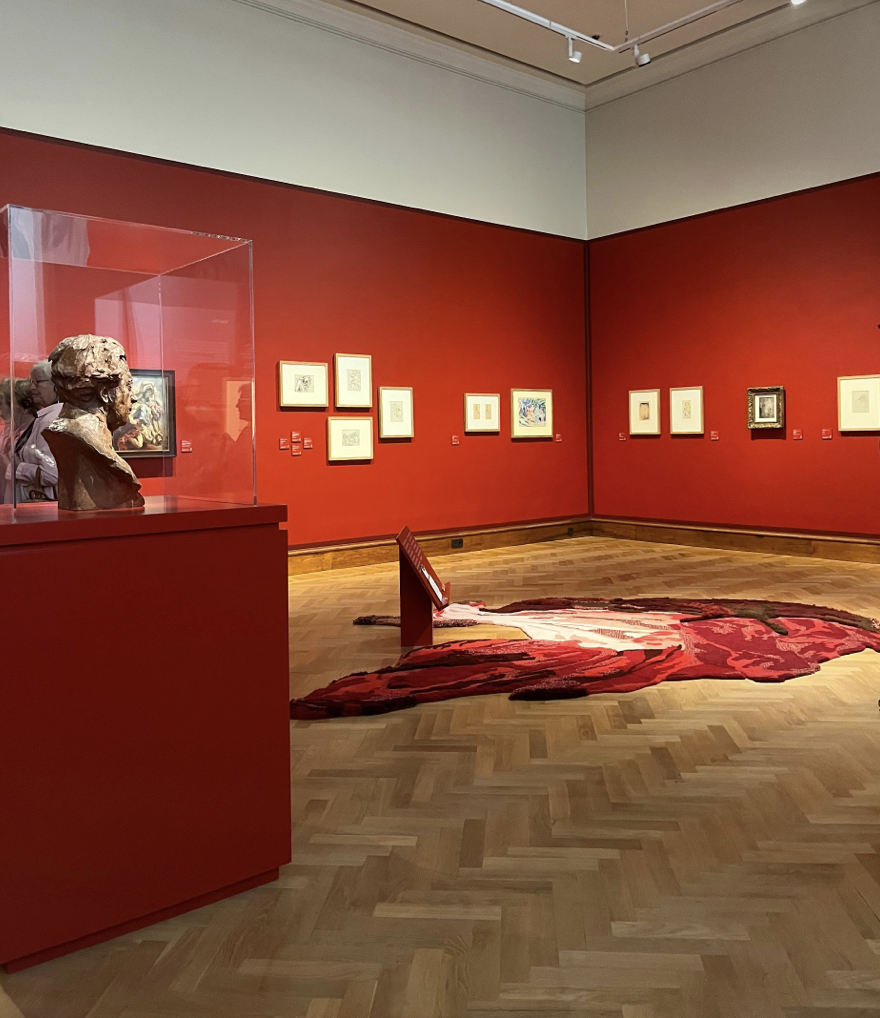
66 works by 10 artists are presented in dialogue across four rooms, centered around the vivid paintings of Ensor, Wouters, and Schmalzigaug. Debussy’s Arabesque plays softly throughout – a nod to the arabesque form’s rhythmic patterns, and a calm contrast to the paintings’ violent reds, deep blues, and bright yellows.
James Ensor, The Intrigue (1890), oil on canvas. Photo: Rik Klein Gotink, Royal Museum of Fine Arts Antwerp – Collection Flemish Community (public domain)
The exhibition title comes from Schmalzigaug himself, who heard something in Peter Paul Rubens’ Adoration of the Magi (1624-1625). Schmalzigaug described it as a singing red – a thread curator Adriaan Gonnissen wanted to pick up on. For Gonnissen, that red is about more than pigment. It is the rhythm hidden in the structure of Rubens’ garments, the way colour gives them movement, almost sound. Rubens “was the Quentin Tarantino of his age,” Gonnissen says – and it is precisely that visceral, chromatic energy that Ensor, Wouters, and Schmalzigaug embodied and reinterpreted, each in their own way.
View of exhibition. Various works.
A Red that Sings invites us to a multisensory way of looking – and listening. Go and see for yourself if you can hear it.
A Red That Sings, Royal Museum of Fine Arts, Antwerp, 11 April – 30 August 2026.
Jules Schmalzigaug, Development of a Theme in Red/ Carnival (1914), oil on cardboard. Photo/ Rik Klein Gotink, Royal Museum of Fine Arts Antwerp – Collection Flemish Community (public domain)?.jpg
Twin Picks: She Drives, She Surfs
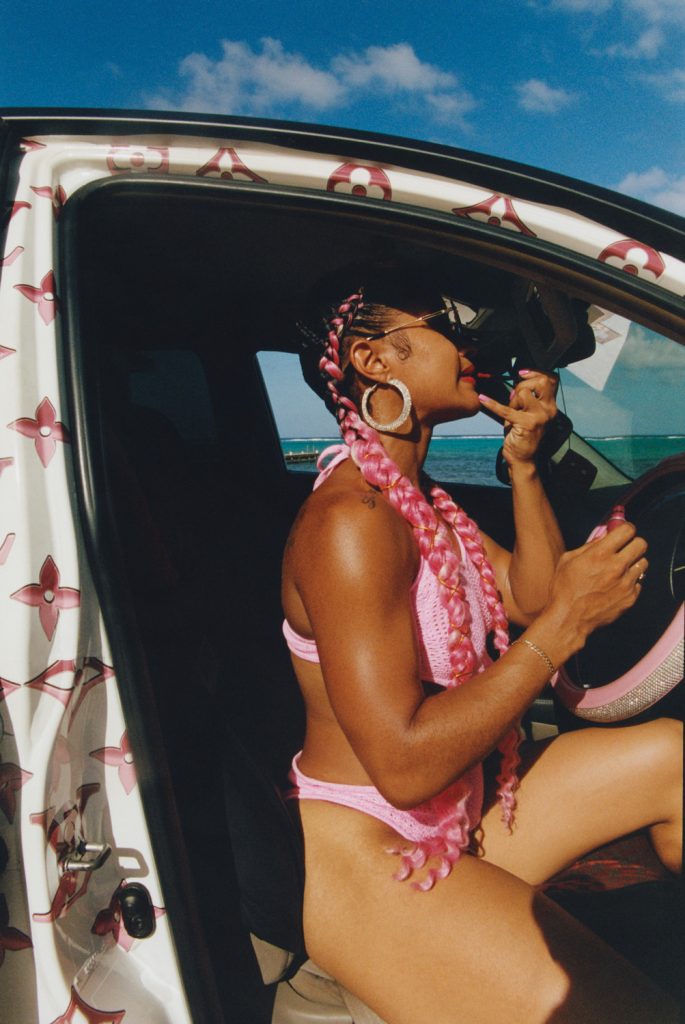
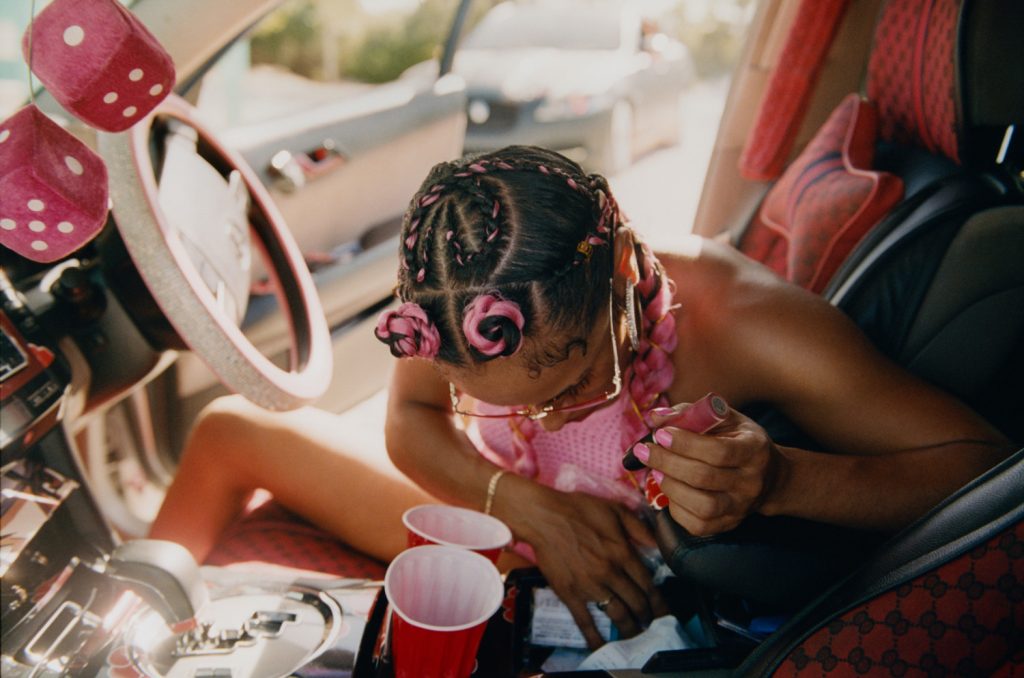
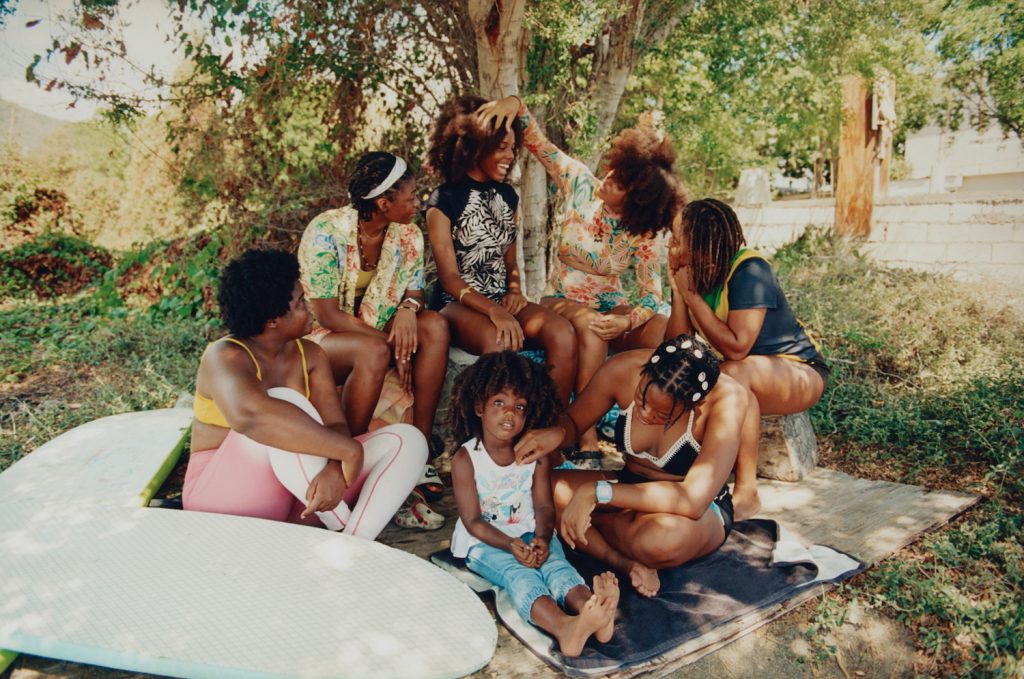
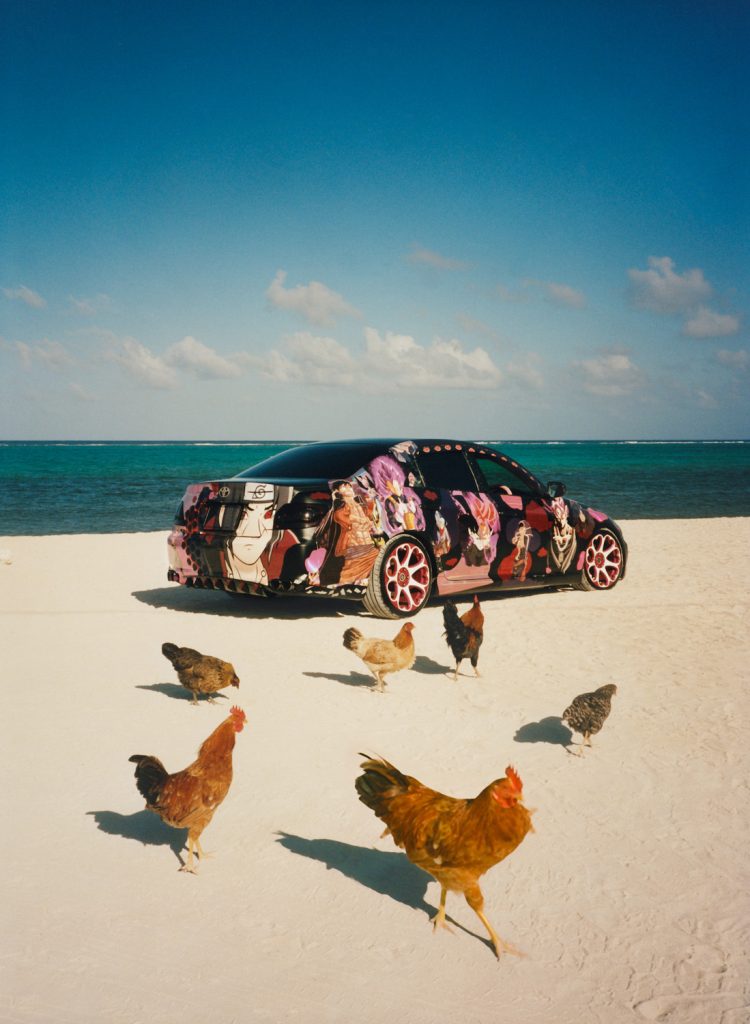
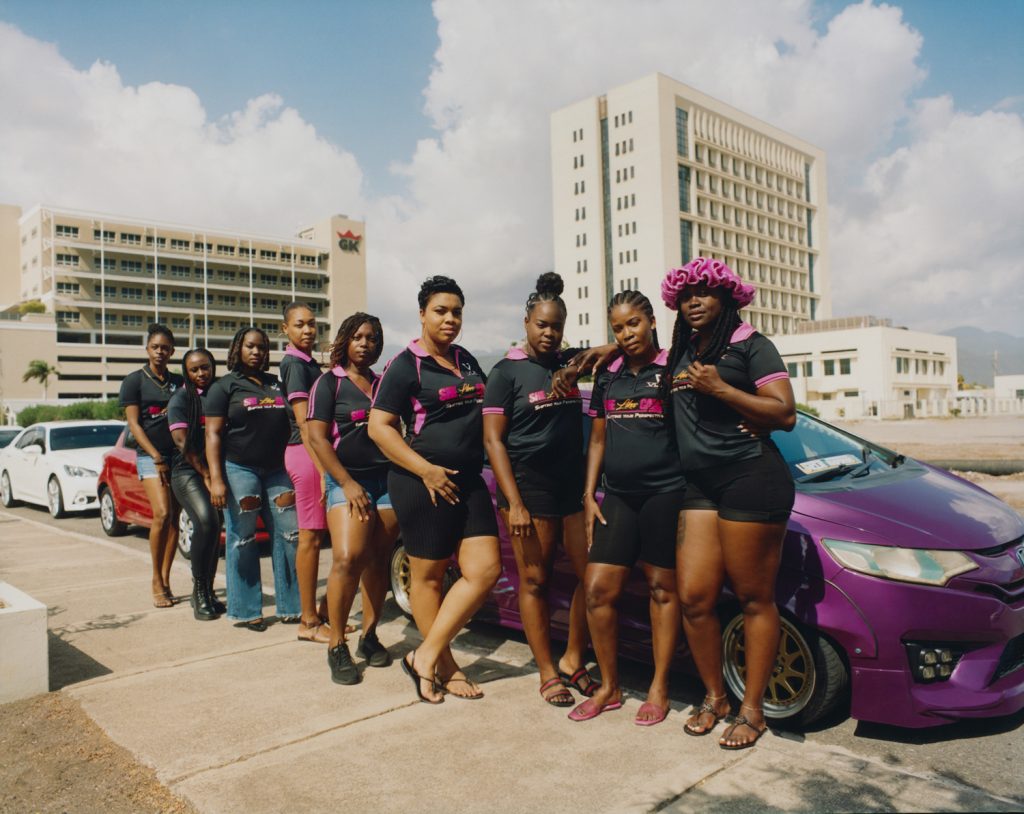
This week is the last chance to see Vogue photographer and Taylor-Wessing finalist Juanita Richards debut solo show, She Drives / She Surfs in Miami. In this striking body of work, the artist brings together a rich collection of beautifully captured photographs of car culture meeting surf culture in her diasporic homeland of Jamaica. The photos capture the sisterhoods born out of women in the Caribbean car scene and the surf collective Surf Girls Jamaica. For the artist, the project seems to expand what she sees as too-often-simplified stories of Caribbean life as viewed through a narrow Western lens. She has previously exhibited at the National Portrait Gallery and been featured in Dazed, Nowness and Vogue, alongside collaborations with Chanel and the appeal of the photos speaks for itself, we imagine we’ll see a lot more of her work to come.
“This body of work was born from love. It began with a return to the Caribbean, the place where I feel most present. Throughout this journey, I saw that feeling of belonging reflected in the women around me: in the way they move through their communities, behind the wheel, and in the ocean”.
“The energy I encountered was pure and community-led. I witnessed women gathering around sport and the sea, finding spaces that offered both healing and escapism”.
“For me, these photographs are an act of witnessing—a record of women who are already writing their own stories.” — Juanita Richards
She Drives / She Surfs, Dalé Zine Saturday, May 2 through May 31, 2026 curated by Mia Roach Penn. A book accompanies the exhibition.
BLOCK PARTY — Closing Reception Saturday, May 30 | 5–8 PM Dale Zine, Miami | Free Entry SHE DRIVES, SHE SURFS goes out the way it came in. Join us outside Dale Zine for DJs, drinks, and unseen work from the exhibition. Old-school block party energy. Everyone welcome. Free and open to the public.
Twin Loves: JWA SS26 Series
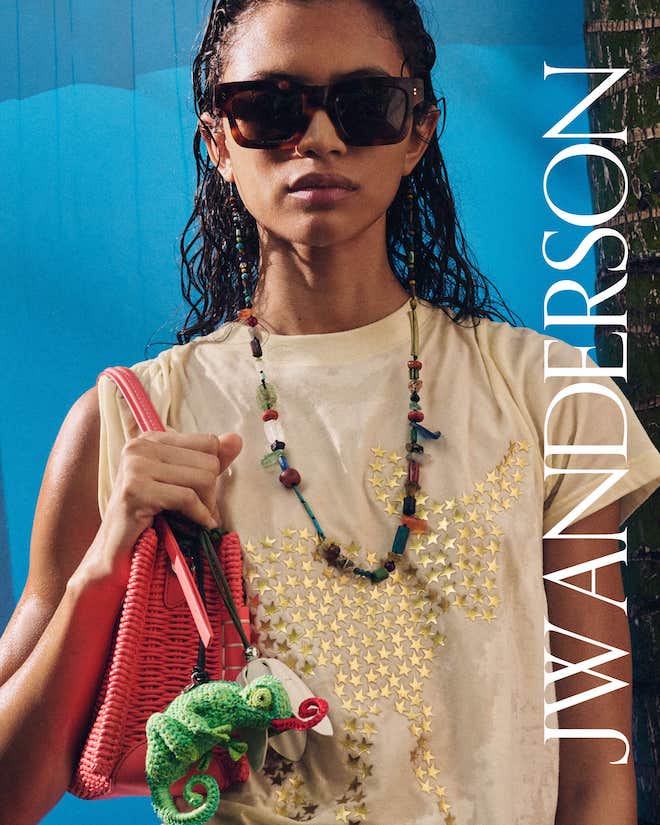
JW Anderson’s Summer Series feels raw, sun faded, and a bit undone in the best way. Jonathan Anderson leans into play here, mixing craft with a sense of escape so nothing feels too perfect or controlled.
It’s a full sensory mix. Woven leather mules, goat suede loafers, and basket weave textures show up across bags and shoes. The cult Loafer Bag returns too, now handwoven and more irregular.
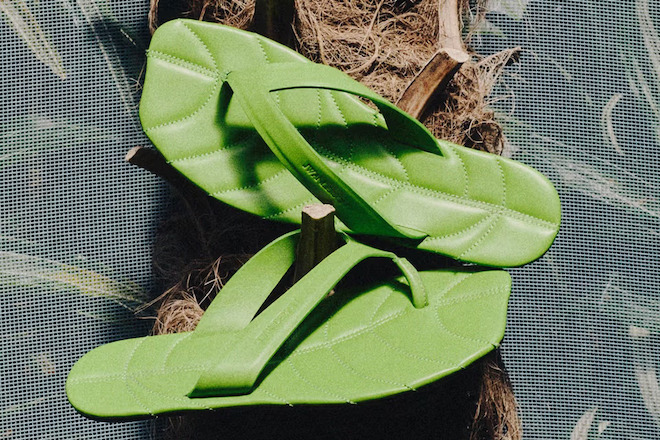
Then there are the Leaf Slides. Lime toned, softly padded, and veined. They’re less “poolside basic” and more wearable still life, echoing the collection’s ongoing love affair with botanical motifs.
The colour palette features bright yellows, fresh greens, deep emeralds. Everything feels light and easy to move in, from loose dresses to open knits and relaxed sets. Nothing is stiff or overworked.
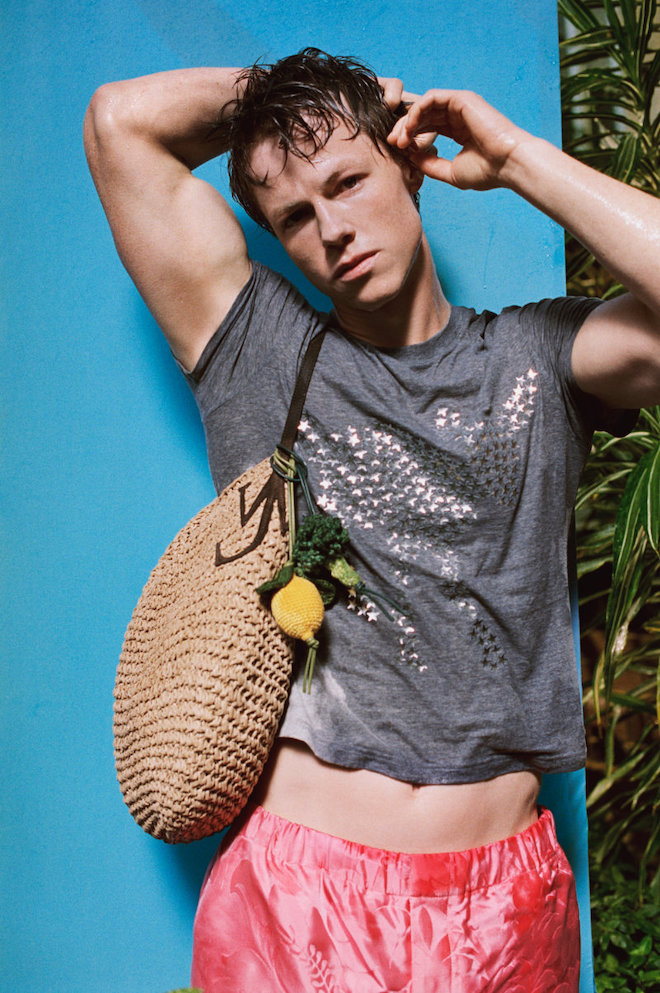
The details keep it fun. Crochet charms shaped like fruit, vegetables, and small creatures hang from bags. It’s styling as storytelling, encouraging wearers to personalise, to play, to not take things too seriously. Because beneath the craftsmanship (and there is a lot of it), there’s humour here. It makes sense when you consider the man behind it. Jonathan Anderson, the Northern Irish designer who built JW Anderson into a cult name, has long blurred the lines between art, fashion, and wit. From reshaping Loewe into a craft driven powerhouse to stepping into his role at Dior, his vision has always leaned toward the unexpected and elevated, but never out of reach.
This is the kind of wardrobe that looks better slightly crumpled, slightly sunburnt, and entirely lived-in.
Twin Loves: Birkenstock 1774
Birkenstock’s 1774 “Romanticismo” collection takes a softer approach to its classics, landing just as some of its most recognisable styles hit the 50 year mark.
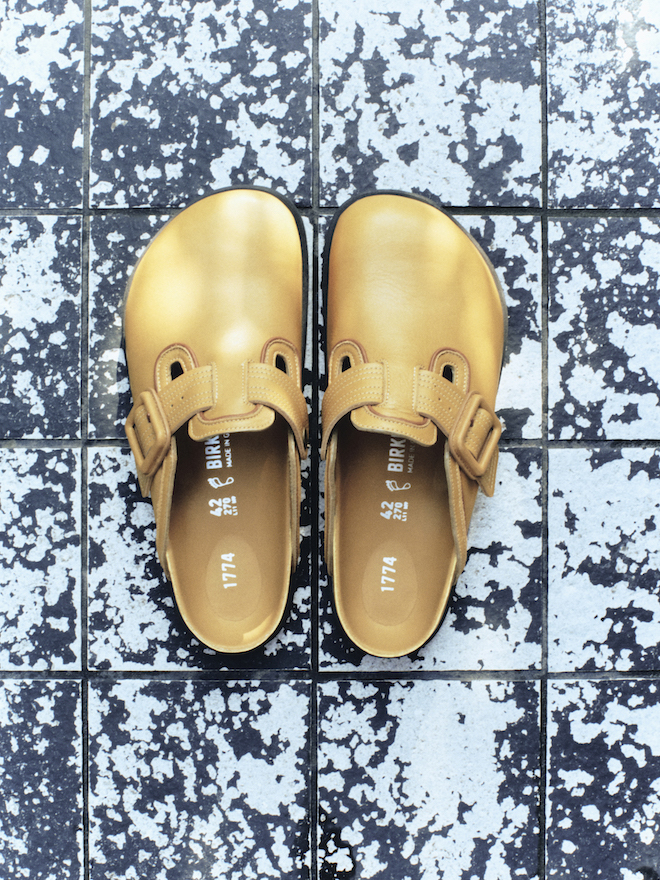
Available from 23 April, the collections lends a loose nod to Italian Romanticism. It’s more about mood than concept: slightly richer materials, cleaner lines, and a tight palette of mustard brown and black. Familiar, just dialled in.
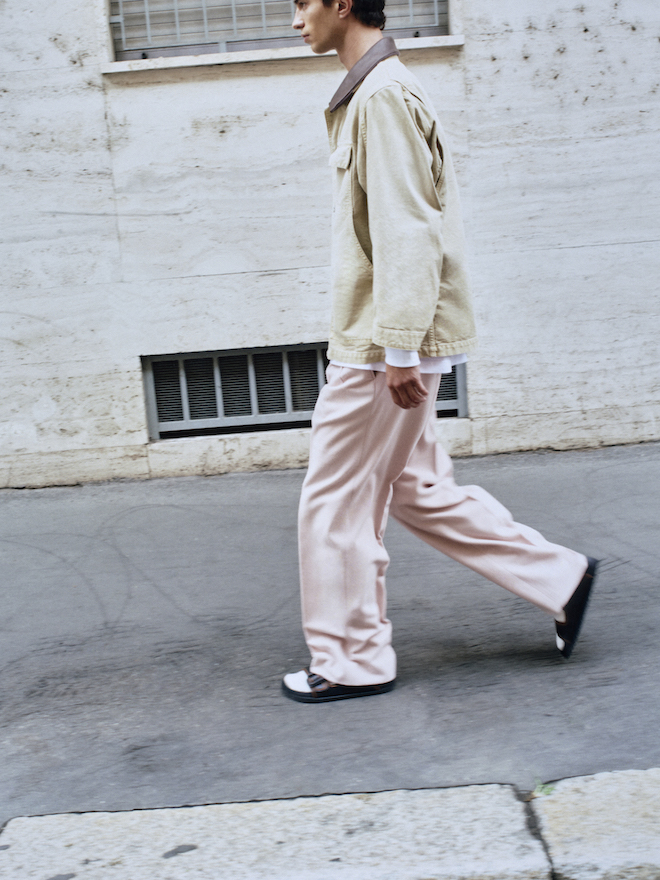
This season centres on the Milano, which reaches its 50th anniversary in 2026. Introduced in 1976, it remains one of the brand’s more structured designs, defined by its back strap and straightforward construction. In this collection, it’s been subtly sharpened: smooth black leather, light contrast piping, and neater stitching that gives it a more considered finish.
Other styles in the collection include the Boston clog and Arizona Two Strap sandal. Both sit within the same language of restraint and refinement, with small tweaks in tone and detail that highlight their shape. Materials across the collection are sourced in Italy and assembled in Germany, keeping the emphasis on quality.
Balancing form with feeling, Romanticismo draws on the past but keeps things effortless and wearable.
Twin Picks: Joanna Piotrowska
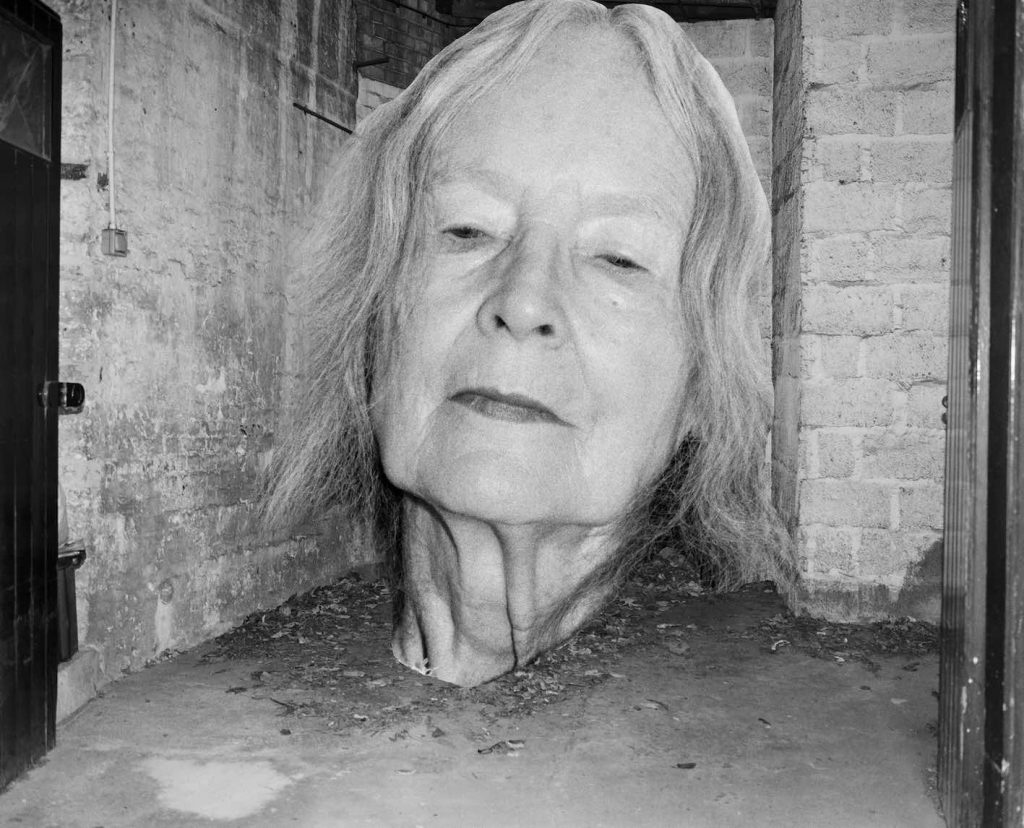
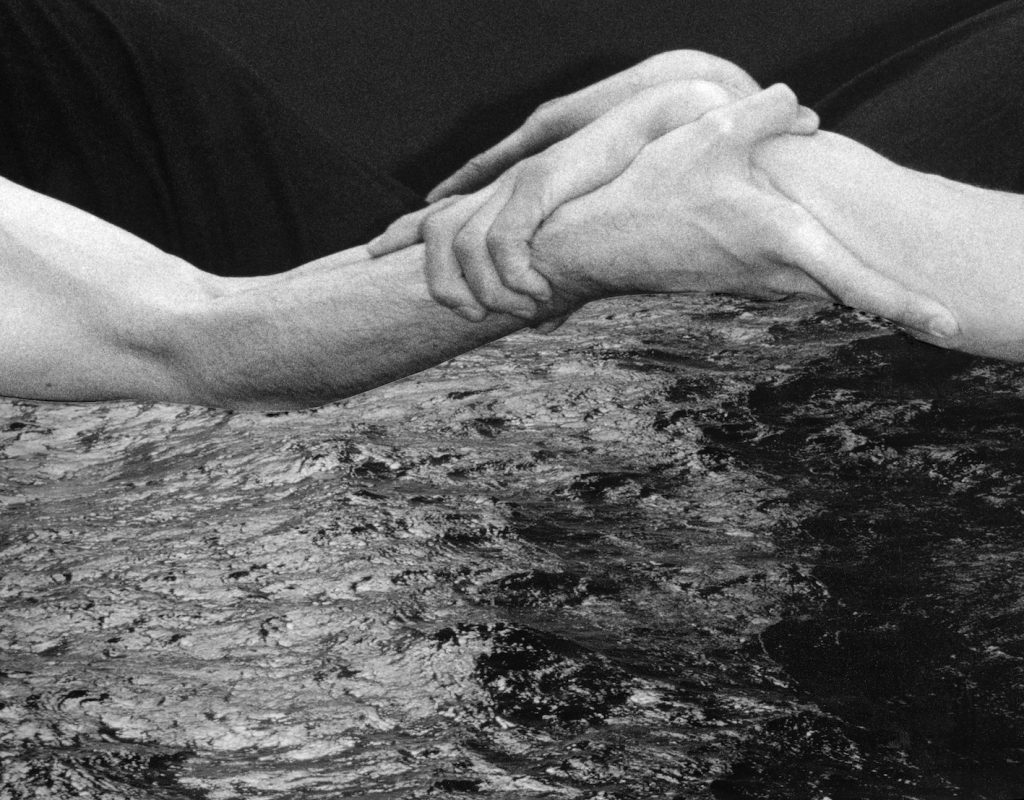
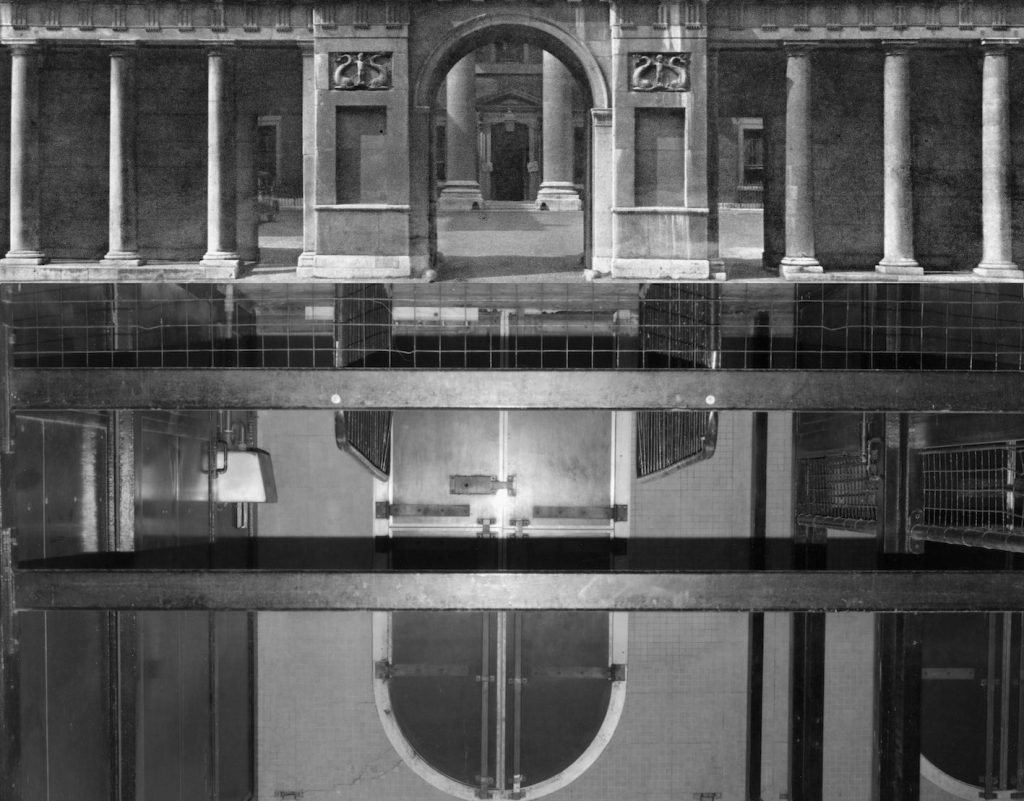
The intricate and searching eye of photographer Joanna Piotrowska is presented this Summer with A moment of darkness at noon. Born in Poland and based in Porto, Piotrowska has an interest in domestic space and human-made environments, “which she pursues through experiments with photography’s expanded field in collage, textile, and the sculptural possibilities of image-making. Her psychologically charged photographs probe human behaviour and the dynamics of familial relations, exploring childhood memories, expression and practices of intimacy.”
In this Scottish showcase, she gathers newly commissioned photographs and collages into a deliberately tuned environment where the domestic becomes shelter and stage. The quiet tension of her perfectly graded monochromes however between memory and gesture. Piotrowska’s subjects are formed from family archives, animal presences and fragments of material form, set in a luminous mid light. Their strangeness as well as the perfection of composition create a compelling pull into the scene she has set.
Joanna Piotrowska, Untitled, 2026, collage, dimensions variable. Courtesy of the artist and Phillida Reid.
Open to coincide within Glasgow International 2026, the exhibition reads as a study in psychic weather, with some reference to Jungian psychoanalysis and a particular focus on intuitive and pre-verbal forms of expressionand some reminiscence of the work of Alain Renais and Chris Marker, the images conjure the everyday and the theatrical simultaneously, hung between exposure and concealment. Images drift into view as though the unconscious has learned to speak through scale, cropping, and proximity, where collage becomes a form of listening. Piotrowska offers no hierarchy of meaning; instead she stages a precise ambiguity in which the self appears as a provisional arrangement, tenderly held and perpetually in motion.
Joanna Piotrowska: A moment of darkness at noon at The Common Guild, Glasgow
Fri 22 May – Sat 18 July
Twin Loves: Dries Van Noten
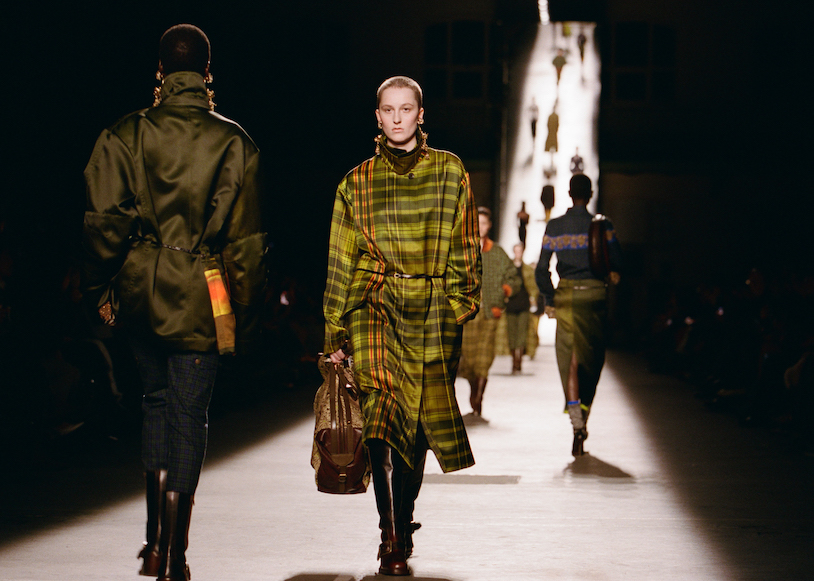
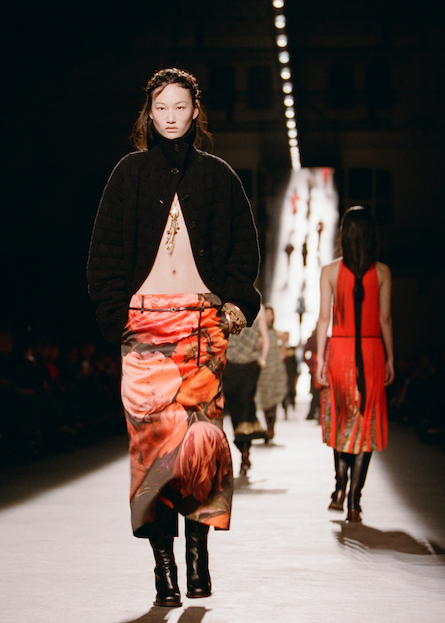
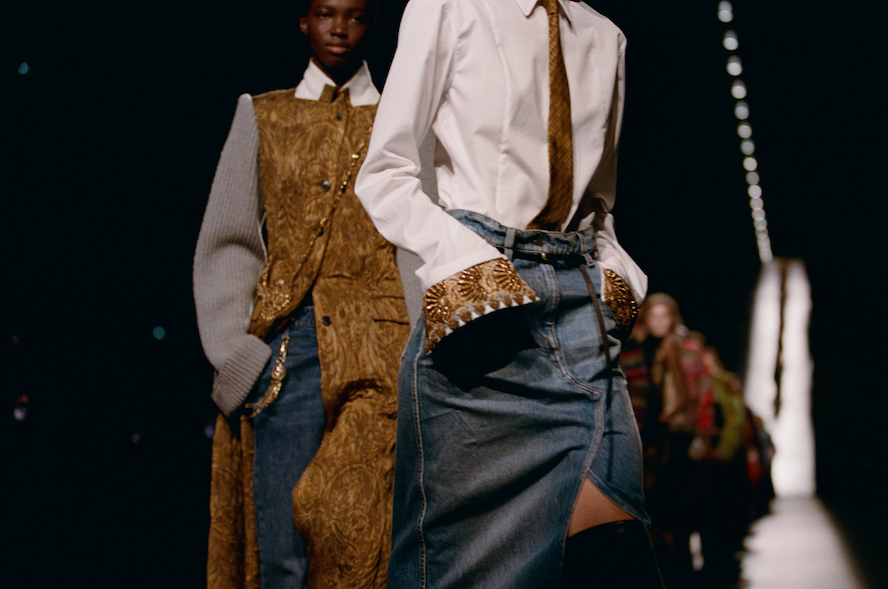
For Autumn/Winter 2026, Julian Klausner chose to open a new chapter for Dries Van Noten by revisiting a location deeply embedded in the house’s visual memory: Lycée Carnot. Longtime followers of the label may recall the brand’s memorable 2009 presentation there, and Klausner echoed that moment by installing a towering mirror at the entrance of the runway.
The reference could easily have slipped into overt nostalgia, a familiar move for creative directors stepping into established houses, but instead it functioned more like a conceptual framing device. The mirror suggested reflection rather than replication, inviting the audience to consider the brand’s history while watching a collection clearly intended to move beyond it.
Ideas of memory, reflection, and transformation, using the metaphor of the mirror as a starting point, translated into clothing that balanced heritage with subtle evolution. Layered textures, rich surfaces, and precise tailoring created depth without overwhelming the silhouette. Instead of leaning on archival reproduction, Klausner distilled the spirit of the label in the thoughtful approach to colour, craft, and fabric, acknowledging the past without becoming confined by it and suggesting a creative direction that respects the house’s legacy while gradually reshaping it for the present.
Twin Loves: Stella McCartney’s Year of the Horse
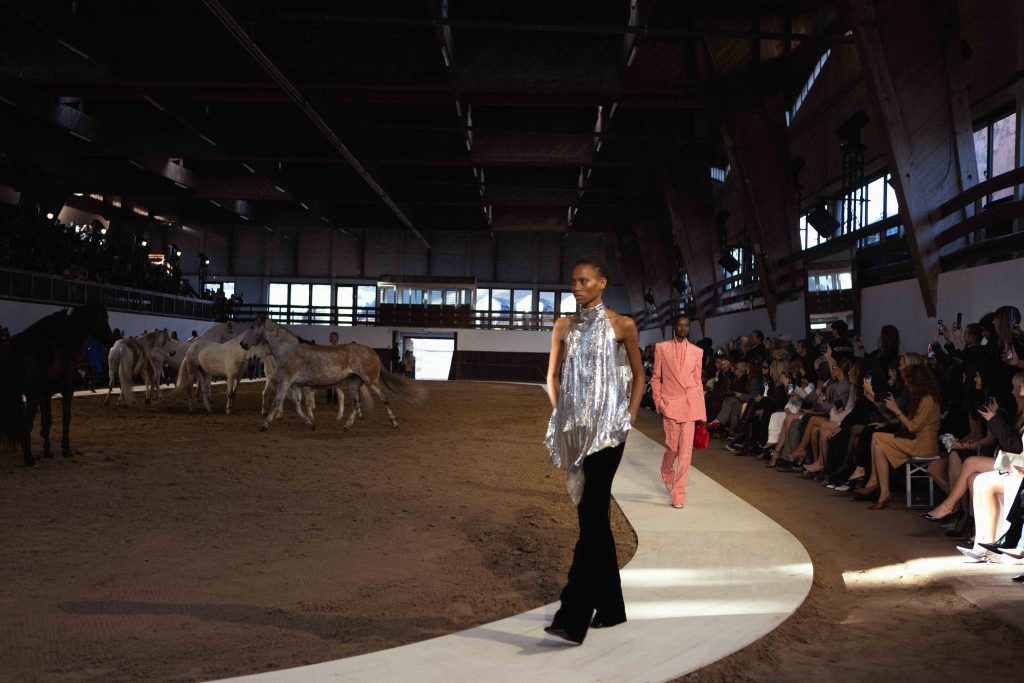
For her Winter 2026 runway show, Stella McCartney brought together fashion, childhood nostalgia and a lifelong love of animals through a collaboration with Hasbro’s MY LITTLE PONY. The show celebrated equestrianism and the spirit of the Year of the Horse, creating a playful and personal moment on the Paris runway.
First introduced in 1983, MY LITTLE PONY has grown into a global cultural icon. Known for its colourful characters and themes of friendship, individuality and kindness, the franchise has inspired generations with its imaginative equine world.
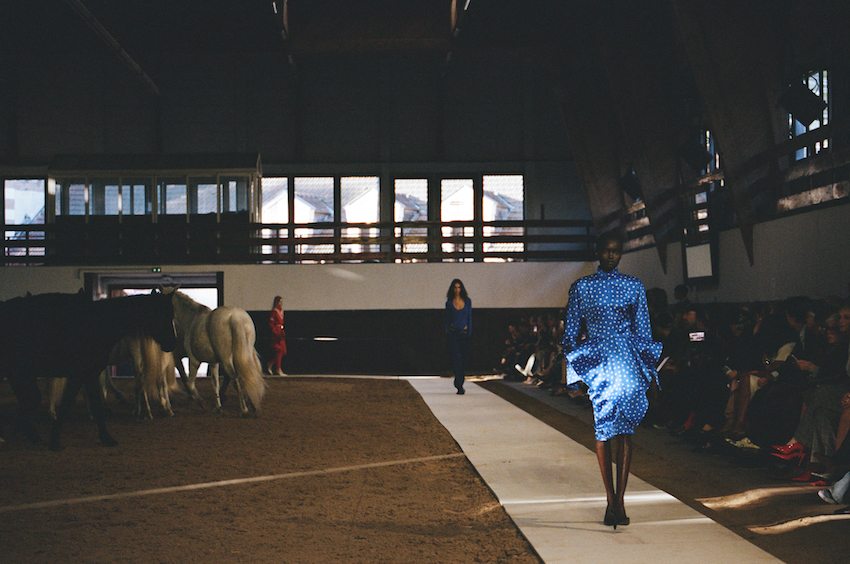
Presented in an equestrian arena in Paris, the Winter 2026 collection reflected key moments from McCartney’s life and career. The British designer drew on memories of a childhood defined by freedom, humour and bold colour, alongside the creative milestones that have shaped her brand into what it is today.
Horses moved through the arena during the show, led by renowned equestrian artist Jean-François Pignon. Guests received retro MY LITTLE PONY toys as invitations, each one finished with a medallion engraved with the Stella McCartney logo.
For McCartney, the collaboration is deeply personal. Her love of horses began early, growing up riding on her family’s farm in Scotland. That close connection to animals and the natural world would go on to shape both her values and her approach to design.
In this collection, MY LITTLE PONY becomes more than a nostalgic symbol of childhood play. Instead, it reflects the spirit of creativity, compassion and individuality that defines the Stella McCartney brand today.
The Winter 2026 collection will be available from July 2026 in Stella McCartney boutiques worldwide, on stellamccartney.com and through selected global retailers.
Twin Loves: Penhaligon’s X Maggi Hambling
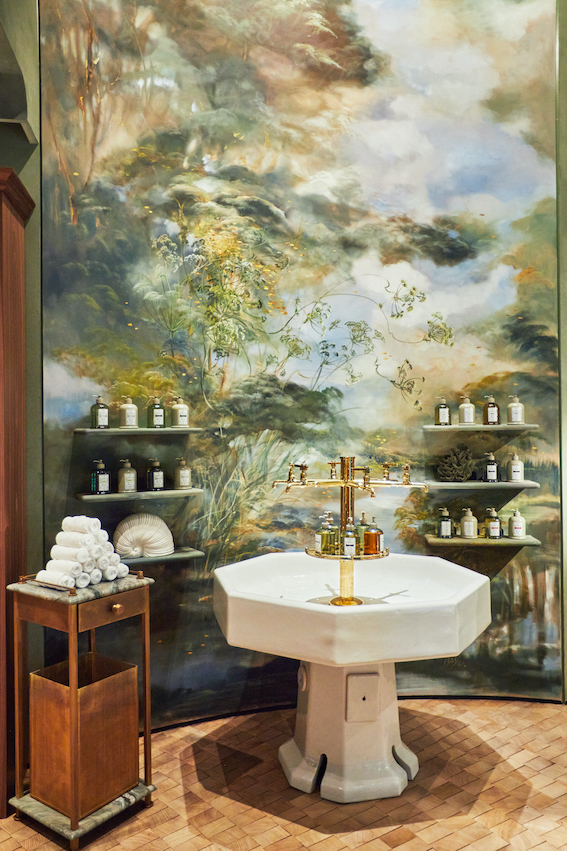
Scent has been firmly back on the fashion and culture agenda this year, with a rise in independent fragrance houses creating innovative scents accompanied by seductive art, design and content, as well as the reimagining of classics. No house could be more classic than icon of British perfumery, Penhaligon’s. After 155 years of perfumed storytelling and desirous design, Penhaligon’s unveiled the grand reopening of its Regent Street flagship, a lavish, visionary refurbishment that looks firmly to the future without relinquishing the past. In collaboration with acclaimed interior architecture studio Michaelis Boyd, the house has created its most luxurious expression to date, in an immersive ode to scent, story and British craft.
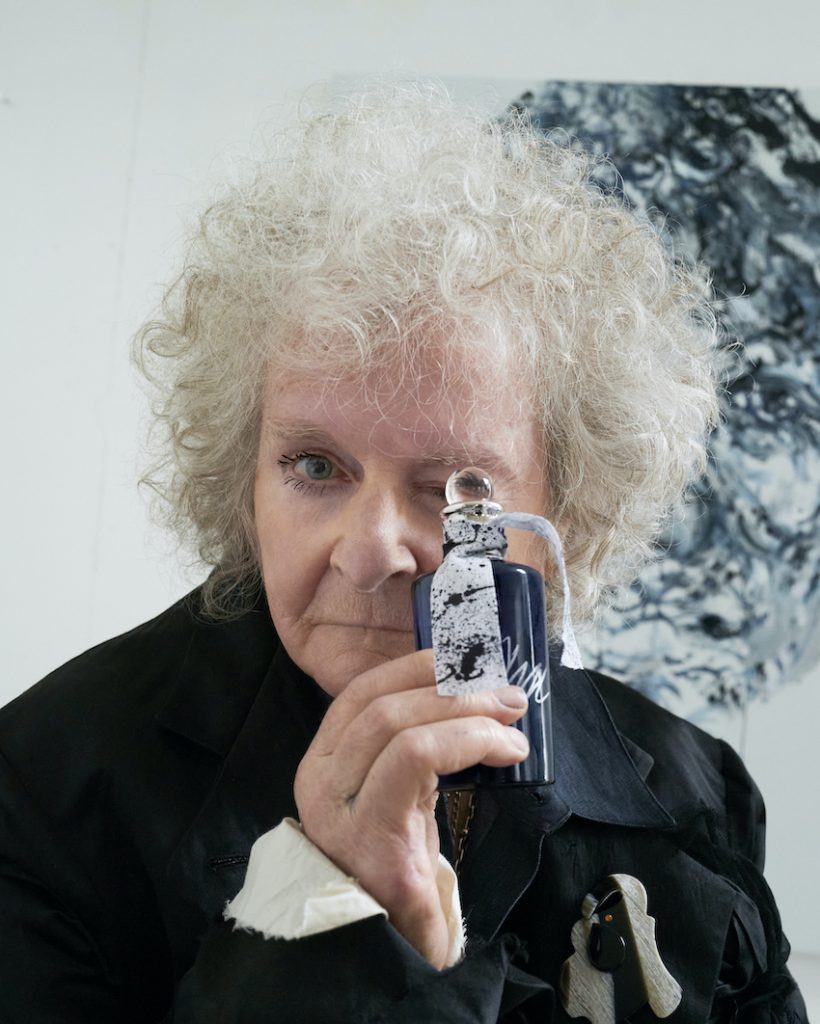
Marking the moment, artist Maggi Hambling reimagines 155 bottles of Endymion Concentré as collectible emblems of a house stepping boldly into its next chapter, each with its own Maggi Hambling ribbon and ink on paper edition.
Craftsmanship anchors the space. A bronze lion-shaped fragrance profiling table by Hamish Mackie commands attention, and a hand-painted mural by Claire Basler evokes pastoral romance. A mosaic entrance by the London School of Mosaic and a bespoke chessboard by Carl Fox and Sofia Karakatsanis extend the narrative.
At the heart of the store design is William’s Green, the brand’s Pantone-registered hue, washing marbles, woods and textiles in a tone that feels heritage-rich and newly assertive. Sustainable, reclaimed materials lend tactile depth, while lighting by Joe Armitage casts a warm, considered glow.
Twin Picks: Declarative Language
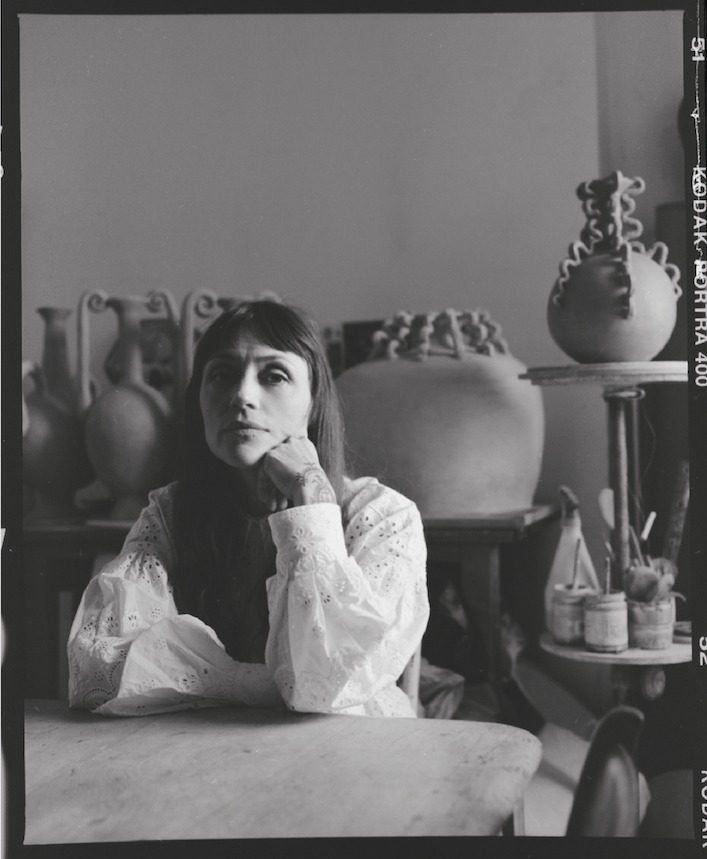
Kelly Jessiman portrait
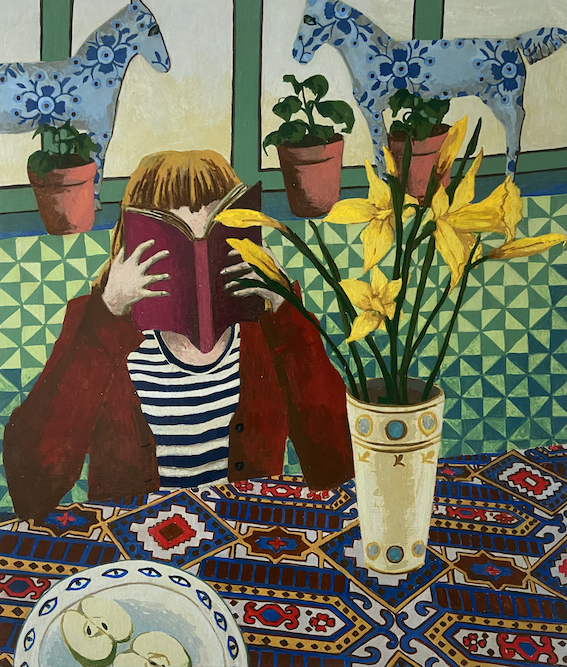
Declarative Language unfolds at Amici Studio as an investigation of care entwined with artistic practice. Co-curated by Kelly Jessiman and Alexis Soul-Gray, the exhibition gathers artists whose practices have been shaped by the sustained, intimate labour of raising neurodivergent children. The show explores how the experience of caregiving, specifically for children with access needs, reshapes an artist’s creative process and “language”. Ongoing conversations between the artists and mothers formed a network grounded in mutual recognition. Insisting on intervention, these practices evolve alongside care rather than in spite of it, where the act of making is also an act of co-regulation.
Kate Montgomery Seedlings and Daffodils
Edie Flowers, Nicola Hicks MBE, Kelly Jessiman, Mindy Lee, Natasha Macvoy, Kate Montgomery, Anj Smith, Alexis Soul-Gray, Maliheh Zafarnezha
Declarative Language: 11 April to 9 May 2026. Amici Studio, 3rd Floor, 12 Claremont, Hastings, TN34 1HA (next to Hastings Library).
Twin Picks: Vivienne Westwood at The Bowes Museum
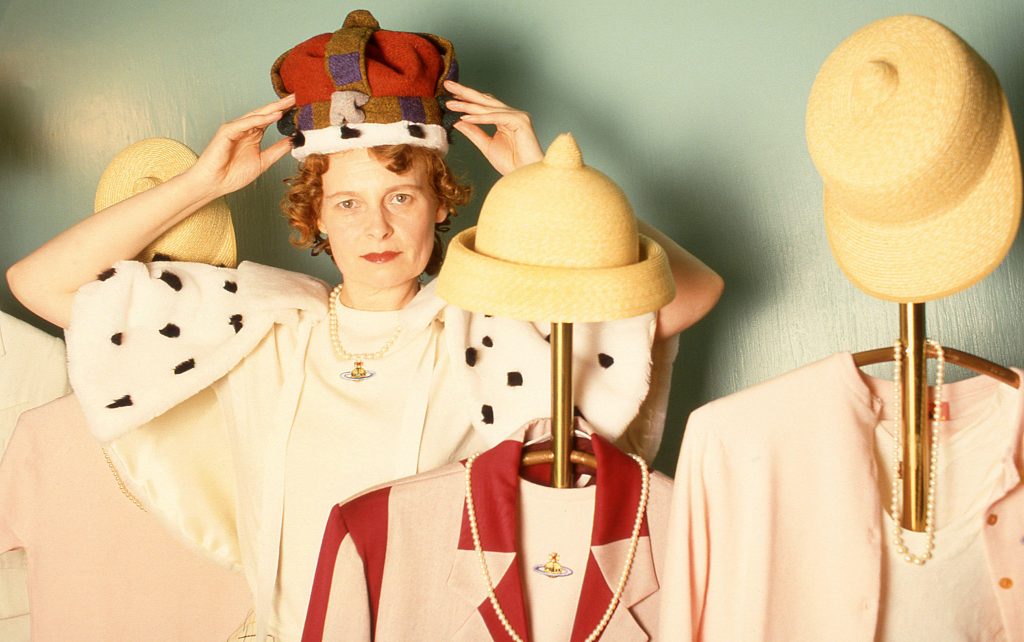
British Fashion designer Vivienne Westwood at her Worlds End Chelsea Store, London, UK, 1987
Vivienne Westwood: Rebel – Storyteller – Visionary 28 March – 6 September 2026
From punk dive to mainstream museum, Westwood’s origin story is now fashion folklore. Born in Derbyshire in 1941, she was a schoolteacher before meeting Malcolm McLaren in the mid-1960s; together they translated the energy of the emerging punk scene into clothes that were ripped, slogan emblazoned and confrontational.
Their London shop — successively renamed Sex, Seditionaries and other provocations became a youth-culture magnet, selling bondage trousers and T-shirts that scandalised the press and sold fast.
That early notoriety sometimes obscures the more surprising turn Westwood’s work took in the 1980s after staging her first commercial collection, Pirates, in 1981, she pivoted toward historical research, drawing on 18th-century painting, British tailoring traditions, period silhouettes and her coveted corsets.
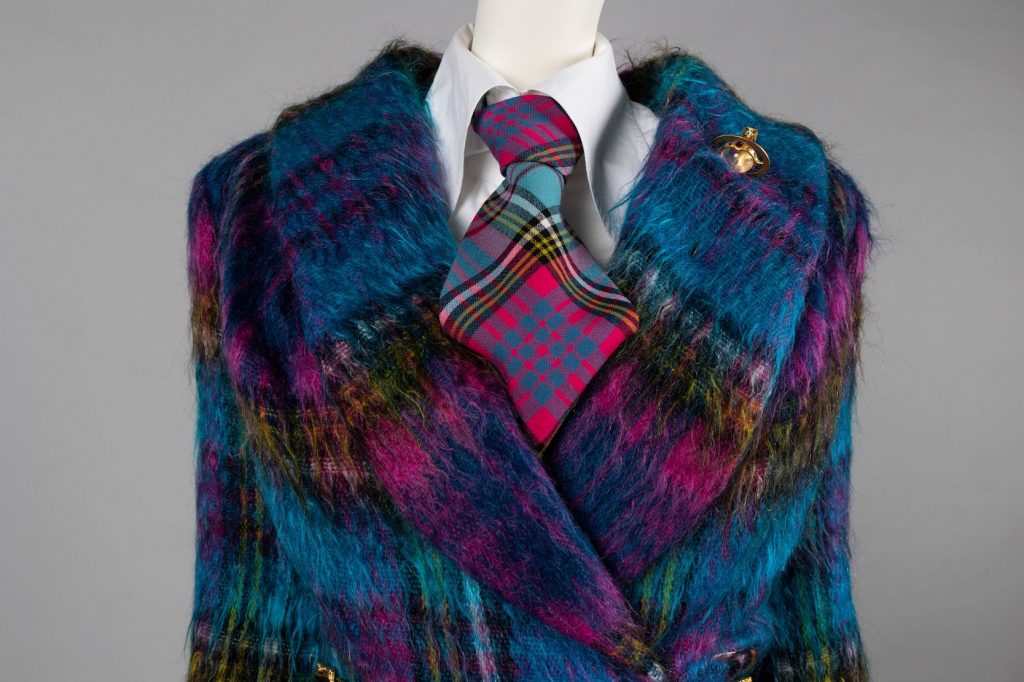
This new exhibition is built around that shift, spanning the early 1980s through the 2000s, it charts how punk rebellion evolved into something stranger and more intellectually layered: couture as cultural commentary.
When the British designer died in 2022 aged 81, tributes described a figure who had reshaped style across six decades — a provocateur whose work fused avant-garde design, political messaging, and the Bowes Museum’s new exhibition, Vivienne Westwood: Rebel – Storyteller – Visionary, leans into her instinctive refusal of norms.
Barnard Castle might seem an unlikely setting for one of fashion’s most unruly figures. But the Bowes, founded on a 19th-century vision of encyclopaedic collecting, specialises in collapsing boundaries between the disciplines of decorative arts, painting, costume and design.
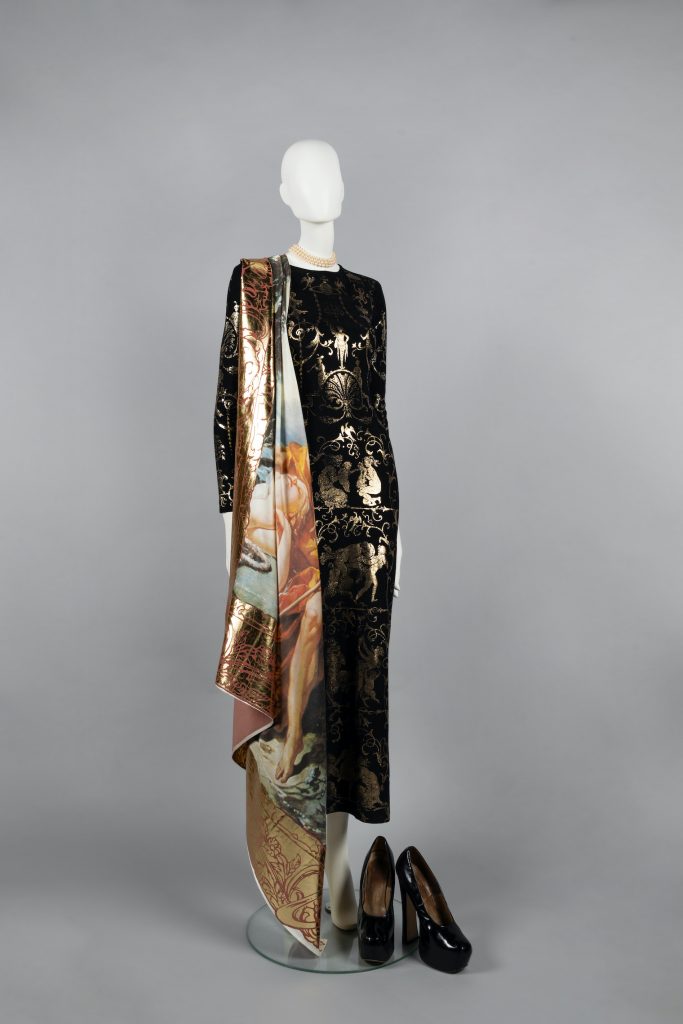
Boulle print dress, Shepherd print gold-framed scarf and patent elevated court shoes AW 1990/91
Rather than present the pieces as relics, the curators foreground process through showing mock-up calico toiles, digitally deconstructed garments and finished ensembles side by side, revealing how Westwood engineered her silhouettes with an emphasis on construction. An intensely technical designer, her experiments with cutting and structure and her attention to how garments are behaved on the body is foregrounded here, as the exhibition pairs her pieces with historical objects from the museum’s own holdings, placing Westwood’s reinterpretations beside the traditions that inspired them.
In that sense, Bowes is an unexpectedly apt host. Westwood’s career was defined by crossing categories: streetwear and couture, fetish and tailoring, protest and luxury. The museum’s decision to build its most ambitious Westwood exhibition yet, following two earlier shows drawn from private collections, suggests a sustained institutional interest rather than a one-off tribute.
The Bowes Museum Newgate, Barnard Castle, County Durham, DL12 8NP
Daily, 10am–5pm
The exhibition is included in general museum admission












 PREVIOUS
 Twitter
 Tumblr
 YouTube
 Facebook
 Instagram
