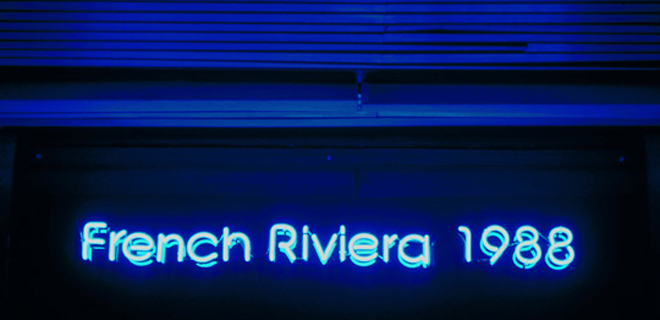
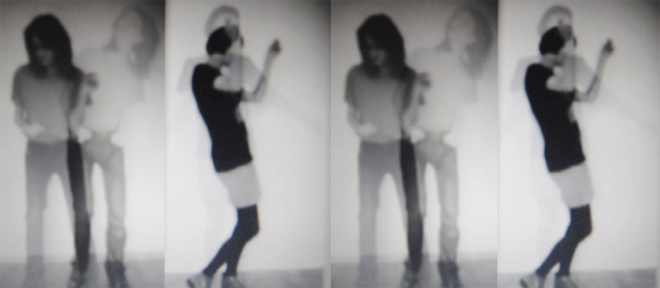
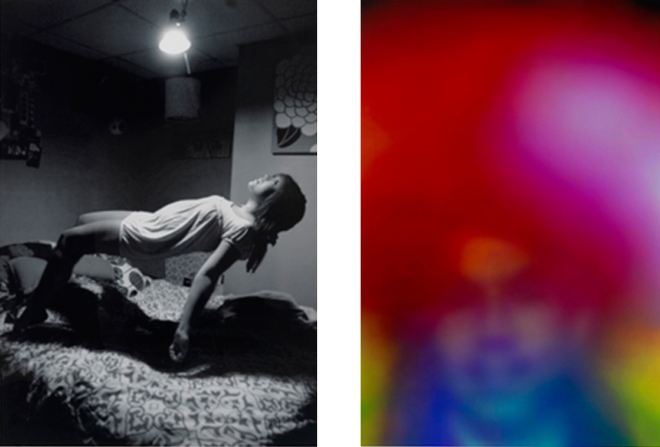
The East End’s newest gallery, French Riviera 1988, opened its doors last night to a packed house. Behind this otherwise inconspicuous neon-lit shop front is the latest project space by the artist duo Samuel Levack and Jennifer Lewandowski. Their spacey inaugural show, Horizon Hypnotique features an ambient collection of distorted photographs, holographic and video works by artists including Alex Ressel, Beatriz Olabarrieta, Lucy Woodhouse and Richard Parry. In-between the crowd, blurred silhouettes of red-hued figures almost dance across the downstairs rooms of the house. The spirit of hazy nights out and their seductive, reckless female stars floods the gallery, and it’s hard not to sway to their invisible beat.
Horizon Hypnotique runs from the 18th February – 13th March 2011 at French Riviera 1988.
Open Friday – Sunday, 12 – 6 pm and by appointment.
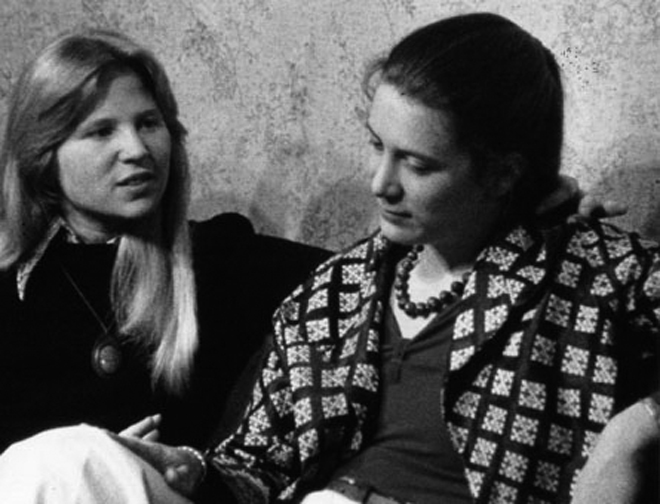
It seems shocking that only one woman – Kathryn Bigelow – has ever been awarded the Best Director Oscar, when you consider that women have been making films since the birth of cinema. It’s that lack of recognition of women in film that drives Cinenova – a volunteer-led collective that’s dedicated to preserving and distributing the work of female filmmakers, artists and activists. This month they’re opening up their impressive archive in an exhibition called Reproductive Labour at THE SHOWROOM gallery.
Films from Cinenova’s collection will be screened daily – it’s a rare opportunity to see pivotal works from the history of feminist, black, queer and experimental film and video. There are silent films from the early days of cinema, documentaries, shorts and feature-length works dealing with themes like post-colonial struggles, domestic work and representation of gender and sexuality.
A quick browse through the 500 titles in Cinenova’s online catalogue threw up some intriguing names: French pioneer Alice Guy is arguably the first ever filmmaker. She directed the 1906 feature The Life of Christ with a cast of 300, and used innovative techniques and special effects. Her contemporary, Lois Weber was Universal Studios’ highest paid director in 1916. She covered controversial social issues like abortion, alcoholism and birth control in films like Where Are My Children?,Hop and The Devil’s Brew (both 1916). One of her most successful films was The Blot (1921).
As well as showing these rare and precious films in their original state, the exhibition has a wealth of fascinating material – photographs, pamphlets and posters – to add some context to the work. The title of the exhibition – Reproductive Labour – also alludes to how much of a labour of love Cinenova is. Run entirely by volunteers, the charity is always struggling for survival and depends on donations for its loyal band of supporters to keep going.
Check THE SHOWROOM’s online calendar to find out which films are being screened and when (theshowroom.org/calendar). Our top picks are Peasant Women of Ryazan on Saturday the 12th February, and Broken Taboos and New Voices in Iran on Wednesday 23rd March at 6pm.
Reproductive Labour: An exhibition exploring the work of Cinenova runs until the 26th March
The Showroom, 63 Penfold Street, London NW8 8PQ theshowroom.org
Words by Phoebe Frangoul
Images from top: Peasant Women of Ryazan by Olga Prebrazhenskaya (USSR 1927) and Daughter Rites.
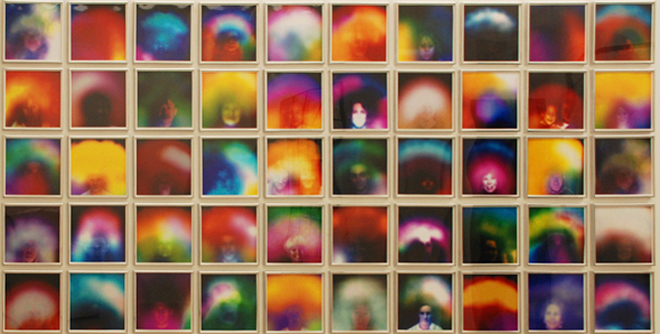
The opening of Susan Hiller’s major exhibition at the Tate Britain makes the London-based artist and her fascination with the intangible teeth marks of superstition in modern culture appropriately omnipresent in the capital.
Meanwhile, Hiller’s solo show An Ongoing Investigation, at Timothy Taylor Gallery continues Hiller’s 30-year study of subliminal psychology. With a typically heterogeneous spread of visual media Hiller exercises her kleptomaniac tendencies by reconceptualising some very familiar works by Joseph Beuys, Marcel Duchamp and Yves Klein.
The psychoanalytical quality of Hiller’s work extends into the mind of the observer – through her studied restaging she re-maps modernist history, poking into our subconscious with a lightness of touch that only an anthropologist could muster.
Facing her work, it’s hard to decipher whether they are homage to a collective genealogy or parody. The Timothy Taylor show is defiantly anti-retrospective: the original works are transformed by Hiller’s strategic impersonation to become living pieces, re-acclimatized within a new century rather than stranded as relics of another era.
Susan Hiller: An Ongoing Investigation is at the Timothy Taylor Gallery from until the 5th March. A major survey exhibition curated by Ann Gallagher is currently taking place at Tate Britain until the 15th May.
Words by Julia Hobbs.
Images courtesy of Timothy Taylor Gallery, London.
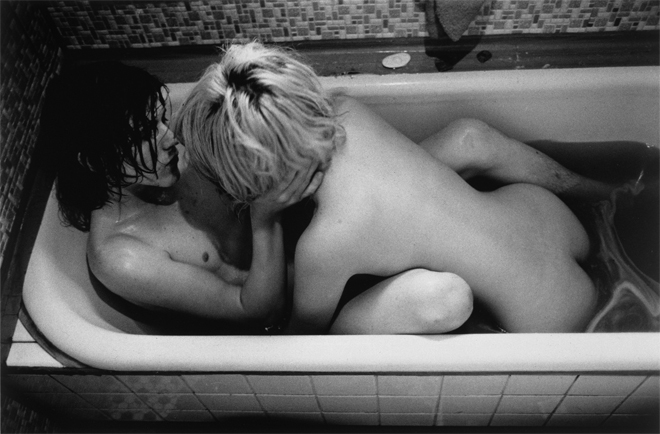
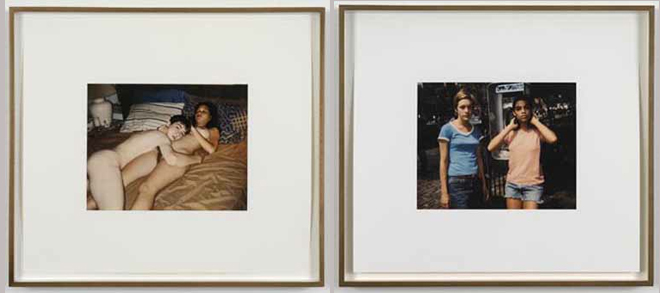
Larry Clark is synonymous with controversy. The word seems to trail the American photographer and filmmaker like a yappy Jack Russell wherever he shows his work. Since the publication of his 1971 book, Tulsa, Clark has been known as the agitator of teenage disorder with images of drug abuse, underage sex and violence. His 1995, Kids, remains the go-to shock film for an unflinching portrayal of teenage-hood.
Now at 67 years-old, Clark has a London show, What do you do for fun?, part-retrospective and part-showcase for new work, it features seminal Nineties shots – from the staged images in his book, 1992, to collages from on the set of Kids.
The show follows Clark’s recent exhibition at the Musee d’Art Moderne de la Ville de Paris, where once again his work sparked controversy when the Mayor of Paris, Bertrand Delanoë, banned anyone under the age of 18 from attending. Clark declared it, “an attack on youth, on adolescents.” Prepare yourself, a contretemps is coming.
What do you do for fun? opens on the 10th February at Simon Lee Gallery
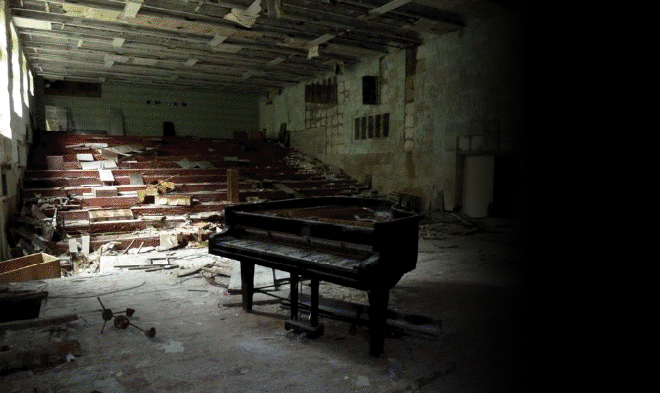
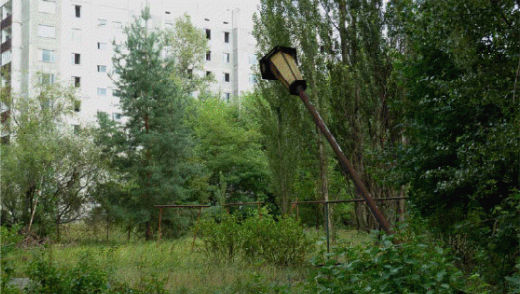
The most recent work of the prolific LA-based video artist Diana Thater transports viewers from within the four walls of Hauser & Wirth’s Piccadilly gallery and into the Zone of Alienation that surrounds Chernobyl’s nuclear disaster site.
Via fragmented footage following wild Przewalski’s Horses, Thater invites viewers into a flickering realm to pose questions about the relationship between man and nature; encasing them within a colourful visual tableau that momentarily distorts perceptions of reality. The video projections that swamp the large blank space are designed to render you online casino bonus childlike, beckoning the realisation that humans exist in this landscape only by implication – through the eroded architecture dotted across the one-hundred mile wide radioactive territory that is navigated during the film. This is not a world that man has abandoned by choice; it is an environment where animals – endangered animals at that – have succeeded humans and thrived. It”s important to remind oneself that this is not an imagined alternate state, but a visceral consequence of our recent history. And yet whilst this is considered Thater’s darkest work to date, it exudes an unyielding optimism that somehow nature will overcome man’s misdemeanours and out-survive us all. And that is a soothing thought.
Diana Thater, Chernobyl is at Hauser & Wirth London, Piccadilly until 5th March.
The aching, fatalistic sounds of musician George Lewis Jr. under the sobriquet Twin Shadow have been steadily engulfing L.A. But with an eagerly anticipated live appearance at London’s Lexington theatre tonight, Lewis’ mesmerizing odes to spirits present and passed are set to make a long-awaited first impression on transatlantic followers.
It’s not only Lewis’ liquescent voice that is the lure; spearheaded by standout track Slow, the album, Forget, is addictive. Crisp, mournful and mid-tempo ballads blur into ticking top online casinos guitar-heavy tracks, creating a debut work that feels almost scientific in its ratio of Eighties New Wave and Brit Pop. It”s a warming blend.
The title track’s crashing beat and distortion spirals with intensity, while the blissed-out scales that rise and fall throughout When We’re Dancing reach biting point with euphoric urgency in At My Heels. Above all, Twin Shadow’s freshness adds a necessary dose of springtime to your playlist. Call it a Twin thing.
Twin Shadow plays tonight at The Lexington, 96-98 Pentonville Road, London.
Download Forget by Twin Shadow at 4ad.com.
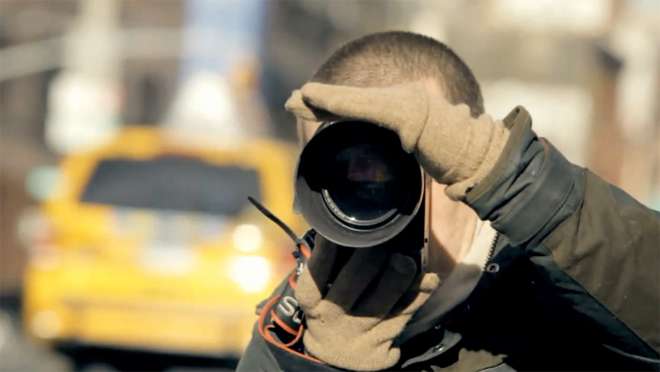
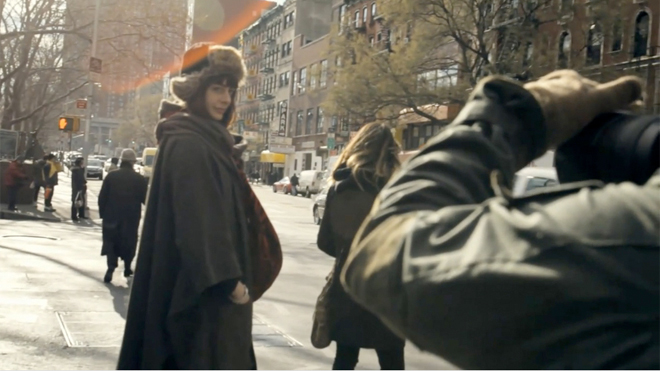
From Henri Cartier-Bresson to Helen Levitt, street photography has always offered viewers new opportunities for people watching. But since the blogging explosion of the Noughties one photographer more so than any other has become synonymous with street style.
The Sartorialist has been name checked in magazines across the globe, and his distinctive style has sparked a thousand copy cats. While you will almost certainly recognise his photographs, which are bathed in daylight and consistent in featuring only the most discerning dressers, you might not recognise the man himself, Scott Schuman.
In a new and fascinating short documentary by Intel, Schuman talks about his work and method. Here he explains the visual elements in his life and his love of taking to the street with just a camera, waiting to be seduced by his next subject.
“It’s so instinctual the way I shoot. The way I do it is just the way I do it. I don’t see 100 images a day that I want to take. I see two or three. So for me, it’s very easy to be patient and wait for those images because that’s just the way I assumed it was going to be.”
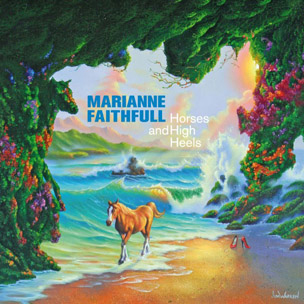
Forty-seven years ago blonde ingénue Marianne Faithfull released her debut single, As Tears Go By. Written by Mick Jagger and Keith Richards, it was the beginning in the making of a rock and roll icon. From Girl on a Motorcycle to the depths of drug abuse, Faithfull has lived life in the fast lane.
Twenty-three albums on and her latest record, released in March, is a rumination upon lost love. Recorded in New Orleans, on Horses and High Heels local musicians and well-known friends – Lou Reed, Dr John and Wayne Kramer from MC5 – lend a hand. “Conventional happiness isn’t my way, you know,” says Faithfull. “But this is a very happy record. I’m not depressed any more. And I think it’s all been well worth it. I did have a bit of a bad time in the Seventies but I think things have been wonderful. So I suppose this album is a bit of a breakthrough.”
Listen to the first track of the album Horses and High Heels at mariannedownload
Aesop is the cultiest of cult beauty brands. Resolutely highbrow, their products are emblazoned with quotes from the likes of Genet, Jung and Gertrude Stein. Interesting architects are co-opted to design all their stores – Rodney Eggleston of March Projects was enlisted for the recent Rue St Honore boutique in Paris. And all three of the London stores – Westbourne, Shoreditch and Mount St are worth visiting to peruse their bijou range of products.
If you’re feeling particularly indulgent Aesop’s Saint Honore skin care kit is especially investment worthy. At £167 it doesn’t come cheap, but inside are a trove of delights for cleansing, toning and moisturising – all including their wonderful Parsley Seed formulation which is high in environmentally protective antioxidants. Aesop tend to use a fusion of hi-tech and natural ingredients in their products making them very au courant: hi-tech naturals and organics are currently the hottest things in skincare.
If you’re on a budget start with something like their Fabulous Face Cleanser with Aloe Leaf, Bergamot rind and Green tea, its mild gently foaming and suitable for most skin types. Or try their Violet Leaf Hair Balm a floral smelling ointment to groom smooth and soften difficult hair. The Aesop website – aesop.com.au is also great for tips on where to eat, places to visit, books to read and art too see. Is this the most cultured beauty brand in the world?
Soul Jazz Records founder Stuart Baker and tastemaker Giles Peterson have put together a stunning visual history of the Brazilian bossa nova scene. Bossa Nova and the Rise of Brazilian Music in the 1960s features cover artwork, artist’s biographies and essays on a musical movement that’s a fascinating insight into the changing social climate of Sixties Brazil.
As Rio developed into an urban society, with ‘apartment living’ and consumer goods, bossa nova projected an image that was modern, sophisticated and cool. At the time Brazil’s newly elected president promised the country, “fifty years of progress in five.”
It was the modernist architecture of Oscar Niemeyer, which dominated this fresh vision of the capital, that inspired much of the bossa nova movement’s cover art. The record sleeve designs, like the country, were radical, innovative and exciting. While Bossa Nova quickly became a musical phenomenon with Astrud Gilberto and Stan Getz’s The Girl from Ipanema an international hit, by 1964 the period of Brazilian optimism was spent, and the country fell under the rule of a violent military dictatorship that would affect the lives of ordinary Brazilians – and the music – for the next 20 years. More than another graphic sourcebook of sublime modernist design for your coffee table, Bossa Nova and the Rise of Brazilian Music in the 1960s, is a snapshot of the vivacious bygone era behind the beat.
Bossa Nova and the Rise of Brazilian Music in the 1960 is available now from, Soul Jazz Records, and the accompanying album will be on sale from the 24th January.
Art students have long been relied upon to inject an irreverent attitude into the music industry and Chicks on Speed are no exception. Since 1997 the transnational collective have mashed-up performance art and music while continually smashing through clichés of femininity.
Their song We Don’t Play Guitars typified their DIY post-punk aesthetic and while they found a home within the Electroclash movement of the early Noughties, they remained joyously un-boxable. The group, aka Melissa Logan, Kiki Moorse and Alex Murray-Leslie, opened for Kraftwerk, released albums, designed clothes, appeared naked on stage and achieved cult status.
For their latest show, HAPPENING, they present sculptural objects that double as stage show props. From wearable guitar shoes with sensory strings to cigar box synthesizers, they twist the conventional band into a work of art. Each object plays upon male fetishes and in particular their DayGlo plastic stiletto is an ironic take on the cliché of male rock gods hammering out guitar chords.
With the spirit of Dadaism and the energy of anarchism Chicks on Speed continue to live in a world where what the lady wants, the lady gets on and does.
Chicks on Speed: HAPPENING is at Kate MacGarry gallery until 30 January 2011 katemacgarry.com
Tucked down a side road in Dalston, in a 6000sqft basement is Late Night Chameleon Café. Known by the acronym LN-CC the self-proclaimed ‘retail concept’ opened its doors this month.
The store is the brainchild of former Selfridges and Harrods buyers John Skelton and Daniel Mitchell who enlisted Twin favourite, set designer Gary Card to create the rabbit-warren interior.
A cylindrical corridor leads to the three fashion rooms showcasing the best of cult fashion design. In one room Damir Doma, Rick Owens and Ann Demeulemeester are ready-styled on mannequins or hanging from suspended rails. Emerging brands like Nonnative and SASQUATCHfabrix are in another while in the third room Raf Simons sits alongside Lara Bohinc and Mawi.
There is a fourth ‘Celestial’ space full of rare art, fashion books and records. All the favourites are here and then some: Jean-Michel Basquiat, Phyllis Galembo, Maison Martin Margiela and Harmony Korine.
But it’s the details that set this boutique apart from other retailers. The brands are carefully handpicked, cleverly edited and curated so that the space feels more like a gallery than a boutique. Built-in benches encourage thorough perusal of the records and art books. Oh and did we mention the changing rooms are on wheels?
LN-CC is a shopping landmark in the making; book your appointment now.
Since the Seventies artist Cindy Sherman has successfully used her own image as her canvas without revealing her true identity. Though the artist is her own sole subject, her photographs are a world away from atypical self-portraiture.
A consummate performer, over the years Sherman has cast herself across the gamut of female identities – from Playboy centrefold and clown, to ageing American socialite and B-movie star.
For her latest turn at Spruth Magers in London, Sherman’s image is again central, but hidden. This time under a fresh array of bizarre costumes and ridiculous personas. Departing from her usual framed photograph format, she has embraced digital techniques, casting her eccentric characters onto large toile style murals, reminiscent of French parlour wallpaper.
Sherman’s surreal universe is populated by dowdy middle-aged women with broken ankles, and naked female warriors whose comedic appearance is at odds with the bucolic backdrop. Disturbing AND funny. This show is not to be missed.
Cindy Sherman is at Spruth Magers London from 12 January- 19 February spruethmagers.com
When Allen Ginsberg first performed his epic hallucinatory poem Howl in 1955, it was seen as the desolate cry of an awakening counterculture. A 3600 word hymn to drugs, jazz, love and lust that defined the Beat Generation.
“Angelheaded hipsters burning for the ancient heavenly connection to the starry dynamo in the machinery of night, who poverty and tatters and hollow-eyed and high sat up smoking in the supernatural darkness of cold-water flats floating across the tops of cities contemplating jazz.”
Ginsberg evoked the atmosphere of William S. Burroughs’ Junkie and laid the perceptual path for Jack Kerouac’s On The Road (picture above). But long before their literary apotheosis these Fifties radicals were for him, simply, “a bunch of friends looking to get published.” During those early days Ginsberg often photographed his contemporaries – young dispossessed men that would go on to define the subterranean era.
This January, a selection of Ginsberg’s images will be exhibited at the National Theatre in London. While the exhibition charts the infaltration of the Beats into the mainstream literary consciousness, it’s also a healthy reminder of the potency of youth.
Angelheaded Hipsters: Images of the Beat Generation is at the National Theatre from 24 January – 20 March 2011 nationaltheatre.org.uk
It’s your last chance to see Graham Little’s virtuoso drawings at the Alison Jacques Gallery this weekend. His pencil on paper portraits inspired by old fashion magazine shoots are beguiling and romantic. Taking inspiration from the pages of vintage Vogue and Harpers, Little breathes a painterly quality into what were once glossy photographs. In doing so, he transforms fashion models into timeless beauties.
Little’s muses are all about muted colours and thoughtful gazes, proving that even in our crowded visual world we can still unearth new stories and narratives from archival images. These softly feminine women live in a world outside of fashion and time. Catch them before they disappear.
The interface between literature and perfume has never been exploited fully by perfumers until very recently. Perhaps it was only natural that Frederic Malle, who has always described himself as a perfume ‘publisher’ and his noses as authors, would be one of the first to exploit the connection. His latest fragrance ‘Portrait of a Lady’ (nose: Dominique Ropion) is just the sort of elevated, elegant and cultivated oriental that the heroine of Henry James’ 1881 novel, Isabel Archer, might have worn as she undertook her grand tour of Paris, Florence and Rome. Malle describes the smell, a composition including rose essence, cinnamon, clove, patchouli and incense as, ‘aristocratic’. And it certainly has an archness, a transcendence, a haute couture poise about it.
Compare and contrast with Byredo’s ‘Baudelaire’, inspired directly by the olfactive ambience of LesFleurs Du Mal, which has juniper berry, black pepper, incense, leather, patchouli and black amber in its saturnine pasticcio. Like Malle, Byredo’s Ben Gorham comes across as something of a bibliophile – he has a scented candle in his collection called ‘Bibliotheque’ with peach plum, violet, leather and vanilla numbered in its accord. A gorgeous scent to waft around in the environs of your old books.
Frederic Malle ‘Portrait Of A Lady’ is £115.00/50ml from Les Senteurs (020 7730 2322), lessenteurs.com and Byredo ‘Baudelaire’ is £115.00/100ml from Liberty (020 7734 1234), liberty.co.uk
Twin“s fashion director Celestine Cooney finds her way onto Vice Style“s new “Love Blogging” short film series. We might be biased, but we think it”s really bloody good.
Celestine teams up with fresh-faced bloggers Alice, Letty & Lousie (pictured above), who have cleverly used their own eponymous blogs to launch play casino their HOT & COOL fanzine….
As promotional stunts go, Nike’s Destroy to Create campaign rules. Corralling a whole gang of contributors – many of them (like Harry Malt) from the Twin family – to be a part of a special merger of art, sport, music and mayhem marking the launch of their Destroyer jackets. Lucky for those who weren’t there to see the chaos unfold on the night, Niall O’Brien filmed the proceedings.
The ‘Destroy to Create’ artworks are currently on show at 1948, Arches 477- 478 Batemans Row, Shoreditch now.
We are near saturation point when it comes to pop-up shops, but have an insatiable appetite for pop-up art spaces. Flash Projects is the latest photography project from the really rather good James Hyman Gallery, who consistently impress with their selection of vintage photography (take this paparazzi shot of Bridget Bardot, top). Now, the gallery will take their archive of prints on the countercultures of the Fifties through Seventies to spaces all over London with exhibitions and limited-edition sales.
Flash Projects’ delicious debut is a collaboration between photographer and artist Jean Clemmer and Franco-Spanish couturier Paco Rabanne entitled, Canned Candies The Nudes of Jean Clemmer (images above and below), a body of work originally produced in 1969. Rabanne’s wicked ‘unwearable’ fashions, crafted from unconventional materials like metal, are the perfect match for Clemmer’s hazy aesthetic. The little-known Clemmer (1926-2001) was immersed in painting, music and photography, and worked as Salvador Dali’s personal photographer for two decades.
The photographic series is seemingly bathed in a silver glow, and recalls the sci-fi spirit of Barbarella (1968), for which Rabanne was costume designer. Clunky chainmail get-ups deemed risqué at the time seem just as modern and fresh now (see young designer Fannie Schiavoni’s chainmail harnesses Fannieschiavoni.com). Canned Candies is a climatic collection that’s the result of an early art and high fashion clash. Invest now.
Canned Candies. The Nudes of Jean Clemmer runs from the 26th November – 18th December at Flash Projects, 8 Kingly Street, London W1B 5PG. flash-projects.co.uk
Francesca Woodman took her first photograph aged 13. The self-portrait reveals a young woman bathed in light, with her face averted from the cameras’ gaze (below, top left). Despite her years, the image set the tone for the remainder of a brief, but brilliant photographic career.
Woodman studied at the Rhode Island School of Design from 1975 – 1979, producing a prolific body of work. A solitary figure in life and art, she was the frequent, lone subject of her images. Before her untimely death, when she jumped from a Manhattan high rise at the age of 22, Woodman generated an archive of 800 images. This week a number of them go on show at the Victoria Miro gallery in London, including rarely seen colour works. The exhibition is a taster of a major retrospective at San Francisco’s MoMA, which ultimately lands at the New York Guggenheim in 2012. Such mainstream recognition has taken time, though Woodman’s contemporary influence spans from Cindy Sherman to Nan Goldin. This is a show that doesn’t need to shout, it very quietly commands the attention.
Francesca Woodman is at the Victoria Miro until 22nd January 2011 Victoria Miro
All images: The Estate of Francesca Woodman, Courtesy George and Betty Woodman and Victoria Miro Gallery.












 PREVIOUS

 Twitter
 Tumblr
 YouTube
 Facebook
 Instagram
