27.02.2018 | Art | BY: admin
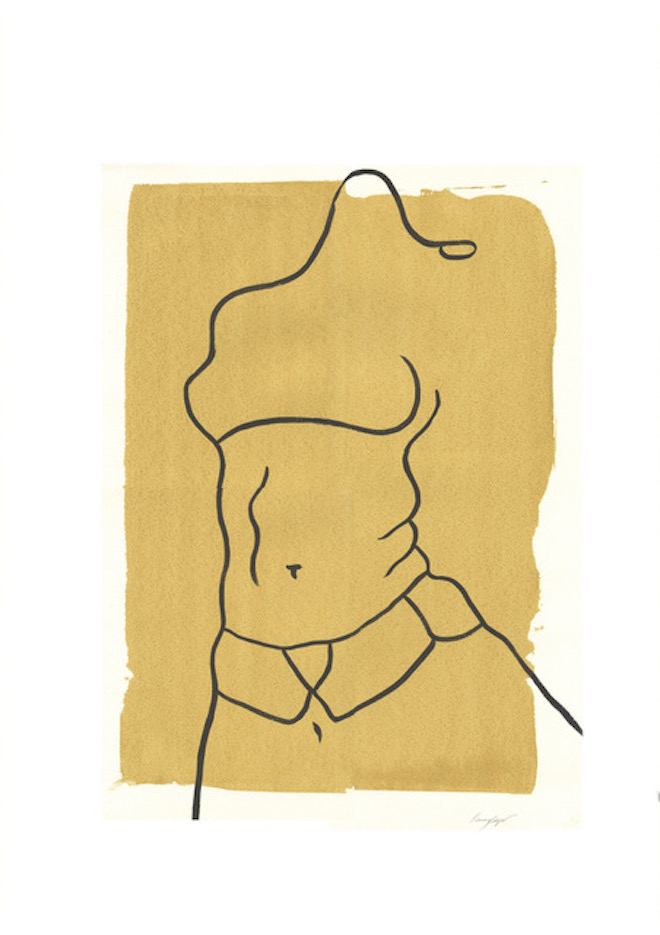
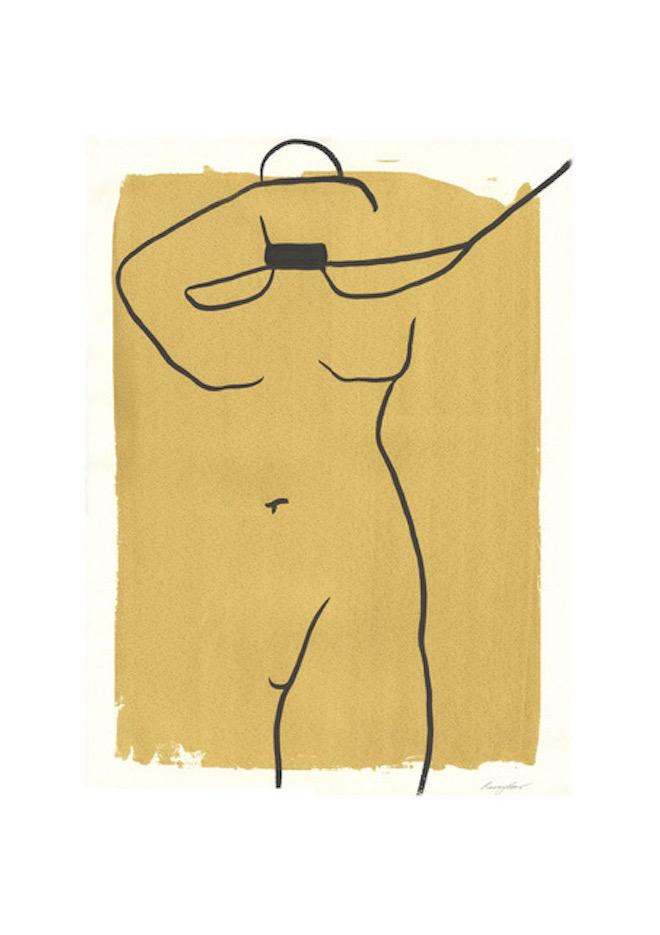
Artist Ranny Cooper examines and explores the female form as a way of addressing issues around self identity and discovery. She shifts our usual associations away from sex and provocation and asks us instead to focus on the ways in which the body is bound in objectification and intrusion, yet also in admiration and desire. Cooper uses her own body as her muse as it has been a positive way for her to address the issues she faces with her own body politics. Inspired by Jenny Saville and her portrayal of the body and all of its fluid forms, Cooper enjoys celebrating this idea of the grotesquely beautiful. In her series ‘Unbound’, the minimal, fluid lines and colours of Cooper’s mix media drawings offer a thoughtful and sensitive representation of the female form. Her use of leatherwear highlights the friction between submission and empowerment as she depicts the action, restrictions and effects of harnesses as a means of representing the duality of lust and scrutiny that women’s bodies are subjected to.
Ranny Cooper, Unbound
Originally from Brighton, Cooper has been based in East London’s Hackney for the last five years, where she spent the first three at London College of Fashion studying Fashion Illustration. The product of a rather bohemian and idyllic childhood, Cooper thinks this may be where her openness towards nudity came from and why she doesn’t feel that her sexuality defines her. I don’t know if I am defined by my sexuality, but know that I address it very boldly. I have always been very sexually open with my body. I grew up in an extremely naked household – it is a good way for me to express how I am feeling as a women. A lot of people see my work and think of it in very black and white terms, as simply sexual, open and in your face. But when you understand the meaning behind it, it is actually very personal. So, it is about sexuality but the point is there is also much more behind the surface.
Cooper acknowledges that the personal element to her work is varied depending on the series she is focusing on. While she always uses the body as her canvas and main subject, the motives behind her use of it are diverse.With my body print series I was expressing different emotions that I felt when I was life modelling. When you are exposed to a crowd of people and you are nude it encourages a range of emotions and I would find so many different thoughts running through my head. It really does boil down to each individual pose having a unique emotion that comes with it. Then when it came to my series ‘Unbound’, I was addressing the misconceptions people often have around sexuality, especially when it comes to the use of leather and harnesses. I involved the harness as a means of highlighting the importance of control for women when it comes to their bodies, which can be both a positive and negative in todays society.
Over the last few weeks, Cooper has started working on a new project, ‘Dismemberment’. In this series she fragments the body. The project merges different parts of the anatomy to explore the cross section between where the human form goes from the sight of desire to the sight of grotesque. Cooper explains how she is taking a new direction with her use of the body as a canvas and her growing obsession with how different angles can make the figure look almost distorted. This project is a little less sexual in a way as it focuses on dismembered and deconstructed figures. I have always been interested in the body looking distorted and out of worldly in a way, which transpired into this idea of how the body can go from a site of desire to a site of grotesque. With this project I still use the naked body but by dismembering it I wish to express the chaos we are often faced with when we let our thoughts run away with us, highlighting the confusion and madness that the mind often provokes.
As Cooper readdresses her practice through the altered perception she now places on the body, she discusses how she defines beauty:
I believe that it is completely in the eye of the beholder. I don’t think there is a typical ideal of beauty. For me, beauty comes from weakness and imperfection. Like art, it is totally subjective and I really don’t think it can be defined any more. Obviously you have ideals that the media represents to people of how we should look, which is a big issue. When I started doing such figurative drawings, initially I focused on slender beautiful women but gradually this made me feel more and more uncomfortable so I started using myself as my own reference – that really made me target issues I had with myself and helped me come to terms with them. I don’t think beauty is a definition I think it is a perception.
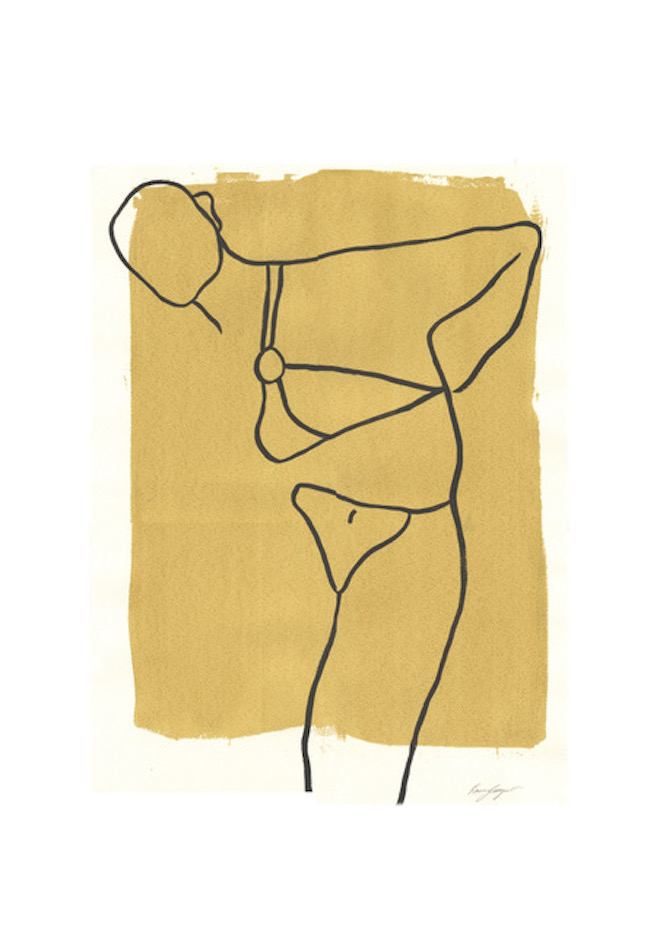
Ranny Cooper, Unbound
With this idea of beauty as perception rooted in subjectivity, Ranny explains how Hans Bellmer, Louise Bourgeois and Jean Cocteau have been lifelong inspirations for her. Likewise, the minimalist linear drawings by Austrian artist Egon Schiele and Mapplethorpe’s fetishistic yet sensual images have been important artistic sources. More recently, she credits the work of photographer Maisie Cousins, whose zoomed images of the female body taken from the series ‘grass, peonies, bum’ are some of her favourites. While Ranny is keen to explore the possibility of living somewhere like Berlin, given it’s notably liberal attitudes within youth culture, she has decided to dedicate the next two years to nurturing her practice here in London. Ranny Cooper will be showing her new series ‘Dismemberment’ at Cafe 119 throughout April. In the meantime, you can follow her practice and intense obsession with poached eggs via her Instagram @rannycooper.
Tags: Art, Ranny Cooper
17.01.2018 | Art | BY: Sarah Roberts
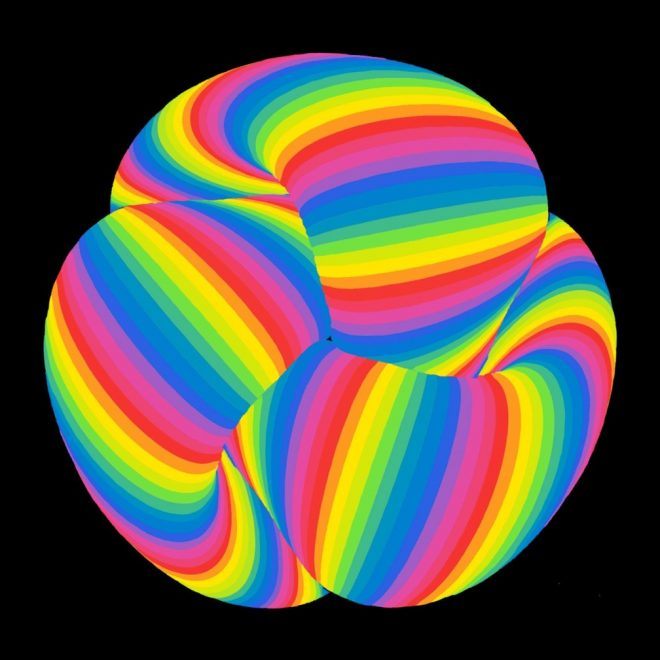
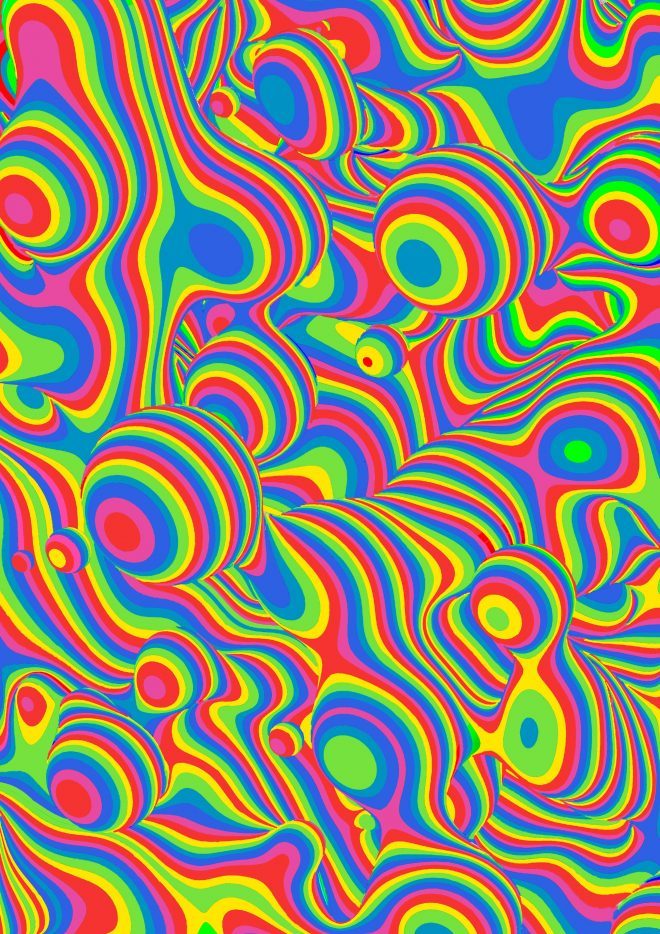
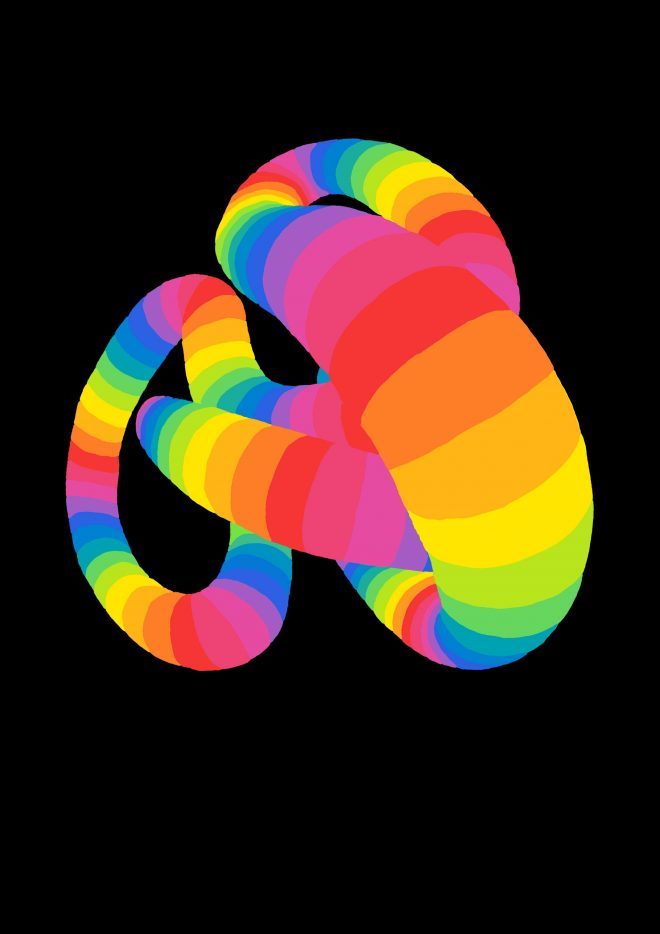
From the 18th January until the 25th February 2018, the Zabludowicz Collection will host Siobhan Coen’s Unknown Knowns, an installation featuring the voice of former US Secretary of Defense Donald Rumsfeld, alongside LED pulsating light that saturates a large print of brightly coloured pixels, creating a hallucinogenic work that is both seductive and destabilising.
Siobhan Coen focuses her work on the function of the human mind. Her research into scientific theories of consciousness and perception is brought into dialogue with social realities, and her examination of neurological, technological and political information-filtering makes her work particularly relevant. We spoke to Siobhan about Unknown Knowns, the inclusion of political figures in her work, and her artistic methods.
Can you tell us about your piece Unknown Knowns?
It’s an evidence-based fiction. I have re-edited the voice of Republican Donald Rumsfeld from his audiobooks, extracting abstract statements until they suggest a narrative. Rumsfeld emerged as an aesthetic philosopher-type character intent on changing the way we see. The audio is combined with pulses of programmed RGB lights that animate a panoramic pixelated print, creating an illusion of movement.
How has the work of artist Brion Gysin informed your practice?
I had always felt a bit short-changed by how little of the information we receive through our senses actually makes it into our consciousness. I read a study by Professor David Nutt, which found that taking hallucinogenic drugs reduced this unconscious brain filtering. Subsequently, I was drawn to Gysin’s Dreamachine – a device for inducing hallucinations from flickering light effects – as a way of accessing all that missing data, and also to explore the possible psychedelic effects of reduced information filtering in society. I have also been influenced by his cut-up technique, a method of rearranging text in order to find truth.
How does your work examine visual perception and unconscious control?
I rework the component parts of digital communication – RGB light, pixels that make up images, and the words of those with the loudest voices – to examine how their qualities rather than subject matter, might affect us beyond our conscious awareness. Questions of how human perception can be manipulated and altered are pretty timeless, and I hope my project is open enough to relate to different cultural and technological moments. In fact, I’m drawn to how these things can be cyclical. For example, Steve Jobs believed that the feeling of connectedness from taking LSD in the 1960s allowed the internet to be imagined. And the internet now seems to be producing a slightly hallucinogenic effect by reducing information filtering. There’s a looping of cause and effect.
What methods do you use to create tension between form and content?
I try to edit the voice so that it sounds believable, in order to highlight how form rather than content can determine what we perceive to be true. But also, the process of maintaining speech rhythms prevents me from imposing my thinking. I find that both the narrative and visual elements become largely dictated by the form rather than the content of the writing. Rumsfeld’s books were full of proclamations and advice, they had a quality of persuasion or seduction that suggested projection to an outer world in order to change it.
How do you put the audio and visuals together to create the final piece?
I create the audio and visual elements in parallel so that they feedback into each other. I find it a way of exploring my interests through a system of embodied cognition, rather than doing so purely intellectually.
How do you choose which political figures you want to incorporate into your work?
I first used the voice of Tony Blair from his audiobook A Journey (2011) – he just struck me as someone who had seen things that weren’t there, so he was a good figure to talk about my interests. In my research I became interested in the political rhetoric of that era, the turn of the millennium, as potentially the beginning of the post-truth phenomena that surrounds us today. Rumsfeld’s abstract language stood out as something very particular however, in the way he deployed it to defocus attention.
What do you hope viewers will take away from the installation?
I hope the piece offers a refocusing of attention, and a shifted view of material that might feel at first familiar. I think of the project as being about truths hiding in plain sight. And at the very least, visitors get to take away a printed transcript if they wish.
Zabludowicz Collection Invites: Siobhan Coen, 18 January – 25 February 2018, Zabludowicz Collection, London, www.zabludowiczcollection.com
Tags: Art, Feminism, Siobhan Coen
30.11.2017 | Art | BY: admin
A graduate from Royal College of Art in 2016, artist Nadine Shaban works across fashion, sound and performance to create idiosyncratic works. Having recently teamed up with Axel Arigato for a new exhibition in the brand’s Soho space, Twin caught up with Nadine to talk about approaching space, working in flux and externalising emotion.
Your new exhibition is entitled ‘Let Me Breathe’ – what inspired this title, and what were you responding to?
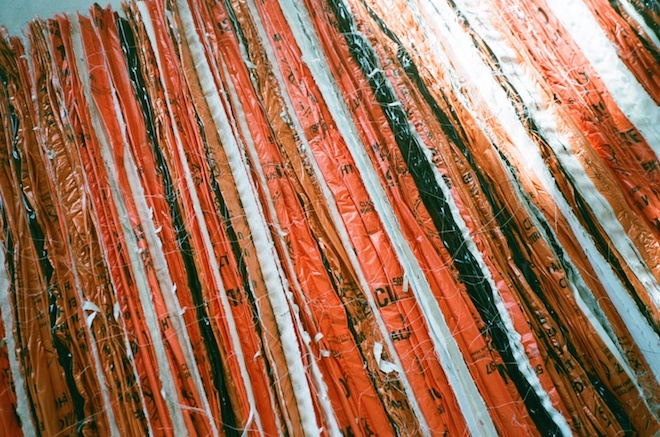
A feeling of being trapped. By situations, pressures and expectations. Wanting to run away from it all. As well as this my work has always been very material based and by the end of my last project I felt very frustrated by the mass of plastic and fabric I had built up around me. I wasn’t enjoying the project and it was beginning to feel like a lot of unnecessary stuff that was just adding to the accumulation of things we have in our lives which we don’t need. I sometimes dreamed about burning it all once the show was done. I’m going through a love hate relationship with my practice it at the moment. This exhibition does involve a lot of material, but I’ve used it to communicate a feeling of suffocation.
Your interest is in creating work that is in flux or transition– what about movement and change interests you? How do you approach a static object to begin to move it towards something else?
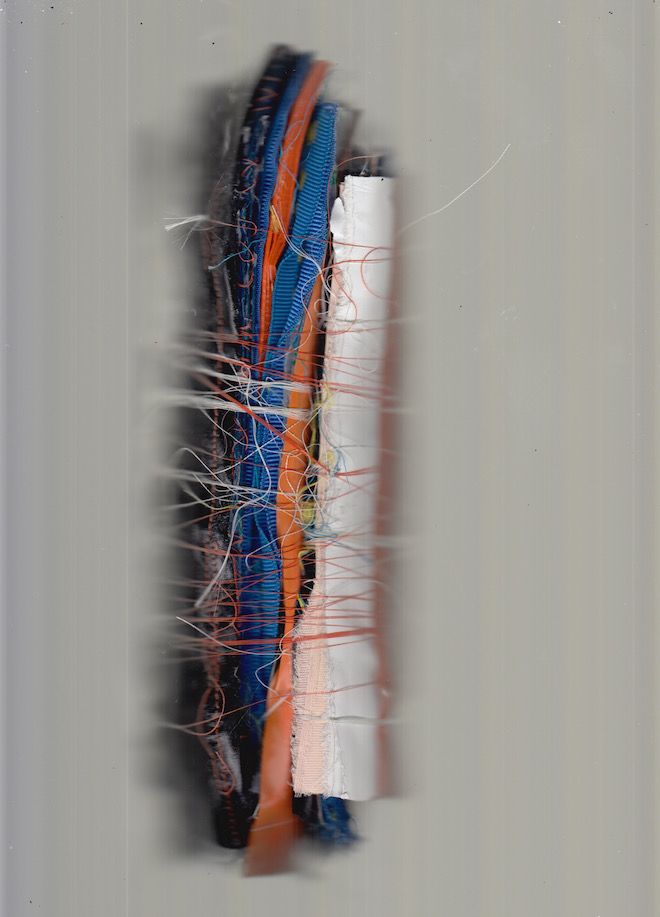
My work is a reaction to my experiences and how I see things and that is something that is always changing. It is the physical actions involved in making work that is an important part of the process for me. Tearing, stitching, mixing and thats about movement. I transform a static object by taking it apart or manipulating it into a different shape. Or more recently working with performers to make the pieces move.
What are the most instinctive materials to work with?
I find I’m very drawn to synthetic materials and materials related to construction. The synthetic aspect is very distant from where the work begins; inner feelings. This contrast allows my work to act as a mask and gives a concrete way to externalise and express what is inside. I often use materials found on building sites because of their relation to transformation and incomplete states and holding things together.
How have you found your practice evolving since you graduated?
I’m open to collaborating. I used to find it very difficult to work with people and would avoid it. My work was something I needed to have complete control over. I find now that collaborating makes projects more fun and allows for further development. And I don’t worry so much about the outcomes of my work, I’m better at trusting my instinct. I guess I’m less precious about it.
You have collaborated with a range of designers, what about your practice aligns well with clothes and the body?
My work is very textural and sculptural so it lends itself to clothing. The contrast created between the heavy and synthetic materials against the natural body creates a mask. I get consumed by my work so I like the idea that a body gets consumed by it. Combining my work with the body also helps to communicate some of the emotions it is related to.
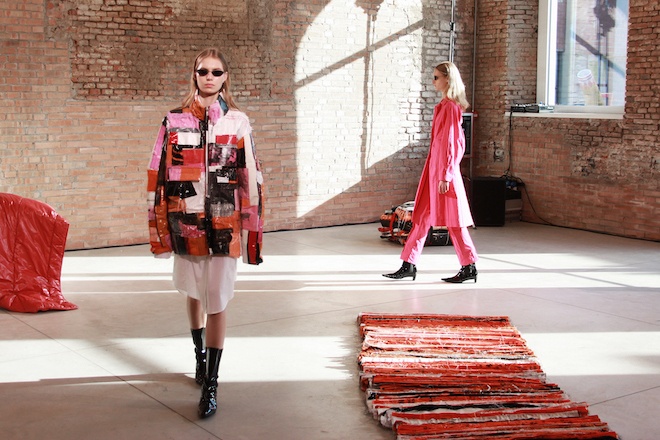
Tommy Zhong SS18
How did the collaboration with Axel Arigato come about? What about the brand aligned with your aesthetic?
The Lobby London approached me to see if I’d be interested in collaborating with Axel Arigato. Their brand has a very minimal and fresh aesthetic, which compliments the mixed media aspect of my practice. The store is very spacious and white with some industrial textures, which makes it an ideal place to present my slightly chaotic work.
You talk about art being a hiding place – how do you approach empty space when you’re thinking about your next work?
My interaction with materials is a bit like having a conversation; it is how I translate what is inside of me. This initial process only really happens when I’m on my own in my own space. But from it comes lots of experiments in the form of small objects. Once I’ve found what is effective I can use this as a starting point to look at how it can be developed on a larger scale.
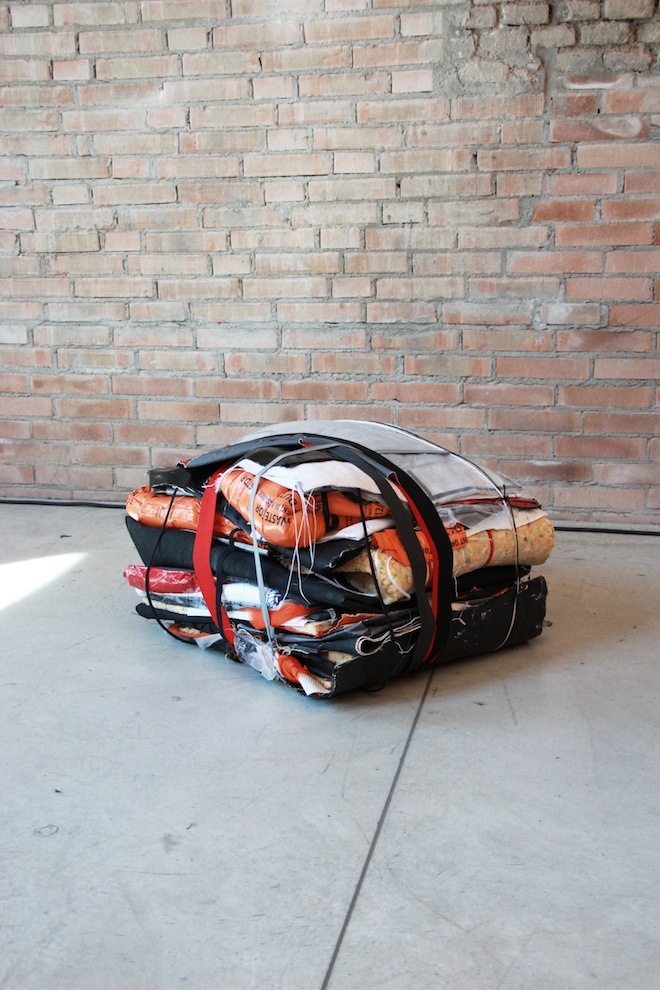
What keeps you interested in larger scale installations?
A desire to create a space that people can become immersed in, be overcome by and take them away from their everyday life. I want to find a way to translate the energy and world that I get lost in when I am making work to people viewing it.
Tags: Art, Axel Arigato, Nadine Shaban
08.11.2017 | Blog , Culture | BY: Sarah Roberts
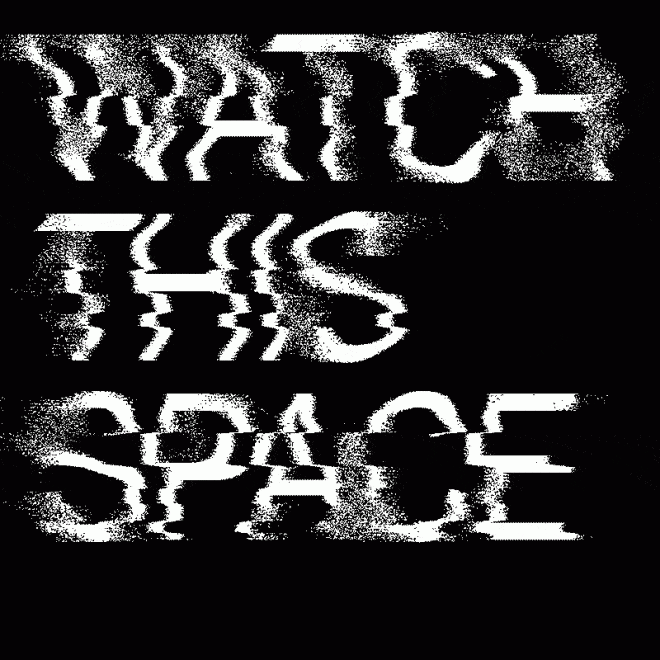
Watch This Space is a book that examines our relationships with our screens, ‘the defining object of the twenty-first century’. A limited edition collaboration between writer, editor and curator Francesca Gavin, and Pentagram partners Luke Powell and Jody Hudson-Powell, the book questions the function of our screens, and how they shape our everyday experience. Watch This Space provides an in-depth analysis of the object that has become an extension of our modern bodies, looking at the impact of screens on society, culture and the self.
The book includes the work of almost 50 contributors, including Yuri Pattinson, winner of the 2016 Frieze Art Award, conceptual documentary photographer Richard Mosse, and artist and director Margot Bowman. It has been produced by Pentagram, an independently owned multidisciplinary design studio with offices across Europe and the United States.
The design of the book actually reflects the subject matter, with the material used on the cover replicating the physical feel of a screen. Inside, pages are printed using Vivid Colour, a new five colour process that adds violet to CMYK, combined with stochastic imaging, which creates a near photographic definition image.
The book launches on November 8th at Tenderbooks in Leicester Square.
Tags: Art, culture, francesca gavin
02.10.2017 | Art , Blog | BY: Francesca Gavin
Frieze is here this week and even those with the most tentative interest in art will be blown away by the onslaught of visual experience coming to the city. Twin rounds up the ten best things to catch at Frieze 2017.
1:54 African Art Fair
This satellite fair in Somerset House, focused on galleries and artists from Africa, has grown every year and shows some of the most interesting and less known work you’ll see in the week. You are guaranteed to discover new artists – keep an eye out for Ouattara Watts, Marlene Steyn and Admire Kamudzengerere. If you cant make it in person t
he website has a good visual compendium of featured artists.
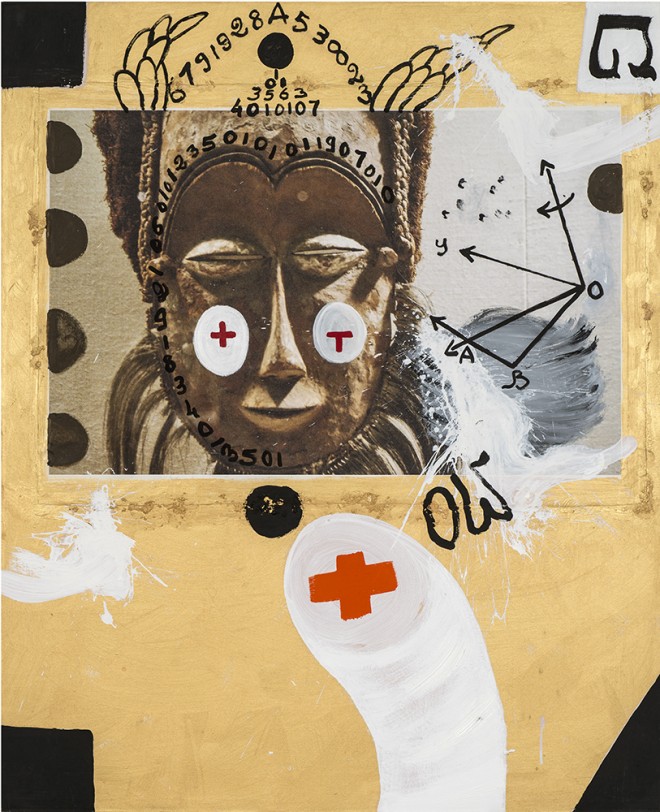
Ouattara Watts, After rain, 2017, Mixed media on canvas, 182 x 160 cm. Courtesy Primo Marella Gallery
Seth Price at the ICA
This retrospective brings together 20 years of one aspect of Price’s work – his videos. They are amazing, influential and worth every minute you watch them.
Jeremy Shaw, Arthur Jafa and Everything at Once by Lisson Gallery at 180 The Strand
180 The Strand is putting on three killer shows for the next few months. Past Twin interviewee Jeremy Shaw has a solo
show on the ground floor, Arthur Jafa is showing a film on the roof in a tent and
Lisson gallery has filled the former office block with massive installations. All free. All exceptionally good.
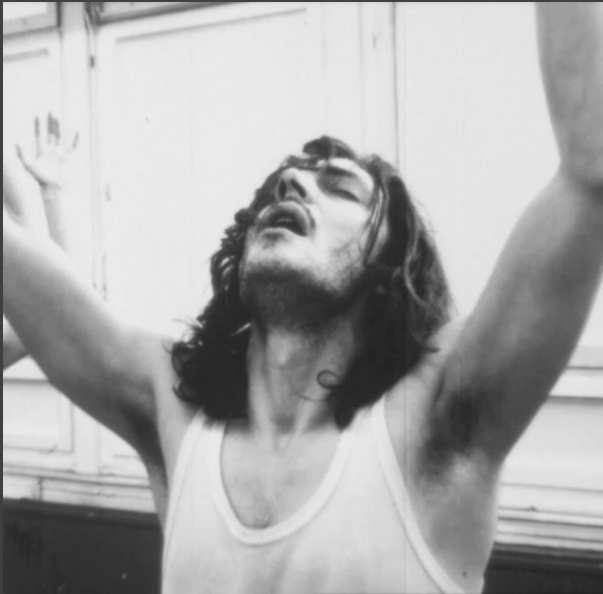
Jeremy Shaw’s sci-fi pseudo-documentary Liminals to be exhibited at Store Studios this autumn, presented by The Vinyl Factory and König Galerie.
Georgina Starr at Frieze Art Fair Projects
Starr is getting some
well deserved attention with a narrative performance project at Frieze, showcasing her mysterious and marvellous take on brains, bubbles, disembodied voices and strong female characters.
Haroon Mirza at Zabludowicz Collection
Psychedelic film installations, a sensory deprivation chamber and mix and match take on collaboration. This brilliant show which is evolving over three months is also the show for a performance by dancer Wayne Macgregor on Thursday (book now).
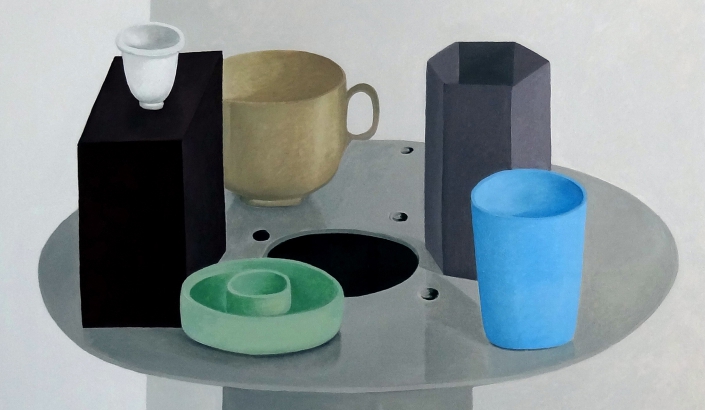
Nathalie Du Pasquier Other Rooms at Camden Arts Centre
Natalie du Pasquier at Camden Arts Centre
Du Pasquier was one of the members of iconic 80s design collective Memphis, who are having a serious moment.
This exhibition brings together paintings and art objects she has created since in a fine art context but still have a touch of individualistic colour and architectural shapes from her earlier work.
Dream Art Fair
You can visit one of the most interesting emerging art fairs from your own bedroom – Dream. This
five day online fair is a great project, with a well curated selection of galleries. Experimental while still being accessible.
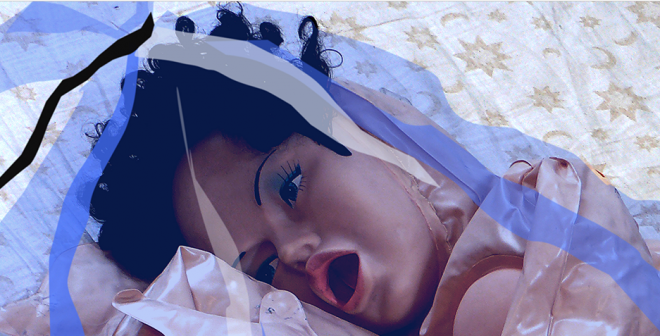
Renate Bertlmann, Eva im sack (‘Eva in bag’, 2010) (detail). Digital print, 80 x 80 cm. Courtesy: the artist and Richard Saltoun, London
Sex Work curated by Alison Gingeras at Frieze
Twin profiled Black Sheep Feminism curated by Alison Gingeras in Texas, showing female artists from the 60s and 70s who were ostracised for their sexual imagery. The curator brings her research to London
in a new form. Expect from beautiful and brilliant takes on genitalia.
Bob Parks Open Air Gospel Choir at Gallery of Everything
If you want something extra crazy, performance artist Bob Parks is your guy. To activate
his show at the Gallery of Everything this Tuesday between 3 and 5pm he’ll be bringing a gospel choice to Chiltern Sreet. Expect it to have a large dose of wildness added on.
10 Sunday Art Fair
This
long running fair down Marylebone Rd from Frieze focuses on smaller and often more interesting galleries. Always worth going to see new work and have real conversations with exciting international spaces.
Honourable mentions, because then things is not enough: Douglas Gordon at Gagosian, Tobjorn Rodland at Serpentine, Dorothea Tanning at Alison Jacques, Superflex at Tate Modern.
Tags: Art, Frieze 2017
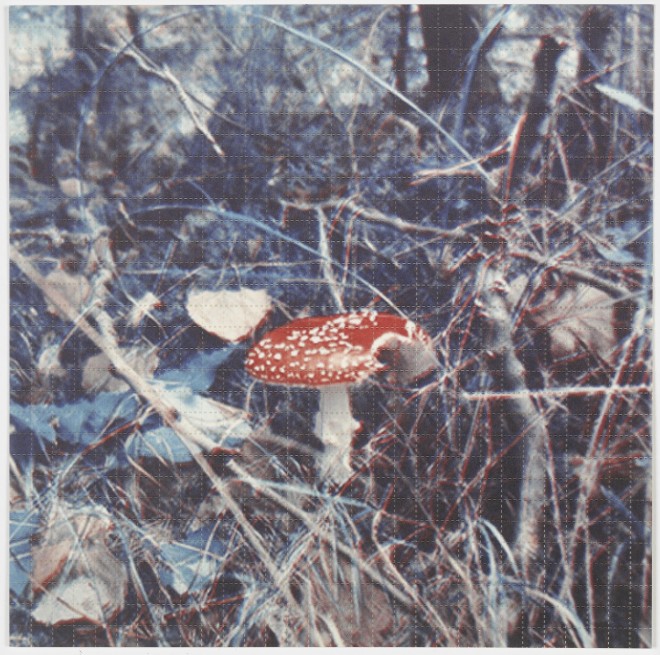
12.09.2017 | Art | BY: admin
Francesca Gavin (Twin, Art Editor) curates a new exhibition in Paris, inspired by the cultural power of the humble champignon.
The exhibition explores the mushroom through cultural and historical narratives, focussing on how this simple fungi has operated at the heart of ritual for thousands of years.
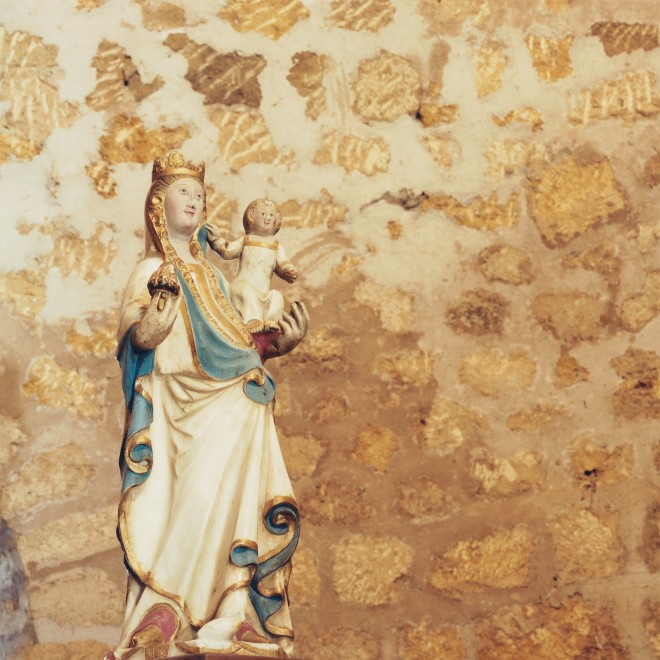
Hannah Collins, ‘The fragile feast, madonna and ceps.’ 2012 – 2017. | image courtesy of galeriepcp
“They were an early form of female empowerment” Peter Cybulski, of galeriepcp tells me, adding that women used mushrooms for a source of income throughout the 19th century.
Throughout contemporary art, the mushroom can also be seen as a source of inspiration, with creatives looking towards it for its ability to signify nature, as well as more abstract, and psychedelic references.
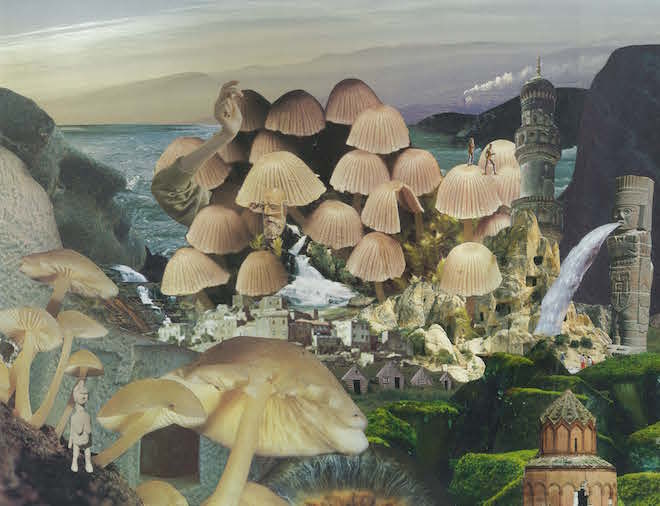
Seana Gavin, ‘mushroomscape’, 2017 | image courtesy of galeriepcp
Bringing together a diverse and exciting range of international artists which includes Hannah Collins, Sylvie Fleury, Seana Gavin, Carsten Holler and more. This new exhibition covers painting, collage, film and photography to offer an exciting and surprising survey of the mushroom, and the strangeness it embodies.
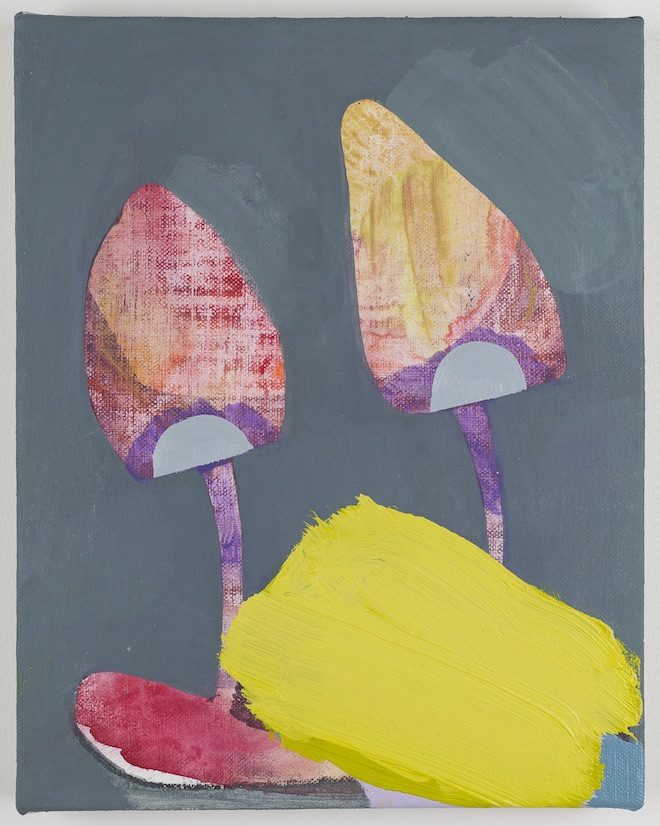
John Millei ‘maria sabina #1’, 2016 | image courtesy of galeriepcp
Champignons! curated by Francesca Gavin is at galeriepcp in Paris until 10th November 2017.
Tags: Art, Feminism, feminist, francesca gavin, twin, Twin magazine
19.07.2017 | Art , Culture | BY: admin
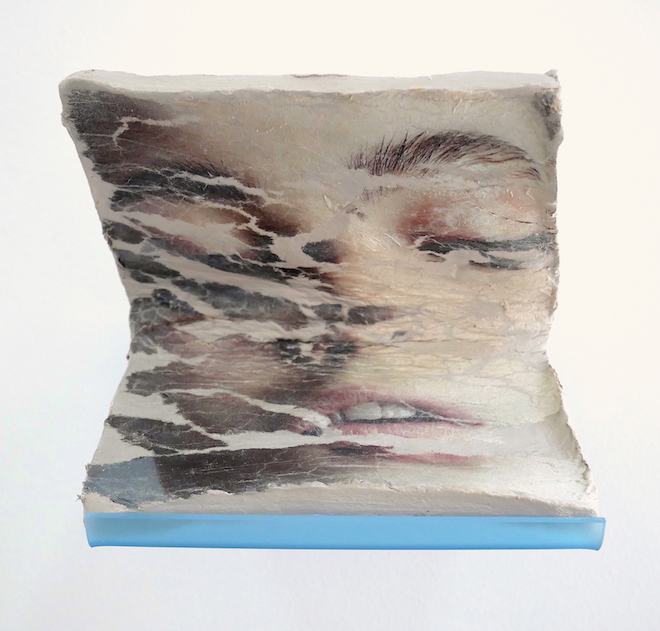
Dealing in themes of feminine representation in the media and the body at large, ‘Facial Recognition’ takes the work of two celebrated British-born artists and turns it into a striking visual dialogue. Images from glossy media form the basis of Melissa Jordan and Eve Ackroyd’s work; subjects are warped and reimagined, transported into otherworldly places, where the traditional figurative is given a new freedom of form.
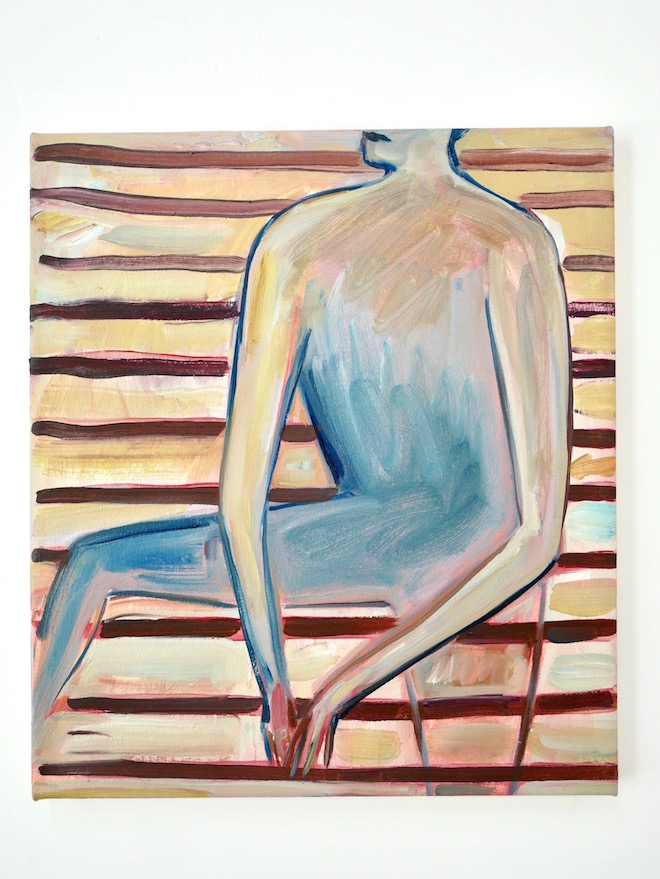
‘Slats’, Eve Ackroyd
Jordan’s work features process-led clay sculptures, Ackroyd is solely a painter; and while in execution their work is very different, the thematic undercurrents and inherent symbolism of their subjects live intuitively in quite a similar space. The artists explain: ‘Trapped in a state of conflict between the visual narratives of their new world and the expressive postures of their past, these paintings and sculptures exist in a remote place, caught in expressions of restlessness and desire’.
The show runs from July 14-22, by appointment at Convoy Projects.
Convoyprojects.com
Main image: ‘Interface 26’, Melissa Jordan
Tags: Art, convoy projects, Eve Ackroyd, exhibition, facial recognition, Melissa Jordan
04.06.2017 | Art | BY: Francesca Gavin
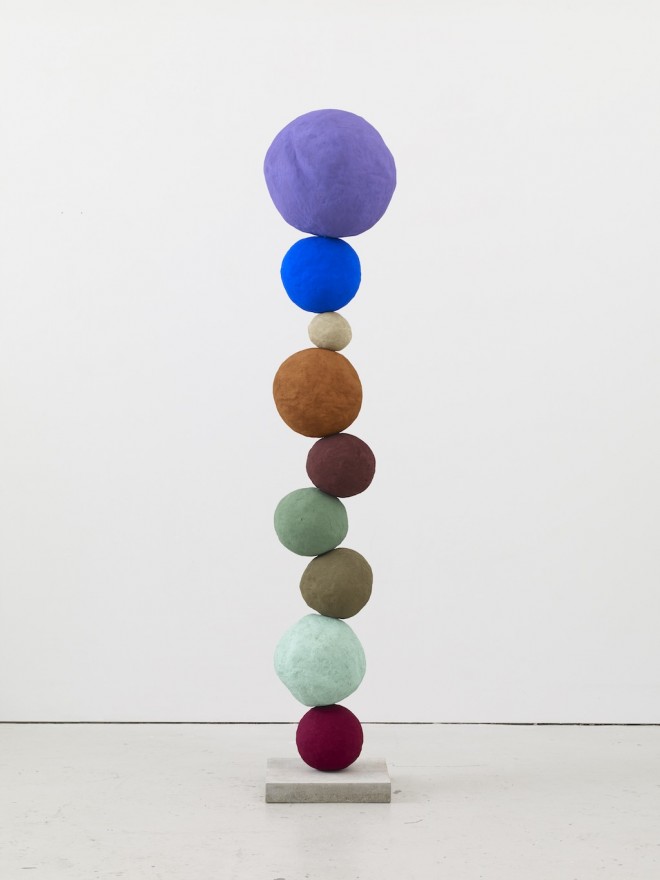
What happens when you take simple objects and turn them into art? Annie Morris’ practice grew out of drawing. Her love of line develop into sculpture, painting and free-hand sewn works that exude joy. She uses everyday objects such as biro pens and clothes pegs to make pieces that brim with a personal visual language full of narrative pleasure.
The staking sculptures she has on show in Form and Volume at CF Hill in Stockholm sit firmly between the abstract and figurative. They are often human scale, or larger than life, but seem to echo the vertical stance of the human body. She reduces her forms to shapes that are circular but inanimate. She plays with gravity, creating balls of pigment and colour that seem to defy the laws of nature.
The formal nature of her stacks veer towards the language of painting. She studied with Giuseppe Penone at the Ecole des Beaux Arts in Paris and Phyllida Barlow at the Slade in London – and reflects their sense of solemnity and play, free space and steadiness.
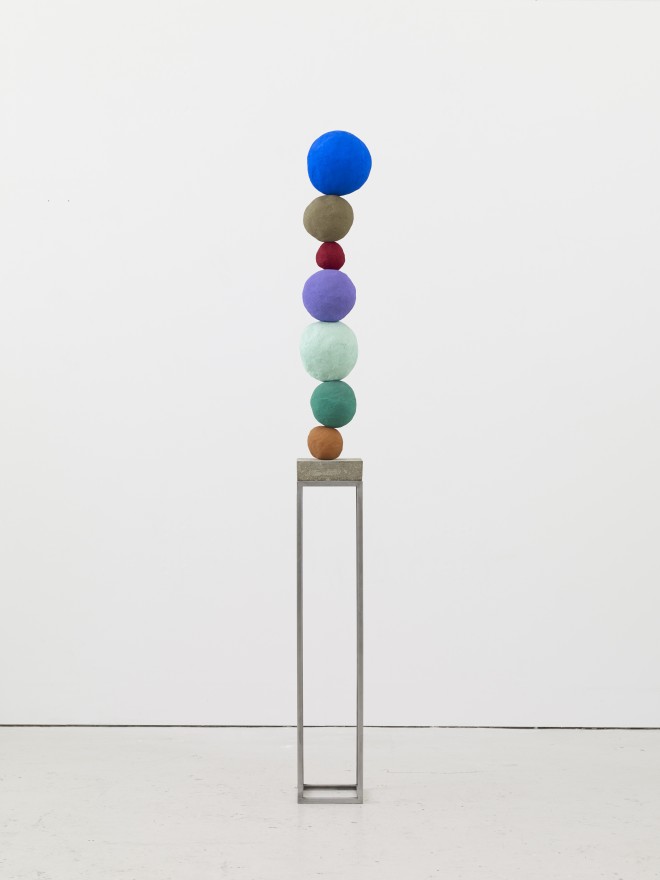
She uses coloured pigment, chalk and watercolour on the surface of her balls, which are intentionally hand made and uneven. Their imperfections give them a feeling joy, lightness and humour. The balls should fall apart, but Morris’ has enabled them to reach upward seemingly through hope and intention as much as anything else.
Each of Morris’ colourful combinations are unique. There is a sense of repetition and exploration in combinations that brings to mind Joseph Albers. She obsessively deconstructs and reconfigures fragments on order to create something harmonious. The stacking series slowly emerged in the wake of her experience of giving birth to a stillborn child, the resulting trauma and the relationship with her desire to have children (she now has two). These are works about hope and harmony in the face of hardship.
Morris has now begun to explore making stack works in metal – experimenting in both bronze and steel. Most recently she has been working with technicians who fabricated work for the iconic British modernist sculptor, Barbara Hepworth. A feminist aesthetic heritage runs throughout Morris’ work, yet her work is not limited by references to gender – her use of line echoes both Jean Cocteau and Louise Bourgeois. This is an artist whose ever-expanding approach is both personal and refreshingly accessible and universal.
Annie Morris is on show in Form and Volume at CF Hill, Stockholm until June 30
Tags: Art, Feminism, Feminism and art
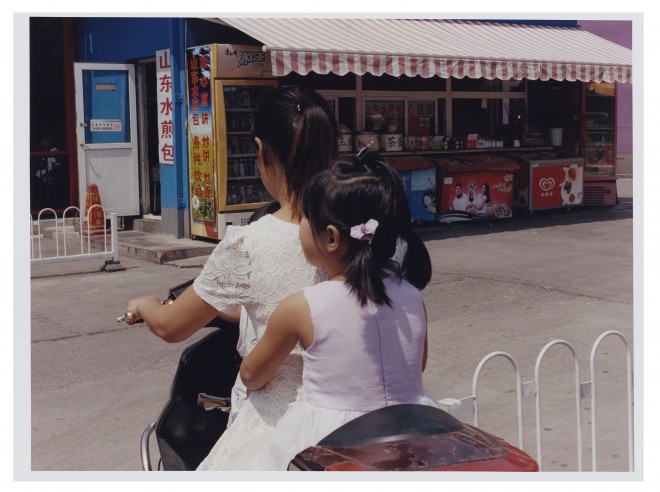
28.04.2017 | Blog , Culture | BY: admin
Gucci collaborator and renowned photographer, Coco Capitán: is an artist who needs little introduction. The Spanish creator’s idiosyncratic eye and quirky slogans have commanded a legion of fans, with 75.6k Instagram followers and counting.
Having graduated from the Royal College of Art in 2016, the photographer has already racked up an impressive string of accolades: she has been a guest speaker for Cambridge University Photographic Society (2016), a member of the Jury for Hyères Fashion & Photography Festival (2016), and was awarded the Pho- tographers Gallery FF+WE Prize (2015).
And then there’s the fact that she’s working with one of fashion’s hottest luxury brands… Capitán’s collaboration for Gucci in February this year saw slogans such as ‘What are we going to do with all this future?’ and ‘Common sense is not so common’ etched across the brand’s sell-out logo tees. But for her latest project, a new book ‘Middle Point Between My House and China’, disenchantment takes a back seat in favour of the imagination.

The book’s tittle is drawn from memories of the photographer’s childhood, in which she thought that if she dug deep into the ground she could tunnel to China. Fast-forward a couple of decades, and Capitan found herself in the country itself – though via the more conventional route of air travel.
The book is therefore both an homage to her journey and the people she encountered on her travels, and to the experience of childhood. ‘China’ and ‘House’ can be understood in both the literal and figurative sense. As is noted in the press release, “‘China’ represented the desire to run away, the attainment of her goals; while ‘House’ was her present reality.” Coco adds, “I wanted to take images that would denote how I perceived China, my personal experience in the country and how I saw the people who were there”.
To mark this hotly anticipated release, Claire de Rouen will be hosting a signing at their London store. Head over on 9th May to snap up a copy of this must-have book.
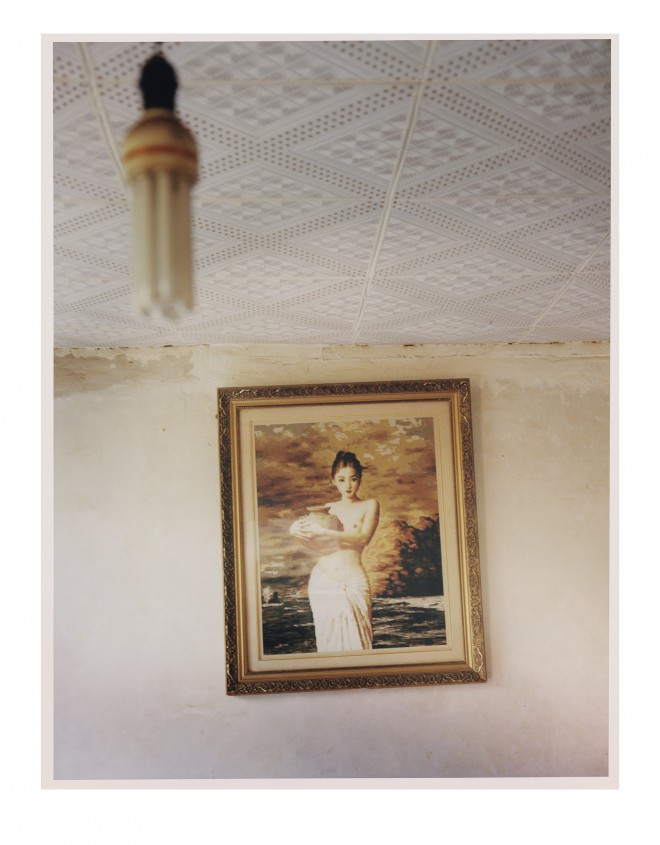
‘Middle Point Between My House and China’ by Coco Capitán is published by Maximilian William, and released in May 2017.
Tags: Art, Feminism, feminist, feminist artist
26.04.2017 | Art , Blog , Culture | BY: Laura Isabella
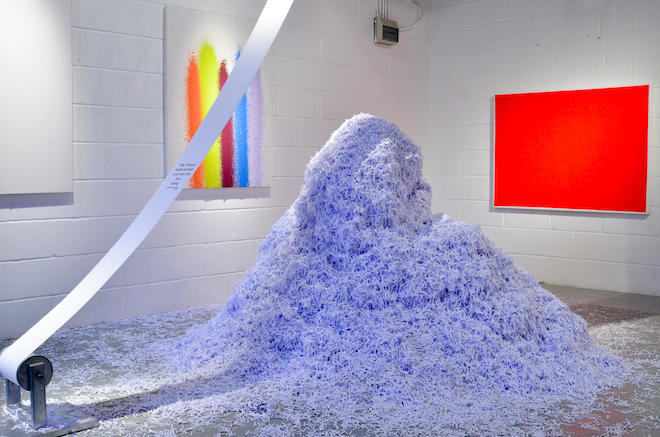
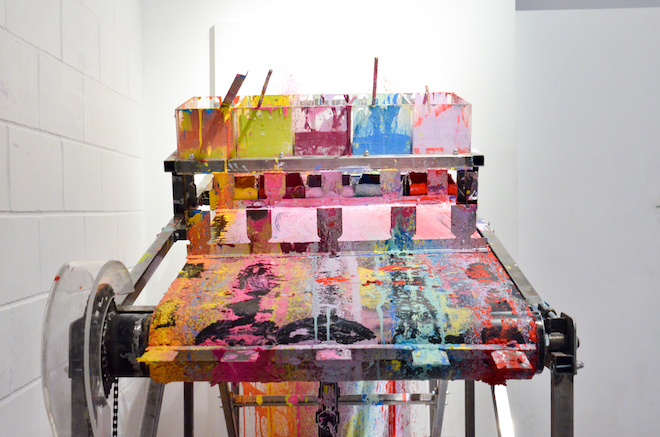
Twin first came in contact with Cara Mills at her Central Saint Martin’s degree show where she presented The Labour of Ideas — a giant shredder which methodically rated then shredded hundreds of her art ideas which fell like snowflakes, gradually amassing to a five foot mound of destroyed work plans. Mills took this art work and developed a second piece, Painting Machine a highly visceral work which spluttered and almost aggressively threw paint creating a new art work experience every day. Fresh off the back of her recent exhibition at Fuimano Projects, Machine: Part A, Part B, Part C & so on… Twin sat down with Mills on the sunny rooftop terrace of RCA where she is currently studying to talk about what makes an idea art and how it feels to be a female artist in today’s landscape.
I loved The Labour of Ideas so much. It draws on all these projects you had in your mind and you’re making all of them, in a way — was that the point?
Yes! I get bored really quickly with my ideas, and I thought there was something interesting about the process artists go through to make ideas and why they chose one and why not another and where do those ideas go when you don’t use them? Where do your thoughts go when they’re forgotten? They’re still there, but not being realised or spoken. I wanted to see their full potential. It was all about this concept that I wanted to make something physical but using all these ideas and I was tongue tied on how to approach that and do it. What was ironic about the piece was there was no hierarchy between the ideas – there was in the ratings sense that they were all rated out of ten – but at the end they all created this pile, and they all had the same shredded weight in this pile.
You had a lot of ideas, the pile was impressive!
It was five feet! I think I started writing down my ideas from March until the degree show, like ten hour days of writing down ideas. The sound of the shredder was really visceral. You became very aware that things were being shredded and destroyed, but that you were also creating.
So in a way all those ideas led to this final idea, The Labour of Ideas machine?
No, it was more a series of tests… I was really inspired by auto-destructive art, that something could be destructive but also creative. Looking at it now, that’s what I was doing. Also the systematic approach – one of the ideas in the shredder was ‘Make a piece about shredding your ideas’ so it was very much in the project. When I’d finished the piece I was empty of ideas… I didn’t really know where to start again. So, that was the end of the idea culmination — but I still write all my ideas down.
It’s really interesting to think about what makes us realise and not realise our ideas…
I sometimes wake up in the middle of the night with an idea for a painting, then don’t do it. What interests me is why? I’m interested in ten years time to look back on my ideas, and maybe then I’ll have one of those ideas I really want to make at that time!
I also liked how with The Labour of Ideas that you could see the ideas, and see the performative piece and machine and take from it what you wanted.
At the CSM show, the same people kept coming back. People were saying that they felt like over time they came back a few times and told me they felt like they were killing my work, like a piece of your work is dying by me coming back, because they’d be reading the idea then watching it shredded. It’s like if you caught it at that moment then you saw it, but then it was shredded, deleted. It’s like you’ve made an idea in your head, is that done? Or do you need to realise it? I was interested in the actual physicality of an idea, like it was one pile made up of hundreds of ideas, metres and metres of paper.
Do you have a mission statement or motive behind your need to create art?
I think it’s about communicating ideas really. I think you get an itch to get it out of you. If it’s stuck, it’s not enough to say it or draw it, you need to make it and leave it there and let it manifest. The journey between thinking and making is really hard.
Your most recent exhibition showed The Labour of Ideas and Painting Machine. What is it about making these really visceral present machines?
It’s about detachment of myself as an artist, and as a creator. I like making something and setting up a situation and letting it happen. The machines will be churning away. I’m very interested in the gallery time frame, the gallery day being the limit but also the potential of the work. The solo show I recently did was three and a half weeks long, so during opening hours that was when the machines were going. The pile would never get any higher than it would be allowed to than the days in the gallery. They’re part of the work. The machines performing and I leave them and the audience see that process.
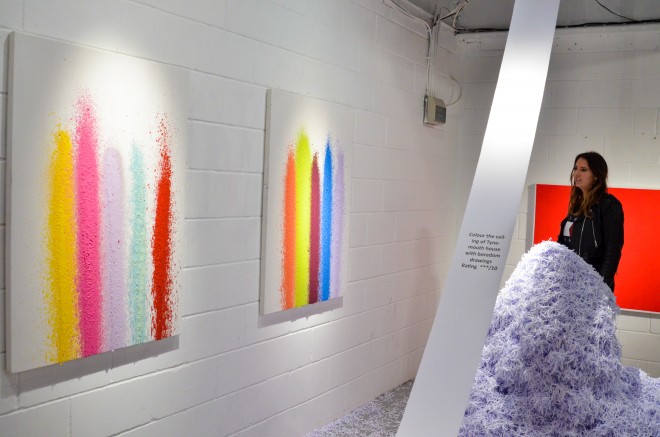
There’s an artist called Michael Stailstorfer who installed an art piece ‘Forst’ at Sammlung Boros in Berlin. It was a steel machine frame which turned a tree trunk and leaves on the ground, as the machine circled gradually the leaves and branches turned to dust creating piles on the floor — first leaves, then dust. I went to see it a few times, and each visit it was a different experience in the two year life cycle of the art works presentation.
That’s so interesting — something I’m thinking about a lot at the moment is ‘what is destruction’? So I’m using a lot of sandpaper on sandpaper and do we expect something to be grounded to flour — when does destruction become creation? When is that? Who decides that? I think what was interesting about the show was that with the Painting Machine it was chucking paint at the wall and kind of being destructive but also creating moments, and with The Labour of Ideas you could come in on the first day and it was a tiny pile of shredded material, and you could come in on the last day and it was this impending five foot mound!
Both could be seen as live sculpture in a way, and also be interpreted on so many levels…
I don’t want to make highly cerebral work only accessible to artists and intellectuals, I want to make something visual that people can interpret in different ways. I’ve looked a lot at performance work and I’m really interested in that — how much the audience plays a role, and what expectations artists put on their audience to complete a work. With ‘Painting Machine’ it was a very different experience depending on whether was moving, or when it was off. I like with kinetic work when something is moving it’s very different when it stops, sort of like how people are very different when they’re speaking to when they’re not. When it was moving it was aggressive and painting and when it was off it was very sculptural and poetic.
I was wondering if we could talk a bit about your experience as a woman in the art world?
It’s funny that you say that… on Facebook this morning I saw a post which said “Enough of Jackson Pollock”. It looked at Lee Krasner who was Pollock’s wife, who was making incredible paintings, and it was so insane because as soon as Jackson Pollock died she went into his studio and her paintings got so much bigger… I find that every artist I’m reading about are all men. I find it really frustrating. I think female artists are making incredible work, and I think historically men were more written about but today I think it’s really important for female artists to be louder otherwise it’s just going to continue to be a man’s world.
How do you navigate that?
I think you just don’t tolerate it. You just see yourself as an artist whether male or female. I think female artists need to not be afraid about working in such a male industry. Just be aware of it, and don’t take any shit.
Tags: Art, Twin interview, Twin magazine, Twin XVI
07.03.2017 | Art , Blog | BY: admin
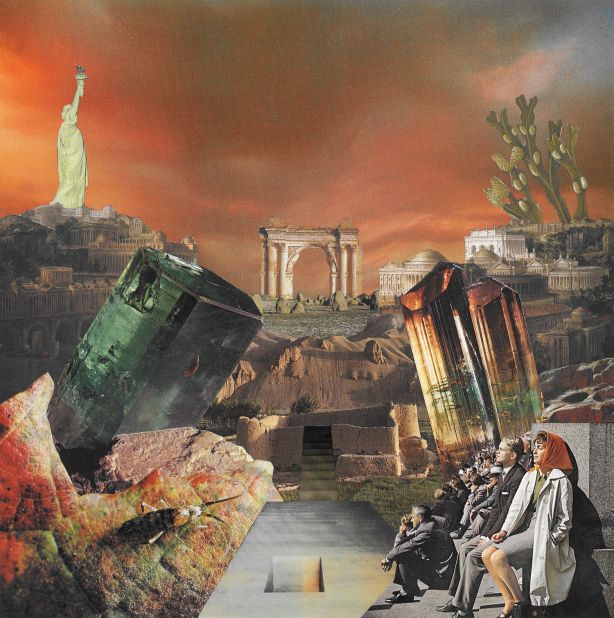
Artist Seana Gavin has rummaged in the super/collider’s library of vintage science books and world encyclopaedias to create surreal collages of imagined landscapes.
Inspired by a mutual love of old educational materials, each collage draws on anthropology, space exploration, mineralogy, botany and astronomy – transforming hard science into a series of otherworldly scenes that are both playful and slightly unsettling, existing outside of any recognisable time or place.
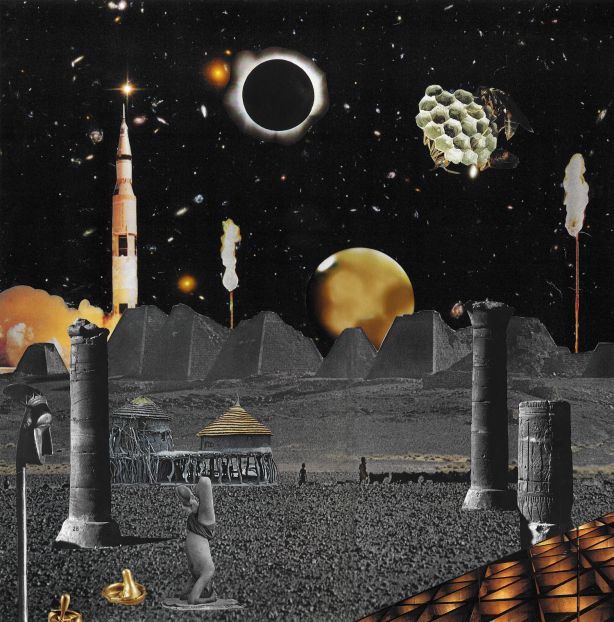
The three new prints follows on from Gavin’s ‘Cosmic Worlds’ series in 2011, which similarly depicted otherworldly scenarios.
The triptych – Planetoid Life, Time Traveller and Liberty Sunset – are available to buy on super/collider now.
Tags: Art, Seana Gavin, super/collider
24.01.2017 | Art | BY: Julia Gardener
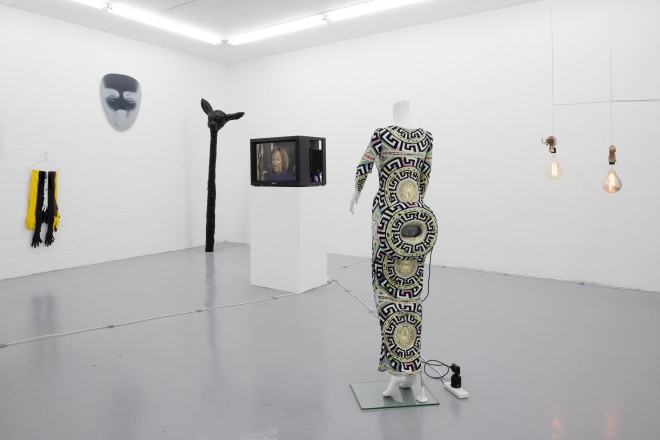
Started by Vanessa Carlos of Carlos/Ishikawa, Condo Art Fair sees 15 London-based galleries host 21 international galleries, joining together to create collaborative exhibitions across the city. Although only in its second edition, the fair has already almost doubled in size, adding prominent galleries such as Sadie Coles and Maureen Paley to its line up this year, alongside emerging galleries, such as Emalin and The Sunday Painter.
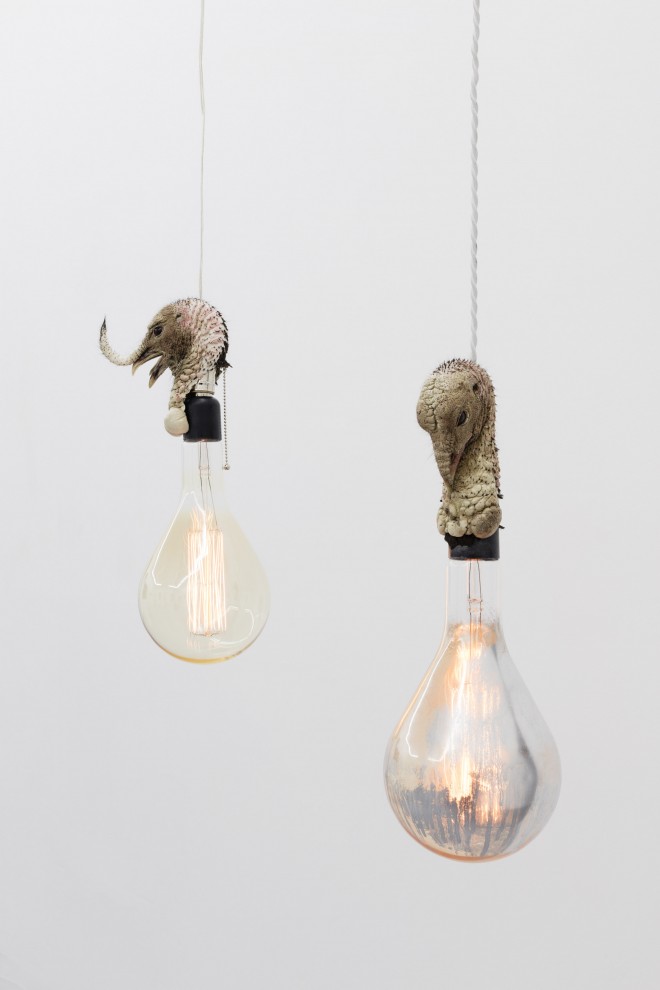
Londoners have a month to discover the spaces alongside each other, more than enough time to revel in the wide range of artists exhibiting in one city. The refreshing unification and generosity between the participating galleries allows for an enjoyable community atmosphere but also embraces individuality, with every artistic alliance creating an entirely distinct and original experience. Consider your new year cultural schedule sorted.
Condo runs 14 Jan – 11 Feb 2017. Find out more here.
Tags: Art, Art Fair, Condo, London Art Fair
25.11.2016 | Art , Blog | BY: admin
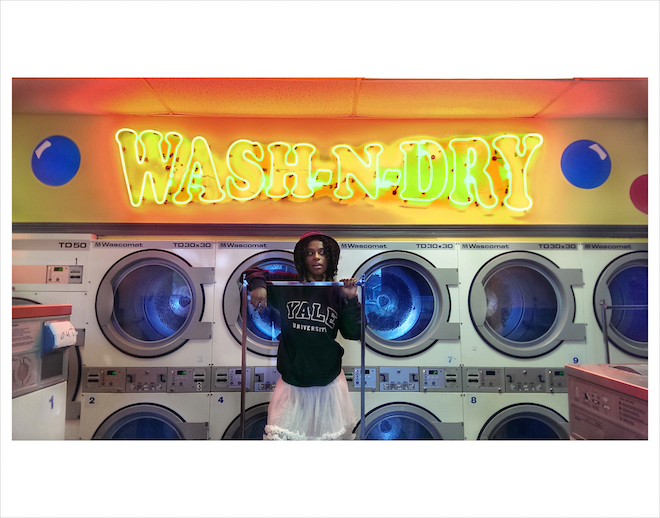
At a time of gross political uncertainty, American artist Tameka Jenean Norris’s new exhibition at the Ronchini Gallery is timely. Opening today, the exhibition sees Norris employ an expansive range of mediums, from video installations to painting and photography, to explore vital themes of black, female identity and self-image in today’s society.
Having grown up on the Mississippi Gulf Coast, Norris later moved to L.A., a transition that influences her new exhibition, in which the artist uses portraits to reconnect with distant relatives. The new collection of work illustrates the pivotal role of history in informing a sense of self, exploring the tension between discovering and owning one’s image and how identity is inherently linked to the past. Throughout, the work forms an engaging critique of contemporary social issues surrounding the appropriation of black culture and female-identity.
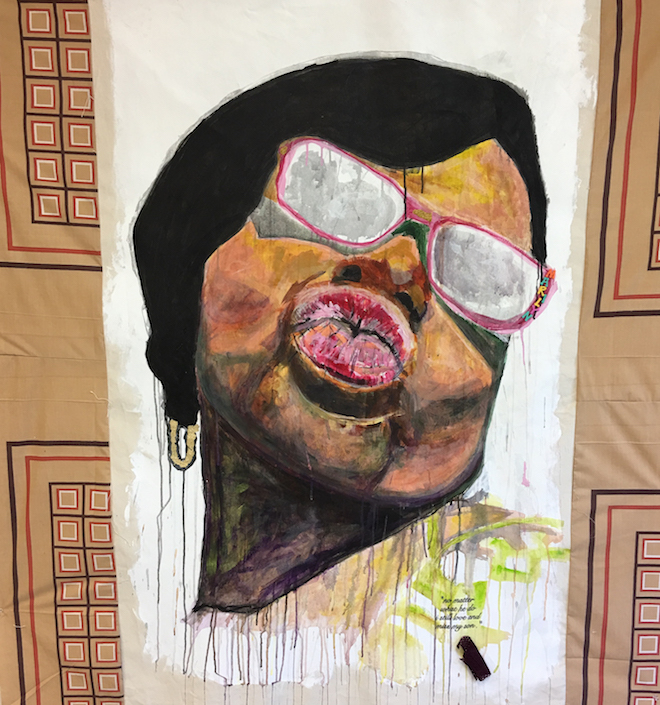
Tameka Jenean Norris, Marilyn No Matter What He Do, work in progress, 2016, courtesy the artist and Ronchini Gallery.
Speaking to Twin about the influences behind the exhibition and her work, Tameka told us:
The exhibition is a continuation of my first show at Ronchini Gallery ‘Almost Acquaintances’, and the works were mostly created at the MacDowell Colony in summer ’16, Peterborough, New Hampshire, and during this fall at The Grant Wood Fellowship, University of Iowa, where I am a Visiting Assistant Professor. Both the residency and the fellowship offered an opportunity for me to concentrate on a new body of work and have some space from the larger, more complicated world. During these periods of isolation, I spent some time contemplating about success in general, ‘black striving’ and missing my ‘family’ on the Gulf Coast and the surrounding areas.
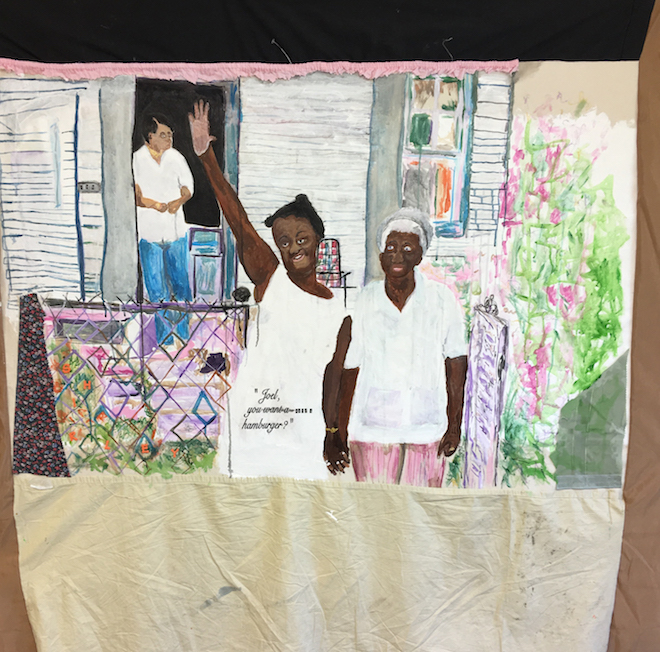
Tameka Jenean Norris, Joel Want a Hamburger, work in progress, 2016, courtesy the artist and Ronchini Gallery
Although I have been making progress as an artist and academically, I feel that I have become disconnected from my family/community/tribe/village in the southern US, and this show is an attempt at reconciliation and reaching out to them. The reference photos I have worked from are mainly taken from Facebook, and some of the family members are deceased, incarcerated and others I have only ever been able to reach via social media.
The exhibition also displays abstract fabric works created by Tameka, as well as an installation of a large woven braid – both serve as metaphors for the memory. “My goal with this exhibition is to create a family tree of sorts and attempt to untangle the line of systematic oppression that has burdened my family and black American culture at large.”

Tameka Jenean Norris, Meka Jean Too Good For You, 2014, video still, courtesy the artist and Ronchini Gallery
Tameka Jenean Norris: Cut From the Same Cloth, Ronchini Gallery, London, 25 November 2016 – 21 January 2017, ronchinigallery.com.
Tags: Art, culture, Feminism, London Exhibition, London exhibition 2016, Tameka Jenean Norris
18.10.2016 | Art | BY: admin
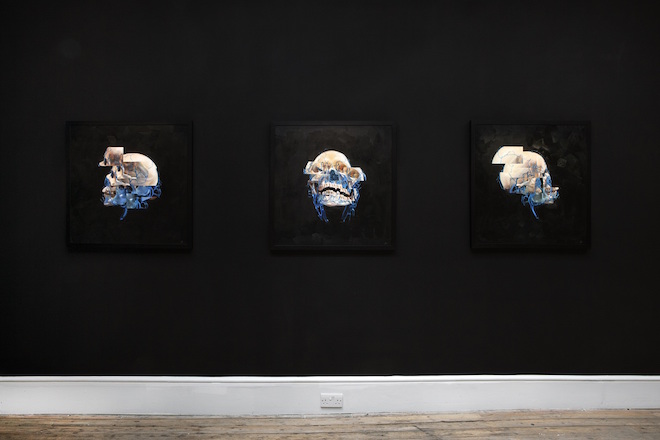
· FLESH · BLOOD · SUBSTANCE · is the debut London exhibition from Mexican artist Golgo. Running now and until the 12th November 2016, Andreas Hijar aka Golgo shows his own personal interpretation of life and death through a series of canvases focused on the combination of anatomy and symbolism. This is a common theme seen through his work, as his interest centres around the human body, its functioning and its decay.
“· FLESH · BLOOD · SUBSTANCE · is the autopsy of my spirit, a reinterpretation of science and soul, an exploration of our concrete presence and inevitable disintegration. This group of work is the fragmentation of my personal approach towards the reasons behind the malady of ageing, changing and existing as substance. Oils, red and blues took the place of scalpels; with them I glanced into the viscera of the corporal and the essence behind the fluidity of extinguishing vitality. Here lies what I feel and perceive as the vacuum of ever changing life and intrinsic end.” – Golgo
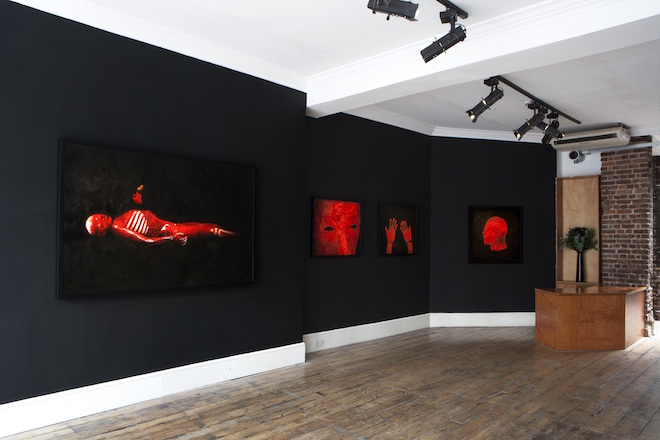
Golgo also continues to produce as an individual creator at his Black Blood Studio, allegedly founded in Mexico City in 1666 and now located in Los Angeles. Golgo employs a wide range of techniques including oil, ink and aerosols. His pictures exploit the popular imagery associated with medieval Europe, playing with the notions of spirituality, corporeality and pain. They also expose the futility of any attempts to draw a line between art and science, as they demonstrate that these areas of knowledge complement rather than conflict each other.
The exhibition runs till 12th November 2016 at Lazarides:11 Rathbone Place, London, W1T 1HR.
Tags: Art, Black Blood Studio, Golgo, Lazarides, Los Angeles, Mexico
08.10.2016 | Art | BY: admin
It is not often that you arrive to an exhibition where the artist has not yet seen the final work, but such was the case for pioneering South African painter Esther Mahlangu, who made the very special trip from her home to Frieze London to see the fruits of her latest collaboration with BMW.
Mahlungu’s first project with the car manufacturer was in 1991 when she followed in the footsteps of male artists like Andy Warhol, Robert Rauschenberg and Roy Lichtenstein to create an Art Car for the brand, the first female and non-Western artist to take part this car came to define an important moment for female artists.

Credit: BMW
Twenty-five years later her signature traditional Ndebele paintings of bold primary hues and stark black lines have been used to transform the interior of a new 7 Series, and Mahlangu seemed more than impressed with the final result as the BMW team revealed the finished piece inside their Frieze lounge area in London.
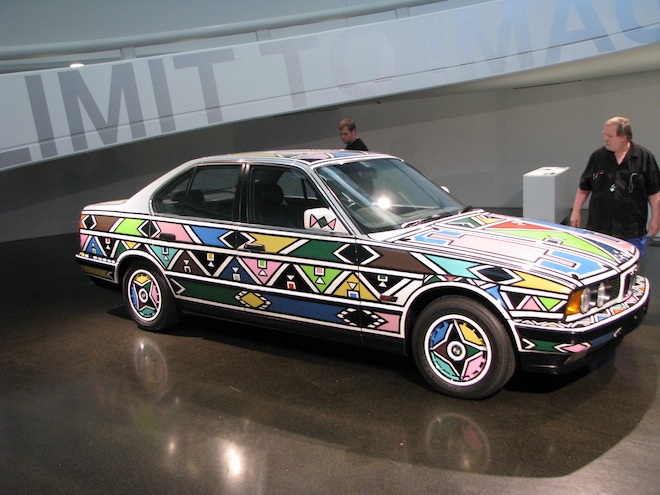
Credit: Strainu
Speaking to Twin about the differences between her large-scale creation in 1991 and the updated subtle approach she has taken in 2016, it was the size of the work that changed her approach. “In 1991 [the project] was huge, enormous as it was exterior.” Mahlangu said. “With the interior I had to be more subtle, to do the construction and think about the process. Usually when I create something, everything is in my head.”
“The biggest difference though is that 1991 was just an art object, where as this one is a useable functional object,” explained Mahlangu, as we watched the car go up for silent auction following its unveiling. With bidding beginning at £120,000, this collector’s item is the pinnacle in functional art, praising new technology whilst celebrating the traditional techniques in Esther’s work.
Credit: BMW
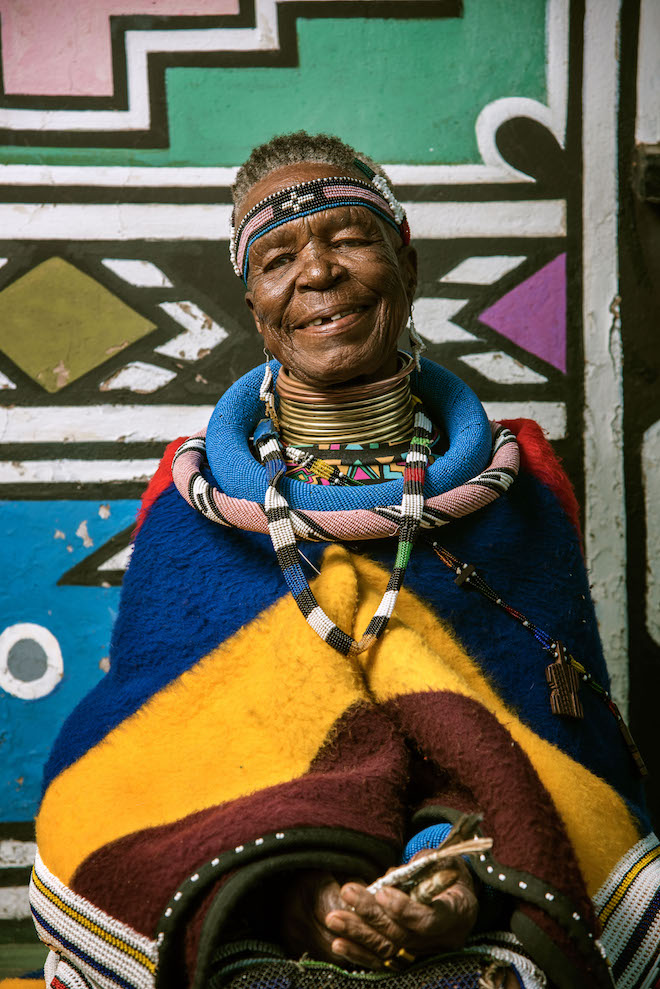
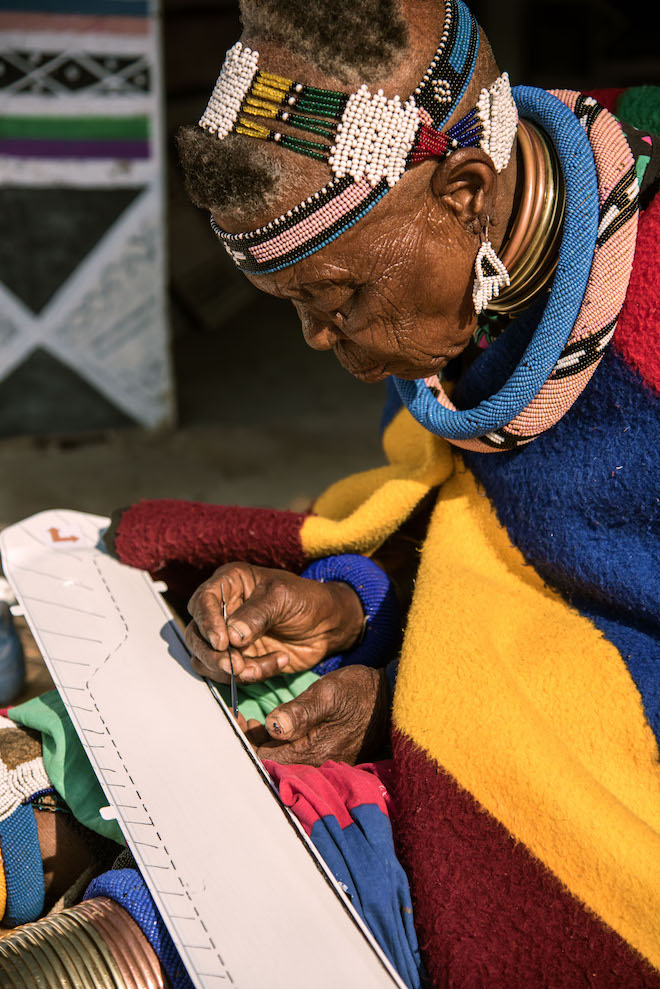
An emblem of serenity, Mahlangu’s presence at the bustling fair was more than humbling. Now aged 81 and adorned in a sea of beaded accessories, bright swathes of fabric and silver necklaces, she is as iconic as her work, upholding the traditions of South Ndebele people of Mpumalanga in South Africa through both her art and her clothing.
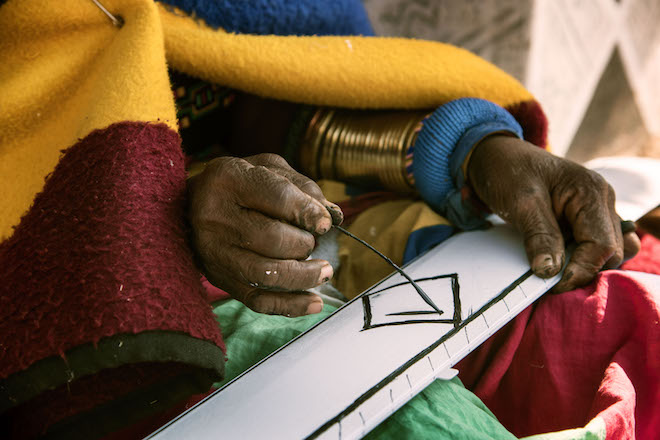
Beginning her artistic career aged ten, Mahlangu was taught the Ndebele painting techniques by her grandmother and mother, who used the same techniques to paint the walls of houses. Her methods have not altered since she was first taught, even for projects such as this.
Credit: BMW
“I only work with chicken feathers,” she explained. “So in the [1991 project] I would bind at least five chicken feathers together to make a brush, whereas with this one I used a singular chicken feather to make the thin line, so you have to have much more control over the thin line than the thicker line.”
The traditions of painting were only carried out by women in South Africa, and have diminished since females have left to travel or take employment elsewhere. This has made Mahlangu’s work all the more important.
“As long as I am able to move I will paint because my fear is that the culture will die out and that is a reality,” she said. “I’ve been working with different brands like Belvedere and did the [Etys] shoes. When people ask why I prefer to work with all of the different brands, I say when they bring me something to do I can’t say no because when I die someday, somebody will own something of mine.”
The BMW Individual 7 Series by Esther Mahlangu is available to bid on now.
You can also see her 1991 design in the upcoming exhibition ‘South Africa: The Art Of A Nation’ at The British Museum which runs from 27 October 2016 – 26 February 2017
Tags: Art, BMW, Esther Mahlangu, Frieze London, South Africa
29.09.2016 | Art | BY: admin
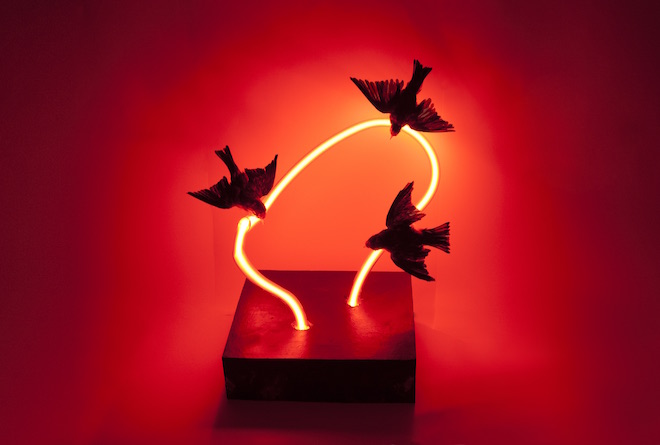
Harriet Horton is heading to Paris. But not before she lets UK-based fans of her brand of taxidermy take a look at the new collection – ‘Camouflage’ – at her London studio.
Having beens fans of Harriet’s work for some time now, firstly becoming enamoured with her ‘Sleep Subjects’ exhibition of 2015, Twin is excited to see such an exciting and irreverent artist continue to develop.
Harriet Horton, Owen, 2016
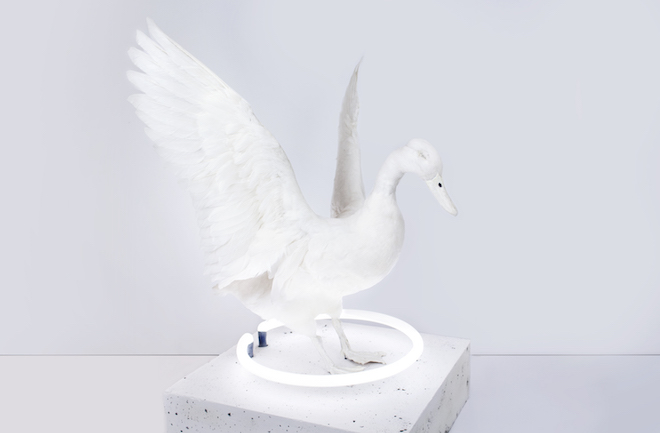
For 2016 the signature neons are still gleefully present, but there is a new, multi-textured element to the works. Materials such as marble dust and cement have been introduced, and create a staggering contrast to the exquisite delicacy of the taxidermy itself, transcending each piece onto an almost angelic plane.
“I’ve always said that when animals are deceased their natural colouring and camouflage becomes redundant,” Horton explains. “I have explored this idea further [for ‘Camouflage’] by either using animals that have no existing markings or stripping them of their original colouring and reconstructing it with light.”
It is fitting then, that a city such as Paris, which is so often known for both its light and its love, should be host to such a stunning example of the two used to breathtaking effect. Unmissable beauty.
‘Camouflage’ opens at the mi* gallery in Paris on 26th October, and runs until 16th January 2017.
Harriet will be holding a private view of the new work at her studio, Darnley Road Studios, on 29th September.
Harriethorton.com
Main image: Harriet Horton, Lovers, 2016
Tags: Art, Harriet Horton, london, neon, Paris, taxidermy
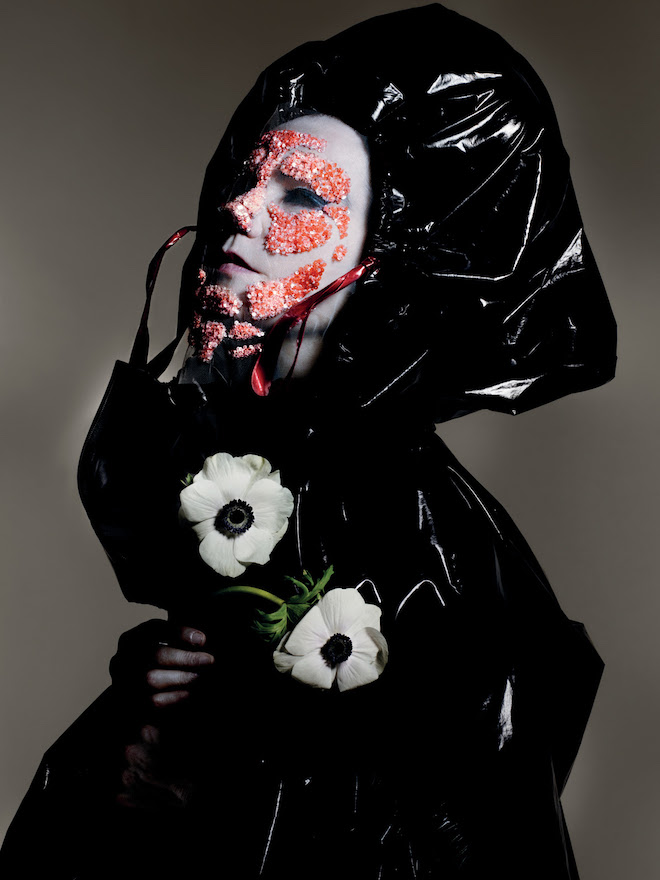
22.08.2016 | Culture , Music | BY: admin
This September in London is about one thing only: Björk. Riding high off the success of her critically-acclaimed album ‘Vulnicura’ she is set to play a number of London shows, as well as hold her own exhibition – ‘Björk : Digital’ – at London’s Somerset House.
For years Björk’s music and visual genius has proved to be both pioneering and iconic in equal measure, and now, the British capital is set to feast on her creative fruits in a variety of mediums. Following the high demand, and subsequent selling out, of her Royal Albert Hall performance on 21st September, an additional show has been announced at the Hammersmith Eventim Apollo on the 24th, with tickets going on sale on Wednesday 17th August. These will be the artist’s first performances in London since the release of her latest album.
Meanwhile, the exhibition at Somerset House is due to feature a number of her digital works, such as virtual reality videos, interactive apps and archive music videos that were created in unison with some of the most spectacular talents from the worlds of visual artistry and programming. Booking is strongly advised.
‘Björk : Digital’ will be on from 1st September – 23rd October 2016. Click HERE for tickets.
Bjork.com
Tags: Art, bjork, digital, Hammersmith Apollo, london, Music, Royal Albert Hall, Somerset House
11.08.2016 | Art | BY: admin
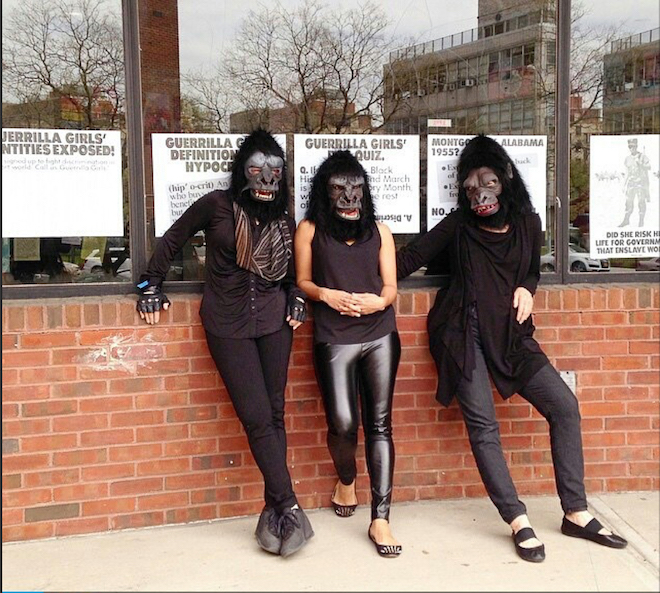
Founded in New York in 1985, the anonymous art collective – the Guerrilla Girls – are finally getting their own, dedicated show. Set to commence this October at London’s Whitechapel Gallery, it is a long-awaited spotlight on over three decades of important work they have done in highlighting the staggering inequalities that take place both historically – and currently – in the art world.
Though the group has seen members come and go over the years, one thing unifies: all participants take the names of dead women – Frida Khalo, Georgia O’Keeffe – and conceal their identities with gorilla masks when appearing in public.
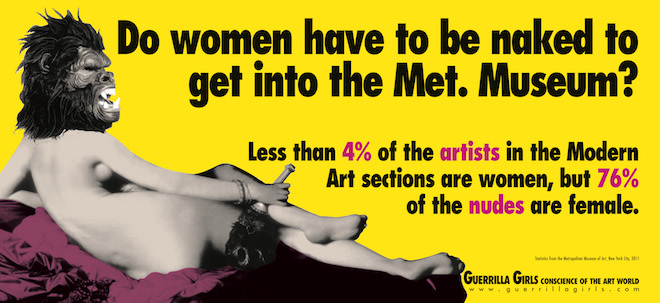
‘Do Women Have To Be Naked To Get Into The Met. Museum?’, 2012, Courtesy of the Whitechapel Gallery
Speaking to The Guardian earlier this week, Iwona Blazwick, director of the Whitechapel Gallery reiterated the real need for such an exhibition to take place, and further demonstrated why the Guerrilla Girls are so vital. “I was just at the Kunstmuseum in Basel where they have just rehung the entire collection from 1900 to the present and I think there are five women.” She said. “Sadly it is still an issue.”

‘It’s Even Worse In Europe’, 1986, Courtesy of the Whitechapel Gallery
Entitled ‘Is It Even Worse In Europe?’, the new show will feature famous works such as the 1986 inspiration behind the aforementioned title, as well as ‘Do women have to be naked to get into the Met museum?’ and ‘Pop Quiz’. However, the large crux of the exhibition will be based on the results of 400 questionnaires that the Whitechapel Gallery have commissioned the group to send out to European museum directors, including their own.

‘Pop Quiz’, 2016, Courtesy of the Whitechapel Gallery
In a public statement, the Guerrilla Girls said: “With this project, we wanted to pose the question, ‘Are museums today presenting a diverse history of contemporary art or the history of money and power?’ Our research into this will be presented at Whitechapel Gallery this fall.”
Let’s see, shall we?
‘Guerrilla Girls: Is it even worse in Europe?’ will be co-curated by Nayia Yiakoumaki, and runs from 1 October 2016 – 5 March 2017; entry is free.
Whitechapelgallery.org
Main image: by Andrew Hindraker
Tags: Art, Feminism, Guerrilla Girls, protest, Whitechapel Gallery
18.05.2016 | Art | BY: admin
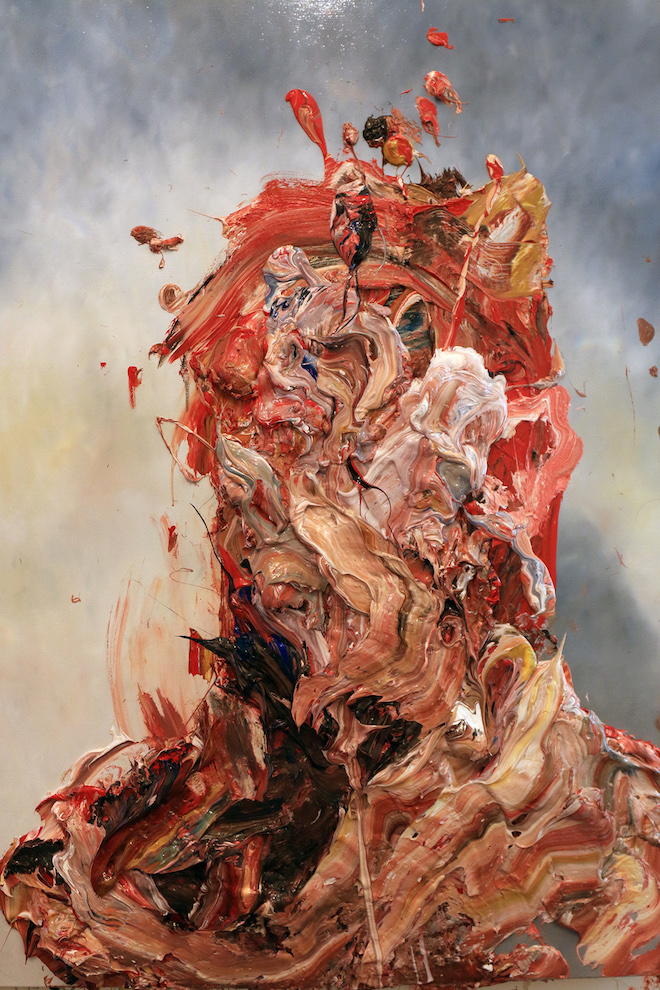
Open now and running until the end of June, acclaimed British artist, Antony Micallef is exhibiting his debut solo Hong Kong show, ‘Raw Intent’ at the prestigious Pearl Lam Gallery in Hong Kong.
Recognised by the art world, Micallef, who draws inspiration from the old masters has been called “this generations Francis Bacon” by Sotheby’s. This is evident through his latest evocative series of work, ‘Raw Intent’ which focuses on the movement of paint, and explores its relationship between the artist, the brush and the canvas.
“Raw Intent is a body of work that uses the mechanics of paint to unearth and excavate emotion using myself as a vehicle. I want the medium to evoke something visceral and emotive without illustrating it. The figures are distorted, pushed and pulled until they start to ‘breathe’ on their own. The object of the work is to instill and convey a sense of energy and life. Emotions are projected onto and tested on these found figures, and the form is stretched to its limit, like subjects in a science lab. I’m interested in that space where the figure almost disintegrates but somehow stays intact, leaving a sense of friction and raw distortion. The medium is celebrated and used in full force in many different ways with many different tools to render life that echoes traces of our emotional field.” – Antony Micallef
The exhibition is on now, and runs until 30th June 2016 at Pearl Lam Galleries, 601 – 605 Pedder Building, 12 Pedder Street, Hong Kong.
Pearllam.com
Tags: Antony Micallef, Art, Hong Kong, Pearl Lam Gallery

16.02.2016 | Art , Culture , Film | BY: admin
Photographer and filmmaker Joost Vandebrug does with apparent ease what many struggle with for years: he let’s his intuition guide his art. But not just his art, also his passion, his productivity and ultimately – his success.
He is a man that wears many hats, but each of them seem to fit just fine. A Dutch art director, turned fashion photographer, who then became a documentary photographer and filmmaker, music video director and now kids’ clothing designer – he appears to weave between creative practices seamlessly.
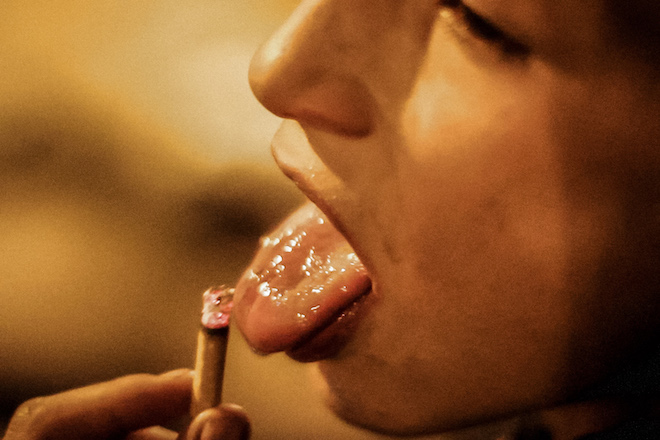
All images from Cinci Lei by Joost Vandebrug
One of Joost’s most successful projects to date – which is still ongoing – is the Lost Boys series. For half a decade he has been following and documenting the lives of a gang of children who call the streets and tunnels of post-communist Bucharest their home. Over 6,000 photographs turned into a book, Cinci Lei, (which he gutsily got off the ground thanks to a Kickstarter campaign) and more than 120 hours of footage is becoming film-shaped as we speak.
Here, we catch up with Joost to find out how – and why – one man makes all that happen.
Firstly, when and why did you realise that you wanted to make pictures and films?
Although my mum and dad are both photographers, I never really considered it as an option while growing up. I was too busy playing in punk bands and wanting to become a rock star. I guess when that failed, I enrolled into art school, but even there I hardy ever worked through the medium of photography and film. It was only after my internship with Erwin Olaf and a year break from Amsterdam (where I lived at the time), that I came back and made a somewhat conscious decision to ‘be a photographer’.
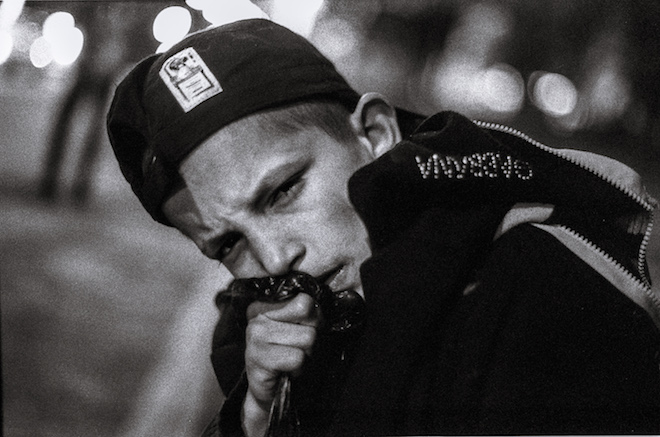
All images from Cinci Lei by Joost Vandebrug
You’re described as both a photographer and filmmaker – how does your approach to each differ, if at all? And if you could only proceed with one of them for the remainder of your career, which would it be and why?
My approach in both film and photography is virtually the same, very intuitive. But lets take my Lost Boys series as an example: I have followed this group of street children and their leader Bruce Lee for over five years, and last year I published a book. In the book I have laid out the pictures, carefully of course, protecting the protagonists, and telling the story of how I see the kids, and what it was like for me being with them for all this time. Though choices are predominately made on visual aesthetic.
Now that we are making a feature documentary about the same group, there is much less that I can – and want – to leave to be interpreted by the viewer. I am compelled for it to be an honest, real and correct document of their lives. Although it will still be a poetic film, the choices that I make are not just from a visual perspective but above all they have to drive the story forwards. The devices available to tell the story are also on a completely different level. And although because of my use of small camera’s for example, which resulted in me being an unadulterated part of the story, the film is in the hands of the protagonists. Which is very exciting, but also difficult as I want to protect the protagonists at the same time.

All images from Cinci Lei by Joost Vandebrug
Can you describe your first serious photographic and film projects, respectively? Can you recall what were you trying to convey with them?
Quite early on, in 2007, I was offered a solo exhibition in FOAM Amsterdam (the photography museum). The exhibition was during fashion week, so they wanted me to make a fashion connection in the work. This work became my first step to combine fashion and documentary. And still today I love to shoot fashion on real people. This can be a documentary project, but also a portrait series with a great artist or musician.
How do you think your work has progressed over the years?
On all levels I got calmer. I used to rush from project to project, making huge leaps from personal work to commercial work. I guess it was important to experiment, so it wasn’t all bad, though nowadays its all come together. My commercial work goes hand in hand with my personal work and I allow myself to dive into my projects much deeper.
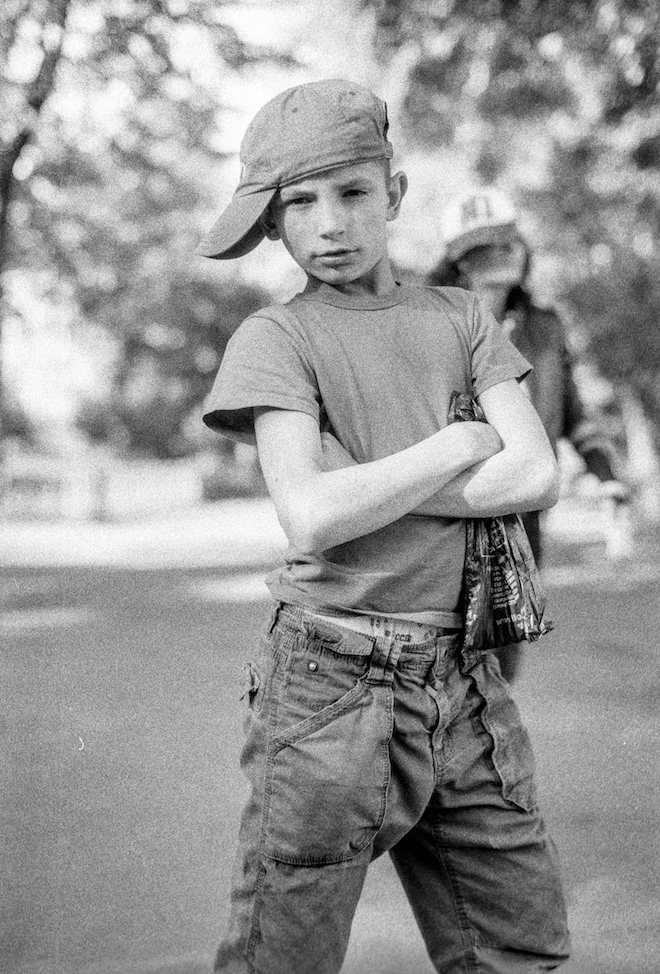
All images from Cinci Lei by Joost Vandebrug
What kind of journeys does your work take you on?
The Lost Boys project opened a whole new world. I am visiting and documenting the lives of young, aberrant and sometimes lost youths everywhere I go. And also, now that I have set up an NGO for the protagonists of the book and film, I am visiting many befriended charities and organisations. It is like an ongoing research and very inspiring to visit all these places where other NGO’s are dealing with similar issues as I went through with the Lost Boys.
Where would you love to shoot, that you haven’t already?
If I think of a place, I usually try and go pretty quickly. But, apart from those kind of research trips, I always go back for longer times to follow up on the people that I have met. Documenting them over longer periods of time. I have no interest in shooting little stories all over the place for the sake of it.
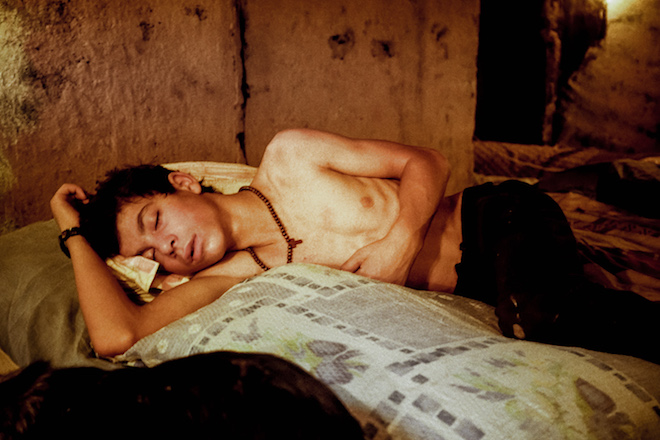
All images from Cinci Lei by Joost Vandebrug
How did you segue into music videos? Was it something you’d always wanted to do?
The great thing about making music videos is to collaborate with great musicians. So its important for me to feel a strong connection with the artist. My work has always had a connection with music, so once i started using video as a technique, it made sense to shoot music videos.
Is there a music video that you wish you’d shot?
The first that springs to mind is Pink Floyd, Another Brick In The Wall.
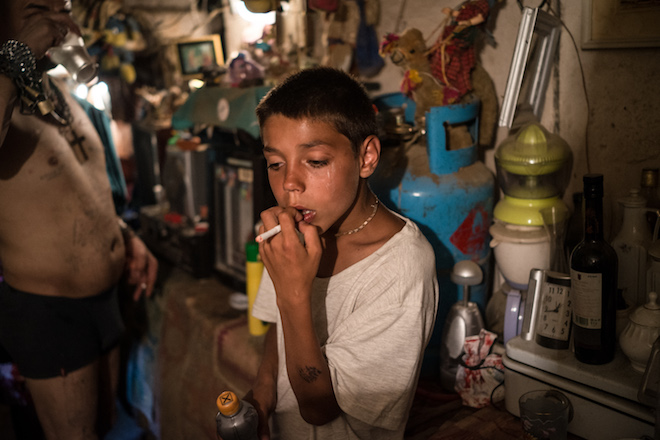
All images from Cinci Lei by Joost Vandebrug
What are you working on right now and in the year ahead?
The biggest ongoing project is of course the feature documentary about Bruce lee and the Lost boys. I have found an amazing supporting team at Grain media who are very dedicated to making this a beautiful film. Its in very safe hands with Katie Bryer (she edited the Oscar-nominated documentary Virunga) who is working on the film full time, so I am able to walk in and out the editing room and thus work on my regular photography and film work as well.
Also, my husband [Tom Eerebout] and I have just launched a kids’ wear label, Jumping Dog which is super exciting. All the pieces are inspired on adventure and interactiveness with the wearer, but best of all with the profits we are 100% funding the Cinci Lei project.
To find out more about Cinci Lei, Joost’s documentary or Jumping Dog visit joostvandebrug.com
All images from Cinci Lei by Joost Vandebrug – buy it HERE
Tags: Art, Bucharest, Cinci Lei, Fashion, film, Joost Vandebrug, Jumping Dog, Lost Boys, photography

 PREVIOUS

 Twitter
 Tumblr
 YouTube
 Facebook
 Instagram
