We are near saturation point when it comes to pop-up shops, but have an insatiable appetite for pop-up art spaces. Flash Projects is the latest photography project from the really rather good James Hyman Gallery, who consistently impress with their selection of vintage photography (take this paparazzi shot of Bridget Bardot, top). Now, the gallery will take their archive of prints on the countercultures of the Fifties through Seventies to spaces all over London with exhibitions and limited-edition sales.
Flash Projects’ delicious debut is a collaboration between photographer and artist Jean Clemmer and Franco-Spanish couturier Paco Rabanne entitled, Canned Candies The Nudes of Jean Clemmer (images above and below), a body of work originally produced in 1969. Rabanne’s wicked ‘unwearable’ fashions, crafted from unconventional materials like metal, are the perfect match for Clemmer’s hazy aesthetic. The little-known Clemmer (1926-2001) was immersed in painting, music and photography, and worked as Salvador Dali’s personal photographer for two decades.
The photographic series is seemingly bathed in a silver glow, and recalls the sci-fi spirit of Barbarella (1968), for which Rabanne was costume designer. Clunky chainmail get-ups deemed risqué at the time seem just as modern and fresh now (see young designer Fannie Schiavoni’s chainmail harnesses Fannieschiavoni.com). Canned Candies is a climatic collection that’s the result of an early art and high fashion clash. Invest now.
Canned Candies. The Nudes of Jean Clemmer runs from the 26th November – 18th December at Flash Projects, 8 Kingly Street, London W1B 5PG. flash-projects.co.uk
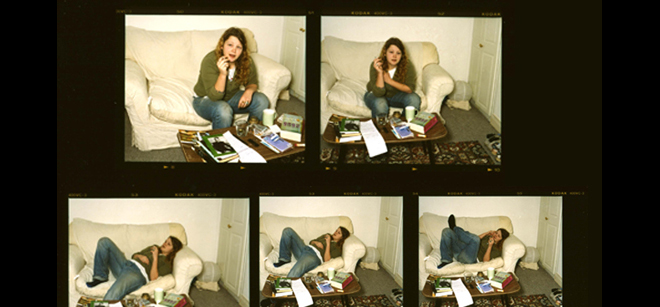
Francesca Woodman took her first photograph aged 13. The self-portrait reveals a young woman bathed in light, with her face averted from the cameras’ gaze (below, top left). Despite her years, the image set the tone for the remainder of a brief, but brilliant photographic career.
Woodman studied at the Rhode Island School of Design from 1975 – 1979, producing a prolific body of work. A solitary figure in life and art, she was the frequent, lone subject of her images. Before her untimely death, when she jumped from a Manhattan high rise at the age of 22, Woodman generated an archive of 800 images. This week a number of them go on show at the Victoria Miro gallery in London, including rarely seen colour works. The exhibition is a taster of a major retrospective at San Francisco’s MoMA, which ultimately lands at the New York Guggenheim in 2012. Such mainstream recognition has taken time, though Woodman’s contemporary influence spans from Cindy Sherman to Nan Goldin. This is a show that doesn’t need to shout, it very quietly commands the attention.
Francesca Woodman is at the Victoria Miro until 22nd January 2011 Victoria Miro
All images: The Estate of Francesca Woodman, Courtesy George and Betty Woodman and Victoria Miro Gallery.
Love art but can’t afford it? Recently there’s been a spate of initiatives to make sure you don’t have to starve yourself to be able to take home a piece of art. Outline Editions is one of them. Founded by arts, lifestyle and features editor Bill Tuckey and curator Camilla Parsons, Outline Editions recognises that graphic design is increasingly in demand as a new affordable wall art.
Following the success of their debut pop-up shop in May, Outline Editions are back with another. The temporary gallery, housed in a former second-hand record store on Soho’s Berwick Street will be a feature in itself: the window and floor graphics are produced by designer and illustrator Kate Moross.
Limited-edition prints from their nature-inspired autumn collection Into the Forest, will be on sale at smile-inducing prices – from £15 to £185. Take in the neon landscapes of new-wave graphic artist Anthony Burrill, or marvel at the intricate detailing in fashion illustrator Klaus Haapaniemi’s designs. Fancy an even more modest purchase? T-shirts, books, vinyls and other products will also be on sale from the likes of Kate Moross or Supermundane.
The temporary store is open until 31st January 2011 at 94 Berwick Street, London W1F 0QF. Open Tuesday-Sunday, 12 – 6.30pm www.outline-editions.co.uk
When Japanese visionaries Issey Miyake, Rei Kawakubo and Yohji Yamamoto stormed the catwalks in the early Eighties they redefined fashion. The androgyny of their architectural shapes not only blew apart how women in Europe dressed, but succeeded in turning fashion into art.
Thirty years on and Japanese fashion continues to challenge Western notions of beauty and the Barbican’s new exhibition, ‘Future Beauty: 30 Years of Japanese Fashion’ charts the history and impact of the country’s inimitable style.
As Kate Bush, Head of Barbican Art Galleries says: “The tight silhouettes of Western couture were jettisoned for new fluid shapes. Out went the magnificent ornament and extravagant techniques of the post-war tradition and in came a stark, monochrome palette and an entirely new decorative language – holes, rips, frays and tears – emerging from the stuff of fabric itself.”
An epic journey through Japanese fashion history, featuring over 100 beautiful pieces by labels such as Comme des Garcons and Junya Watanabe – courtesy of the Kyoto Costume Institute – as well as catwalk footage and archive interviews, the exhibition dazzles the senses. Spanning the grand masters to the new radicals of Japanese design, it’s the story of an avant-garde fashion culture where breathtaking beauty and innovation are all part of the same rapid beating heart.
‘Future Beauty: 30 Years of Japanese Fashion’ is at the Barbican Centre until 6 February 2010. Barbican.org/JapaneseFashion
Images by Lyndon Douglas. Words by Boudicca Fox-Leonard.
This month Twin’s art editor Francesca Gavin curates ‘Syncopation’, a ten-day Berlin exhibition that explores personal notions of selfhood. Gavin’s work as a curator, editor and writer is already varied, yet: “My true alternative self is a musician,” she explains.
Gavin grew up making music, performing below fleapit cinemas; steeped in the embrace of jazz and folk. Her grandmother’s record label Dial Recordings, which released Charlie Parker and Mile Davis’ records, sparked a love of soul, jazz, hip hop and black music culture and its relation to art.
The show presents the work of artists and musicians Cory Arcangel, Frankie Martin, Jeremy Shaw, Matt Stokes (pictured, top) and Mark Titchner, and is one part of a bigger exhibition – Despina Stokou’s project ‘D12’. Like the Detroit rap group who failed to find twelve members, instead asking six MC’s to create alteregos, Stokou has invited six artists to showcase theirs.
Head to the private view to catch a live lounge jazz performance by Gavin, accompanied by Julien Quentin. The party continues at Bierhaus Urban from 11pm with Jeremy Shaw and Gavin on the decks. Deeply buried true selves may just be revealed.
Jayson Scott Musson, How to Hip Hop, 2010, video still.
21.10-31.10, Grimmuseum, Fichte Straße 2, 10967, Berlin, open daily 2-7pm. grimmuseum.com.
The after party is on the 21.10, Bierhaus Urban, Urban Straße 126, corner Graefe Straße
One of our standout booths at Frieze this year showcased the work of innovative Texan filmmaker Ryan Trecartin. New York gallerist Elizabeth Dee’s space was home to the first London solo showing of the young LA based artist. Shorts from Trecartin’s seven-part project ‘Any Ever’ (on now at MoCA in LA) sat alongside a series of images featuring the glamorous characters that inhabit his fantastical films. We were captivated by Veronica – pictured here with Ryan – the space-age go-getter who neatly sums-up our consumer culture – shiny, sexy and tantalisingly shallow. We’re hooked.
While the Frieze Art Fair takes hold in London, over in New York Tribeca Cinemas are holding the inaugural Architecture and Design Film Festival. Following the mantra – design directs everything – the festival celebrates the spirit of architecture and design through film.
Here are Twin’s picks of the festival from the features length films, documentaries, and shorts: –
Big Brother Britain (2009)
An animated film highlighting the extent to which surveillance penetrates every aspect of life in Britain.
My Playground (2010)
Following Team JiYo, this Denmark-based documentary explores the impact Parkour and Freerunning are having on the perception of urban spaces.
Milton Glaser: To Inform and Delight (2008)
A documentary portrait of American graphic design, co-founder of New York Magazine and the enduring I
Narrated by Dustin Hoffman this film provides not not only a testament to the evolution of modern architecture, but a portrait of the late Julius Shulman, the world’s greatest architectural photographer.
Stylist, creative director, jewellery designer, Polaroid artist, cult film producer, boutique owner: Maripol’s CV reads like a Soho House members list. But no, this is one woman’s work. Wholly appropriately, then, is it that her first monograph, entitled ‘Little Red Riding Hood’, should be a mixed media scrapbook.
Drawings, designs, Polaroids and writings chart her creative journey from a stint at the famous Fiorucci house to her recent collaboration on a line of accessories with Marc Jacobs. Thrown into the mix are snapshots from her work with Grace Jones, Deborah Harry and, most notably, Madonna, whose iconic ‘Like a Virgin’ style was Maripol’s brainchild. This is one seriously covetable coffee table book.
scientific documentation and investigative – yet humorous – art. Deemed able to stop time, Eadweard Muybridge, born Edward James Muggeridge in 1830 in Kingston upon Thames, is now the focus of an exhibition at Tate Britain. Best known for using stop-motion to prove that a galloping horse has all four feet off the ground at one stage in its stride, the Tate’s retrospective works reveal a fuller picture.
Leland Stanford, Jr. on his Pony “Gypsy”—Phases of a Stride by a Pony While Cantering, 1879
Muybridge’s documentary approach and catalogue aesthetic prefigures cinematic technology and is yet wholly reminiscent, for modern audiences, of that medium. His composition of panoramic landscapes is akin to the skill of a film director. What’s more, his invention of ‘zoopraxiscope’ – a method of projecting painted versions of his photographs as motion sequences – anticipated the technological advancements that were to come in cinema.
This is a show that appeals to biologists and historians, as much as photographers as filmmakers. The visceral truths Muybridge uncovered about natural life and technology’s possibilities are ultimately: “a feat in photography which has never been excelled, and which marks an era in the art.”
Ted Polhemus is anthropologist by training, but a photographer in practice. He spearheaded the notion of ‘style tribes’ in the mid-Nineties with the opening of his V&A Streetstyle show and accompanying book. Sixteen years on, street style has evolved. So, this evening, Polhemus is re-launching his influential book with some much-needed updates. We caught up with him to find out just what has been going on over the past couple of decades…
Why was it important to update the book now?
It was such a different world in 1994 when Streetstyle first appeared. I had thought we would see something interesting come from Japan but I had no idea just how interesting and how varied. Even more importantly, instead of one centre – one where it’s at – now, in the 21st Century, new styles can crop up anywhere and everywhere. It was important to celebrate this truly global transformation. And, to note the extent to which fashion is increasingly influenced by street style – the result being that today’s consumer demands to be part of the creative process and refuses to be led around by the nose like a passive fashion victim.
How did you get involved with PYMCA?
PYMCA started solely as a youth culture oriented photo library and, as I am myself also a photographer of street and club images, they were the people who handled my work. Then when www.pymca.com expanded to also include a cultural research facility I contributed text and ideas. Although not a conventional publisher PYMCA is perfect for this book – bringing unequaled photo research, knowledge and international contacts into the project.
What is fundamentally different about street style now as opposed to when you first published this book in 1994? The interesting thing for me is how fashion is so different in 2010 than it was in 1994 when Streetstyle first appeared. Or consider how different it is today from what it was in the year I was born, 1947 when Dior launched his ‘New Look’. Today there isn’t just one new look, there are hundreds and thousands of them. Nor does the designer get to impose a ‘total look’ the way Dior once did: today most of us are creative consumers who sample & mix different styles of our own choosing. To be provocative: fashion has gone out of fashion and been replaced with personal, idiosyncratic, do your own thing style.
Would you say style tribes still exist?
As for street style the big news is that just as people today seem unwilling to conform to the dictates of fashion, so too most are unwilling to conform to the ‘uniform’ of a particular style tribe. In, say, the mid Sixties you could be a dedicated follower of fashion, a Mod or a Rocker. Now most of us are just us – sampling & mixing our own unique style ‘statement’. This is true for the majority today in the UK, Europe and the USA where street style first appeared. If you look to places like Mexico, Argentina and Brazil you will on the other hand see lots of different, active style tribes. From the perspective of the UK or America, however, although plenty of marketing people and (how I hate the term, sorry) ‘Cool Hunters’ keep sighting new tribes on the horizon, I think that if examined properly (for example actually ask people ‘Are you an Emo’?) we find an unprecedented epidemic of individuality. Never before in human history have people had such choice in how to look: for most of human history your tribe laid down very strict guidelines on appearance. After that, for about 500 years, fashion decreed what was in and what was out and people did as they were told. Now anything goes and it is certainly exciting.
Why do you think people are nervous to be associated with a certain style – and now rather than before?
I think people are fed up with being crammed into stylistic boxes – more often than not, labels which have been imposed from without. Once people experienced the thrill of creating their own, unique look there was no going back. When will today’s fashion journalist realize that their job now is to celebrate and present the diversity which is all around us rather than to try to cram everything into a single ‘direction’? The world of fashion – style – has changed so much but, interestingly, many professionals within the fashion industry don’t seem to have noticed.
Can you sum up the difference between fashion and style for us?
Historically, fashion came only from professional designers, from the upper class end of the market, defined a single ‘direction’ (a ‘New Look’) which all but the socially suicidal would conform to. Style bubbles up from all sorts of unlikely places – often the ‘wrong side of the tracks’, from crazy teenagers, musicians experimenting with visual as well as musical style. Also, while fashion was always about constant change, style can be happy to settle on timeless classics. Do people really still, religiously change everything in their wardrobe every season? I can remember when people did. But I think we’ve changed our attitude to change and with it our attitude to fashion changed for its own sake. I can remember when it was a compliment to say so and so was ‘trendy’, now, more often, it is a put down.
How does your street style work feed into your other projects?
I’m currently working on a new book about my baby boom generation and, while incorporating a lot about street style, it also opens out to examine design in all its forms. That’s my thing: using style as a mirror onto what is happening at every level in history and in our own times.
Which other (street style or otherwise) photographers do you admire?
I so love the work of Martin Parr – but really it’s a love of all those photographers going back even a hundred years who have recorded real people exhibiting themselves in public.
Do you keep up to date with what people like Facehunter and the Sartorialist are doing?
Not on a day-to-day basis but I think that sites like these (and there are actually hundreds now) are the way of the future. Professional models where clothes which some stylist has chosen and which you suspect they might not choose themselves just look so unexciting now. All over the world – Helsinki to Havana, Mexico City to Tehran (both of which have their own style blogs) – people are transforming themselves into works of art. And doing it themselves. DIY.
Lastly, what’s your style? In what era/style were you most comfortable?
In my time I’ve been a Modernist (think Modern Jazz Quartet, Miles Davis), Beat, Hippy, Glam Rocker, Punk, Goth, Perv (I wore a black latex catsuit to the launch of the Streetstyle exhibition in 1994 at the V&A) and now (afraid to see if I can still fit into the latex catsuit but also keen to rescue the world from our present epidemic of casualness which threatens civilization as we know it) have returned to a minimal, less is more Modernist style. At the book and exhibition launch at The Book Club tomorrow Sept 30 I will be wearing my black Thai silk suit, black shirt, a tie the colour of deadly jungle snakes and black Italian shoes (not trainers!).
The Streetstyle book launch and exhibition private view is on Thursday 30th September 6pm-2am at The Book Club, 100 Leonard Street, EC2A 4RH
Images by Ted Polhemus and Belen Asad, courtesy of PYMCA.
This autumn sees the arrival of ‘Empire’, an exciting sculpture show from Marcus Kleinfeld at the Hannah Barry Gallery in Peckham, South London. You may know Kleinfeld’s work from the ‘Let There Be Sculpture!’ show held in the grounds of Roche Court in Wiltshire. He’s also exhibited at Barry’s acclaimed Peckham Pavilion exhibition at the 53rd Venice Biennale.
This Berlin-born, Goldsmiths graduate’s work makes grand gestures. Just look at the vibrant and expressive paintings shown here. This show promises to be no different – his is a piercing social commentary on status and order. For the first month of the show, the artist’s supporting paintings and drawings will be on display in the secondary Hannah Barry space on Bond Street.
‘Empire’ is at The Hannah Barry Gallery until November 24th. The Bond Street gallery is open Monday – Saturday 10am – 6pm and Peckham 12pm – 6pm Friday & Saturday, or by appointment
Sarah Cockings and Briony Clarke are Welcome to Happy. And today they are coming to roost. Got it?
Sponsored by the Arts Council, fine artists Sarah and Briony – collectively ‘Welcome to Happy’, – have spent the last three weeks rolling their red gypsy wagons around North London as part of a rather refreshing, nomadic installation. Assuming ‘the role of traditional street peddlers or modern door to door salesmen’, they have knocked on every door in Archway and offered locals the chance to invest in interactive art works at affordable prices (between £1.50 and £35). An antidote to an often profit-driven industry, rather than hard cash, they hope to forge personal connections within the community.
In the spirit of new friendships Sarah and Briony are continuing their interactive work this evening: post wandering, they are coming to roost at the volunteer-run charity-cum-gallery TOANDFOR. The private view is a concluding episode of a journey that highlights the heart of this project – to move beyond the typically transient and often severed experience between artist, artwork and viewer.
TOANDFOR, 720 Holloway Road, Archway, N19 3NH. The private view is on 24th September, 6-9pm.
The exhibition runs until the 10th October.
Artist Richie Culver uses words to grab his audience”s attention and bring old images to life. Last year his collage featuring Jesse Owens at the 1936 Olympics bursting out of the starting blocks, along with the line – “Have you ever really loved anyone?” – stormed the Tate Modern, and since then he”s been busily building an oeuvre of black and white photos reinvigorated with his sharp slogans.
Now in his debut solo show at W11 Gallery, Culver has seized the chance to exhibit his statement canvases alongside personal photography.
“I”ve documented my life over the past 10 years with no intention of anyone ever seeing the photographs,” says Culver.” But after my art started getting attention with the Jesse Owens piece, I thought: “Why not show this other side of me too?”. They touch people in different ways which is something I never expected.”
The photos in question are dark images of love, loss and heartbreak. A naked lover curled up on a bed, remnants of last nights parties and portraits of local characters reminiscent of Diane Arbus – all are shot in his black and white stamp. Culver, who recently shot the cover art work for Twin girl-crush Coco Sumner”s debut album, says it was his own realisation at a young age that he wasn”t going to make it as a rockstar that helped him to discover his own voice.
“It started with my playing around with words.. coming up with song titles and lyrics.. and when you don”t play the guitar too well, you”re basically just left with all of these words. For me they then turned into images.” He doesn”t disappoint.
“Borstal Spots and Polka Dots” is at the West 11 Gallery until Sunday 26th September.
“Thinkers became earners, creatives became entertainers, and a whole dumbed-down generation now feels entitled to success and profit without having to work or think too much.”
The End of Success Culture.
This is the manifesto of London’s first Anti-Design Festival, an antidote to the slick, commercial face of the capital’s annual Design Festival. ADF is the brainchild of designer Neville Brody – the man behind The Face magazine – a celebrity in the industry, and as close as a graphic designer can get to being a household name. ADF is Brody’s stance against the commercialization of his craft, and the festival is an attempt to evaluate and redefine the direction of the industry.
Visit the world’s smallest cinema, debate the relationship between academic and professional life and discover what the art world could look like in 50 years time. It’s all going on at Redchurch Street, E2 – which will be a hub of interdisciplinary activity for 10 days, across 10 venues. Join street artist Ben Eine, curator and academic Cecilia Wee and artist Sarah Maple in the battle against the spiritual hollowness that Brody feels has gripped our creative cultures. In their own words ADF will be, “at best an alternative to well-rehearsed design and at worst another hyped-up London show.” You decide.
The Anti-Design festival runs from the 18th – 26th September. The main venue is RADLAB @ Londonewcastle Project Space 28 Redchurch Street, E2. Go to antidesignfestival.com for the full line-up.
Nashville blue skies, blazing sun and railroad tracks – cult film maker Harmony Korine’s fashion short Act Da Fool for Proenza Schouler’s A/W 10 collection is charming. Korine follows a sweet gang of suburban girls clad in the labels paint drip patterns and leather as they idle away hot days – spraying, drinking and getting wild. These high-end little ladies roaming shopping trolley and tyre-strewn landscapes are – refreshingly – a million miles away from Proenza’s usual slick Manhattan habitat. It’s Kids gone high fashion. Korine clearly ain’t no fool.
Artist Gemma Land’s work references the surreal and the uncanny. With influences such as Dali and Lynch, her photographs of North London suburbia and moribund twins feature an unsettling symmetry.
For Land it’s all about contradictions. “The identical twins wearing the same outfits question our perception of the real,” she says. “They appear the same and yet are different at the same time.”
It’s an oxymoron that fascinates her and in her series of images of suburban semi-detached houses, Bourgeois Utopias, she shows how homes that started out as identical structures over time become individualised by their owners.
And like Dali before her, who merged fashion and art with his designs for Schiaperelli, earlier this year Land launched a collection of scarves of her surreal photographs for A/W 10 London Fashion Week. She is now planning a new range inspired by Gothic writer and Art collector Horace WalpoIe. In Land’s words: “It’s art disguised as fashion.”
In the meantime though, her fascination with all things twin continues and she is currently on the hunt for more identical siblings. It’s a subject we too find fascinating.
‘The Twins: Once and Again’ is at the Silent Room gallery until the 9th September.
‘Contraband’ is an extraordinary series of works by New York photographer Taryn Simon. Compiled over five days, the book documents over 1,000 items that have been seized by customs at John F Kennedy International Airport. It’s amazing what people will try to get away with carrying or sending – the objects in question range from an African cane rat infested with maggots, to a South American pig head, counterfeit American Express traveller’s Cheques, gold dust and heroin. Often it’s the way that the banned objects have been concealed that is the most intriguing of all.
The book reveals the dark brass tracks of America and the contradictions of a system that we often try to forget. Each of Simon’s photographs is composed with forensic care. They are like a scientific record which leaves no room for ambiguity. Yet the personal nature and the geometry of the objects themselves means they are often cast in a seductive and haunting light. The result is perfectly lluminating – humanising even the most forbidden fruit.
‘Contraband’ by Taryn Simon is published by Steidl this month (steidlville.com), and an exhibition will also open at Lever House, New York on September 30 and run until December 31, 2010 (gagosian.com).
In the early hours of Saturday 28th August 2010 British photographer Corinne Day died after a long battle with cancer. Born in 1965, Day became known for her raw aesthetic and documentary-style. She first picked up a camera while working as a model, recording the everyday lives and struggles of her colleagues – and returned to the UK with a prolific body of work. In 1990 The Face magazine gave Day her first editorial commission – an eight page story featuring the scrawny teenage beauty Kate Moss, styled by Melanie Ward and entitled ‘3rd summer of love’. The resulting collection of black and white shots of a freckle-faced, squinting Kate Moss launched the careers of all three women.
Corinne Day’s career has been punctuated by controversy – not least for her 1993 Vogue shoot of Kate Moss in her Soho flat wearing boyish underwear and framed by fairy-lights. Yet it’s her hard-edged, grunge style that made her so influential. Like her contemporaries Juergen Teller and David Sims, Day helped to distort, disturb and reinvent the glossy face of fashion photography. But by the late Nineties she’d became disenchanted with the stale and airbrushed look of magazine editorials, turning instead to reportage. This body of work was collected in the book ‘Diary’ published by Kruse Verlag in 2000 – her anti-fashion antidote to the world of glamour.
Honesty was at the heart of Corinne Day’s life and work. On discovering her terminal illness in August 2009, she insisted on recording her entire hospital experience – combating despair with documentary. In her own words: “Photography is getting as close as you can to real life, showing us things we don’t normally see. These are people’s most intimate moments, and sometimes intimacy is sad.’’
Poet Kate Tempest was possibly our favourite feature in issue two of Twin. We love her attitude, her words and her new video for Line in the Sand directed by Joe Roberts.
A steady hand, super sharp vision and infinite patience make artist Dalton Ghetti’s impossibly tiny pencil tip sculptures possible. For the last twenty-five years the Brazilian-born, Connecticut based carpenter has been spending spare moments carving everything from boots to buttons into graphite with the aid of a blade, needle and knife. These miniature masterpieces can take years to complete, and are so delicate that inevitably they often break. But Dalton persists, making miraculous, microscopic art to give away to his friends.





 PREVIOUS

 Twitter
 Tumblr
 YouTube
 Facebook
 Instagram
