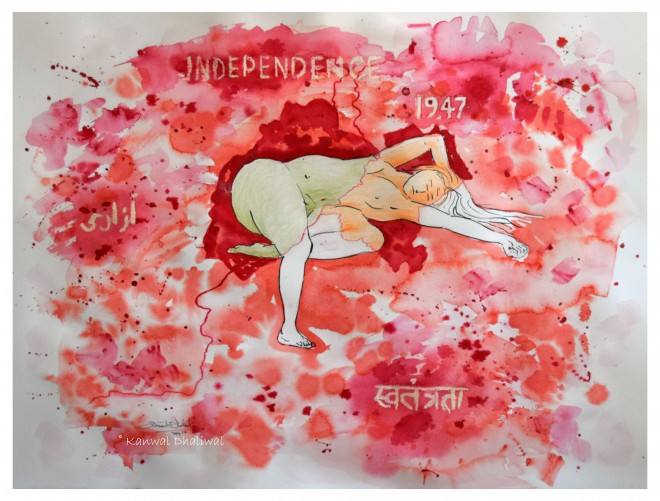
Nasty Women UK
This weekend, Stour Space in Hackney Wick will be transformed into a free art exhibition, packed with talks, comedy shows, DJ sets and spoken word performances, as well as live music and workshops. Alongside these creative events, there will be artwork on sale, with all proceeds going towards End Violence Against Women
The event is being put on as part of the Nasty Women global art movement, which began in New York to increase awareness for women’s rights, using art to channel freedom of speech and self-expression. The organisation brings together people of all genders, races, faiths and LGBTQIA identities, and its name comes from a comment Donald Trump made about Hilary Clinton during a televised debate. It has since become a rallying call for women who are standing up against misogyny and gender inequality.
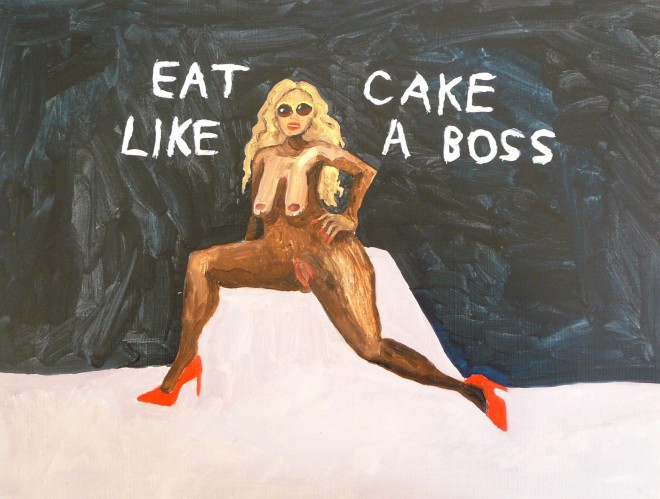
Eat Cake Like a Boss by Rachael Rebus_Image courtesy of the artist
Taking place across the weekend of the 23rd and 24th September, the multidisciplinary exhibition employs a variety of different art forms, including sculpture, street art, ceramics, and an immersive art installation in which visitors can create their own virtual artwork. Virtual Reality is a recurring theme throughout the exhibition, with other spaces recreating instances of street harassment and everyday sexism using VR, to give a visceral understanding of what those experiences are like.
Famed comedian Ava Vidal will be taking to the stage over the weekend, along with spoken word artists Salena Godden and Joelle Taylor. Included amongst those who have donated their work are experimental ceramicist Carrie Reichardt, and Louisa Johnson, the great granddaughter of Suffragette Emmeline Pankhurst. One of Johnson’s donated items is a handwritten letter by Pankhurst herself, written during her stay at Holloway Prison.
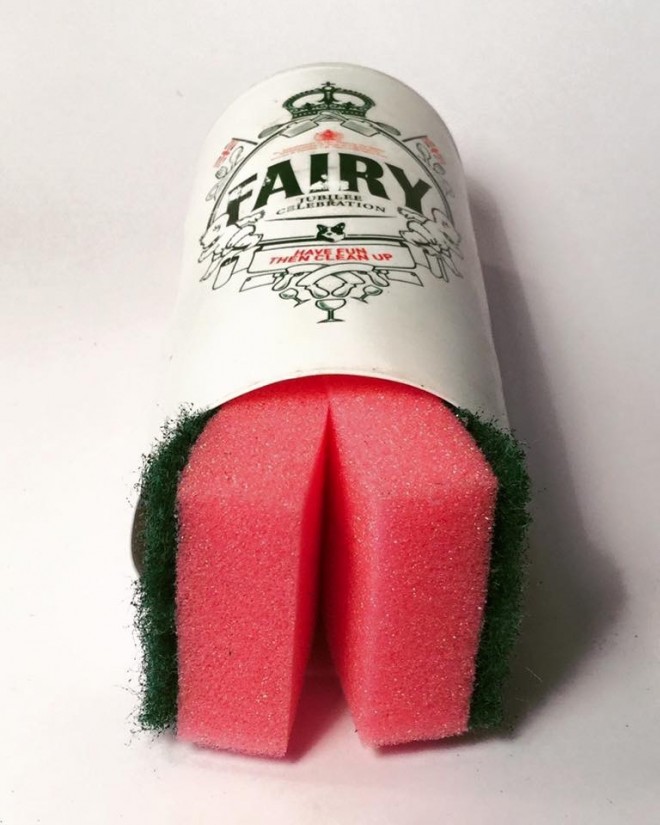
Fuck Washing Up_by Stacey Guthrie_Image courtesy of the artist
Nasty Women will be open on Saturday 23rd September and Sunday 24th September, from 9am until late, at Stour Space in Hackney Wick. http://www.nastywomenuk.com/
Tags: Feminism, Nasty Women
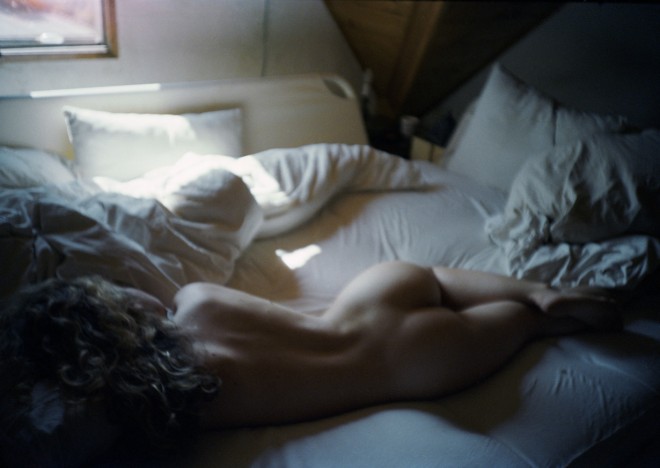
In bed with Cass Bird
Beds have always offered a world within a world, a place where sex, loss, pensiveness and commonality can all exist in the same place, and sometimes all at once. It is these dichotomies and juxtapositions that photographer Cass Bird plays with in a new exhibition at Red Hook Labs in New York.
This new series of portraits tells the story of her family, with pictures of wife Ali, and their two children weaving a story of laughter, intimacy and feeling connected.
Alongside familial images are examples of Bird’s fashion photography, which has featured in publications such as French Vogue and Wall Street Journal, as well as Twin magazine.
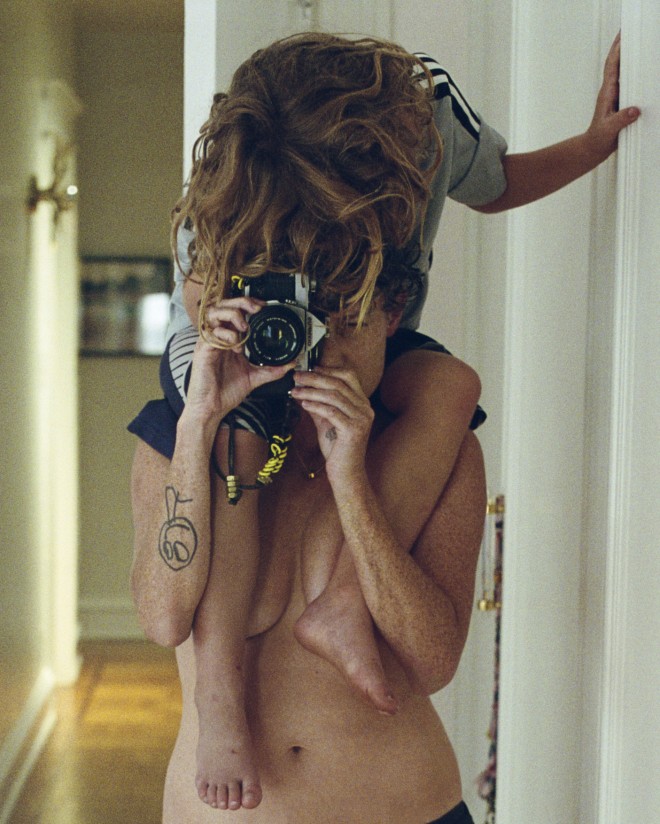
‘Self Portrait with Mae’ (2014), Photography Cass Bird
Here the same off-kilter, fluid and sensitive compositions relay an eye that is totally attuned to its subjects; whether it’s professional or personal, Cass Bird communes with these moments rather than directs them.
‘In Bed’ is on at Red Hook Labs, Brooklyn until September 24th.
Tags: Cass Bird, Feminism, feminist, feminist artist, Twin magazine
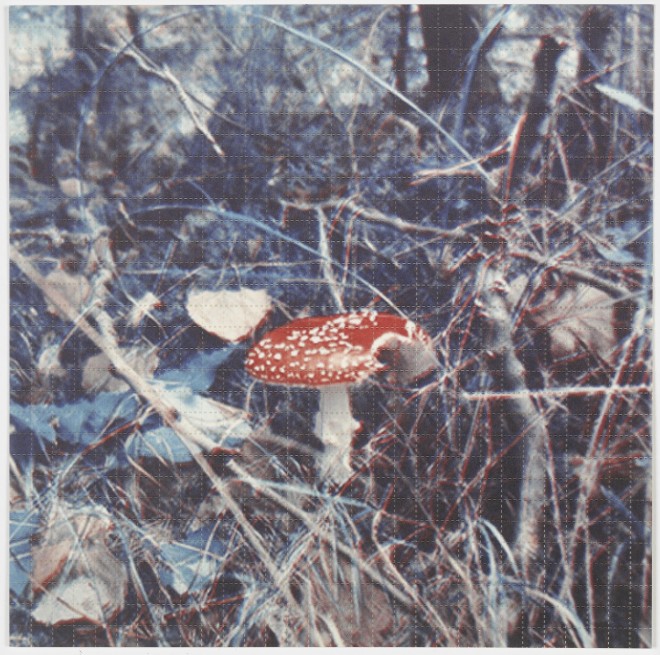
Champignons!
Francesca Gavin (Twin, Art Editor) curates a new exhibition in Paris, inspired by the cultural power of the humble champignon.
The exhibition explores the mushroom through cultural and historical narratives, focussing on how this simple fungi has operated at the heart of ritual for thousands of years.
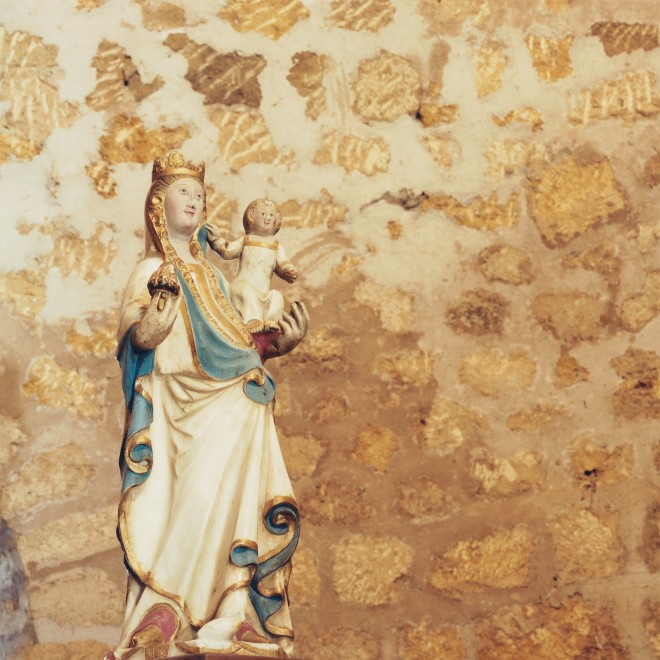
Hannah Collins, ‘The fragile feast, madonna and ceps.’ 2012 – 2017. | image courtesy of galeriepcp
“They were an early form of female empowerment” Peter Cybulski, of galeriepcp tells me, adding that women used mushrooms for a source of income throughout the 19th century.
Throughout contemporary art, the mushroom can also be seen as a source of inspiration, with creatives looking towards it for its ability to signify nature, as well as more abstract, and psychedelic references.
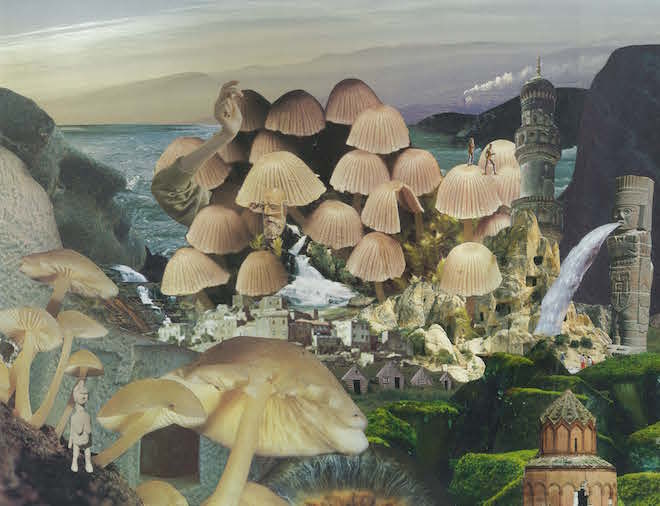
Seana Gavin, ‘mushroomscape’, 2017 | image courtesy of galeriepcp
Bringing together a diverse and exciting range of international artists which includes Hannah Collins, Sylvie Fleury, Seana Gavin, Carsten Holler and more. This new exhibition covers painting, collage, film and photography to offer an exciting and surprising survey of the mushroom, and the strangeness it embodies.
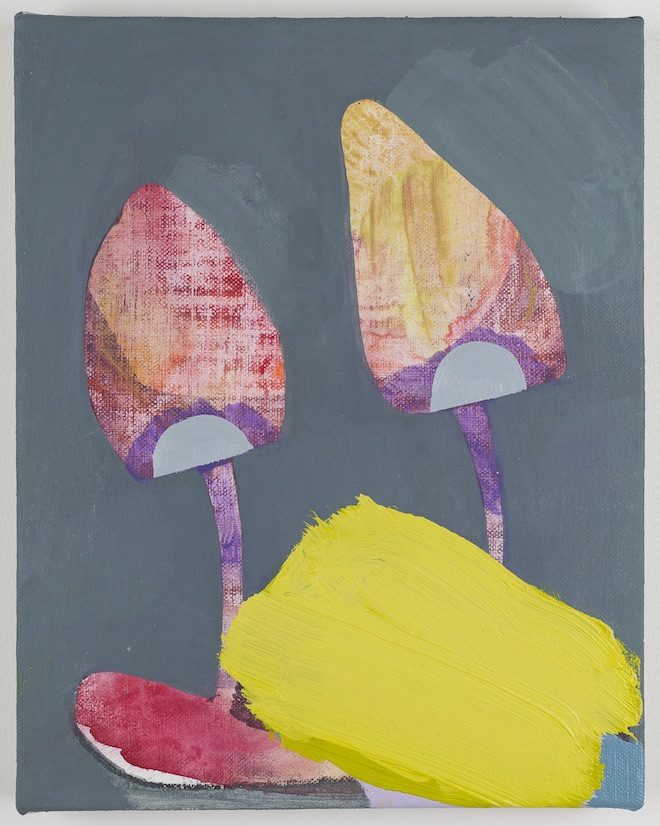
John Millei ‘maria sabina #1’, 2016 | image courtesy of galeriepcp
Champignons! curated by Francesca Gavin is at galeriepcp in Paris until 10th November 2017.
Tags: Art, Feminism, feminist, francesca gavin, twin, Twin magazine
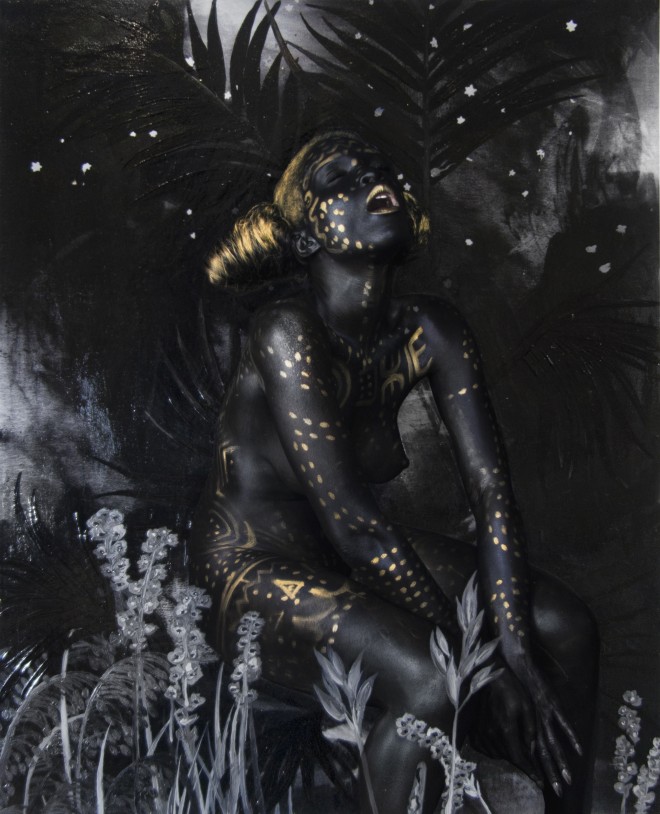
“A black and gold chapel, of sorts”: Artist Lina Viktor presents her fictional dystopia
From the 12th September to the 20th October, Amar Gallery in London will host Lina Iris Viktor’s first solo exhibition in the UK. Of British and Liberian heritage, Viktor explores narratives surrounding race and the African diaspora in her work.
Black Exodus brings together both new and existing abstract works, which have been made using Viktor’s trademark black and gold colour palette. This exhibition marks the first ‘Act’ in an evolving series for the artist, which reimagines artistic and socio-political definitions of blackness. Twin spoke to Viktor about the implications of her two-tone colour palate, and the exhibition’s roots in a mythologised dystopia where the black race no longer exists.
Black Exodus is based on a mythologised dystopia, where the black race has been extinguished. How do these works respond to that theoretical future?
These works are not literal interpretations of this theoretical concept, but rather investigatory visualisations that are very abstracted; the entire idea is completely abstract, though it may bare historical significance and relevance. My work has always been driven by concept. Whether or not I have chosen to clearly express the driving force, the conceptual narrative is central to the development of a body of work. On this occasion, I believed the concept was imperative to share when reading the work. However, these concepts are and never should be constricting.
All of my work is essentially a continual experiment – with concept, colour, and material stripping away all that is nonessential. The idea of a dystopic world where the black race no longer exists was conceived to illustrate how integral and essential the black race has and will always be to the development of humanity. It is more of an idea to keep in mind while viewing the work rather than a signifier that is sought through the work. The black in the work and the surrounding space is allegorical – as are all the hues, resonances, and finishes of black that are incorporated. Black is source: without it we all would cease to exist (as would light), so even theoretically it is an impossibility. But it is an interesting future to contemplate – especially with all that continues to be done to stymie the progress of those that belong to the African diaspora globally. It is our daily reality. I simply pose the question of a future without the black race, for the viewers’ contemplation rather than mine. I hope the works can further elaborate that question.
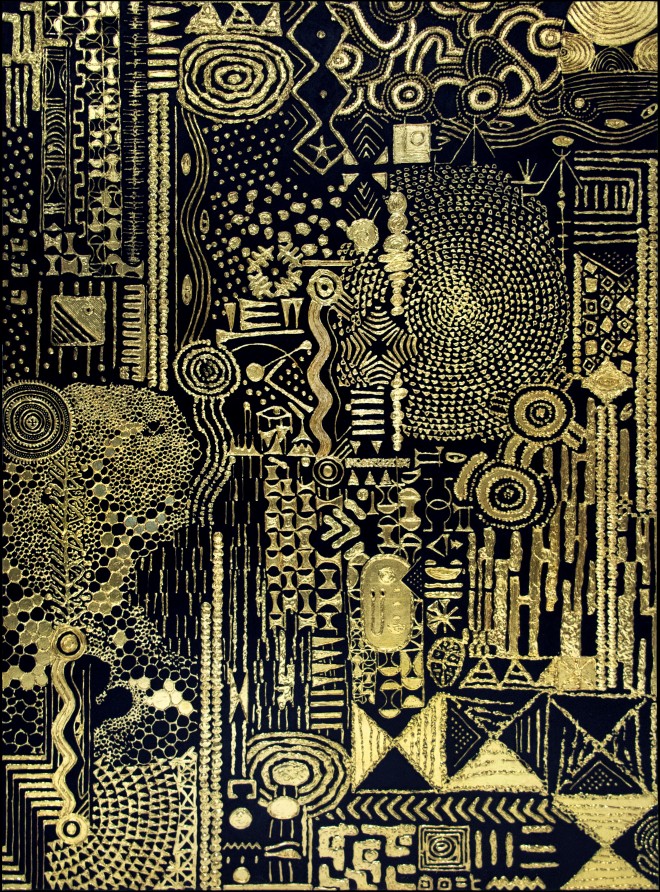
Lina Iris Viktor, Constellations III, Pure 24 Karat Gold, Acrylic, Gouache, Print on Matte Canvas 2016, Unique, courtesy the artist and Amar Gallery, London
Your colour palette for Black Exodus exclusively uses black and gold. What are the associations of those colours for you?
These are mainstays in my artist palette, which has always been very specific and focused. The departure into an entire body of works within this even more restricted palette was about stripping away all of the nonessential, and also seeing how far I could stretch and push these contrasting extremes into a series of unified works within a unified space. In my practice, black is a value – one polar extreme of the colour spectrum; it represents the full absorption of light within the colour spectrum and it contains all colours. Therefore it is completely saturated and colour-full. Gold is the closest to a godly metal one can find. Revered since its discovery, previous civilizations have likened it to the sun – a bearer of light – the immortal metal that will never tarnish, fade, or rust. Both black and gold hold light in very different frequencies and resonances; gold shines in the dark and requires very low-lit conditions to illuminate. In this exhibition, the gold imbued in light depicts the interconnectedness and interdependency of light to dark and vice versa. Both are required to appreciate the other.
This exhibition marks the first Act in an evolving series for you. How do you see the series developing?
I am already planning Act II for next year, and it will take the form of next solo show in New York. I grew up acting and in theatre, and I view each solo exhibition as a continuum, an intervention or revolt that is staged to counter what we have all been taught. This Act is called ‘Materia Prima’, meaning ‘first matter’, so it deals with the concepts expressed on a universal and primitive level through abstraction and limited palette. It addresses the relationship of light to dark, absence and presence et al. The next act will be an evolution from that, and it will be more topical and less abstracted. Essentially it will be the next chapter in my exodus story.
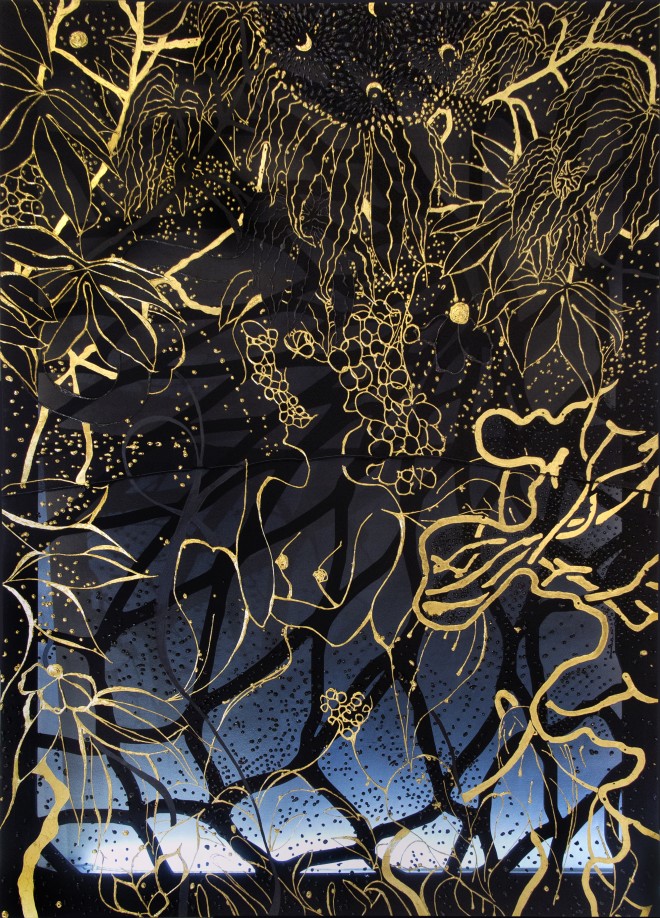
Lina Iris Viktor, Black Union Pure 24 Karat Gold, Acrylic, Charcoal, Poly Resin, Wood on Fabric 2017. Unique, courtesy the artist and Amar Gallery, London
How does this body of work depart from your previous collections?
I feel like all of my work is just a continued conversation that builds on the previous – each one poses more questions, and pushes me further technically and conceptually. But really, every artist only has a few good ideas that they delve deeper and deeper into over time. No matter how varied the work may appear, I have found that the core thesis is usually very consistent; they are essentially the questions you have been asking since you were born that you have yet to resolve.
This work is more complete as it is a suite of paintings, and it utilizes different creative processes to produce each – many processes that were experimental and will most likely be refined over time. I have become more open to the experimental aspect of work production – creating with less of a determined outcome.
Can you tell me a little bit about your artistic process?
A great deal of thinking and planning before execution. The execution happens quickly, but the preparation can take an age.
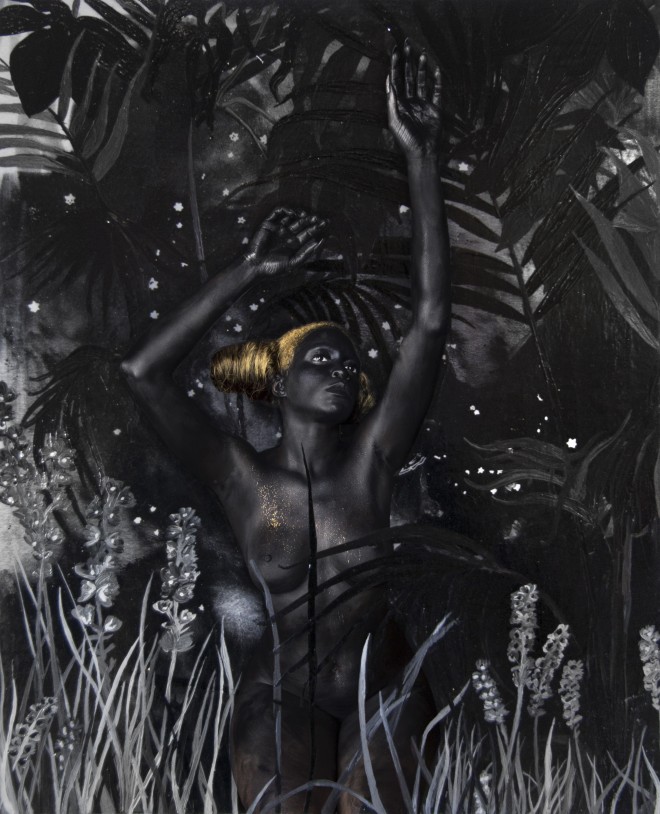
Lina Iris Viktor, Dark Continent No. XX _ A prophecy. And the scramble began . . . Acrylic, Ink, Print on Cotton Rag Paper _ 1 of 3 _ 2017, courtesy the artist and Amar Gallery, London
How does your work unite materials and methods from both contemporary and ancient art forms?
I gild with 24-karat gold, which is an ancient practice that I have modernized for my usage. I gild on a variety of substrates and materials that are not conventional within traditional gilding practices.
What do you hope people will take away from this exhibition?
I hope that it is somewhat of a visual assault, a slight overload for the senses in simple complexity. The works are very dense and the space is also limited, adding to the visual barrage. I want people to enjoy it on an aesthetic level, as well as really contemplate this theoretical concept when viewing the work. I just want them to hold that idea in their head and think about the implications. I believe anyone open enough to view my work will also be open enough to ponder this fictional dystopia. The space will be built to be one of contemplation – a black & gold chapel of sorts.
Lina Iris Viktor’s first solo UK show, Black Exodus: Act I, will be on display at the Amar Gallery in London from September 12 to October 20 amargallery.com
Tags: Feminism, Feminist art, Lina Viktor
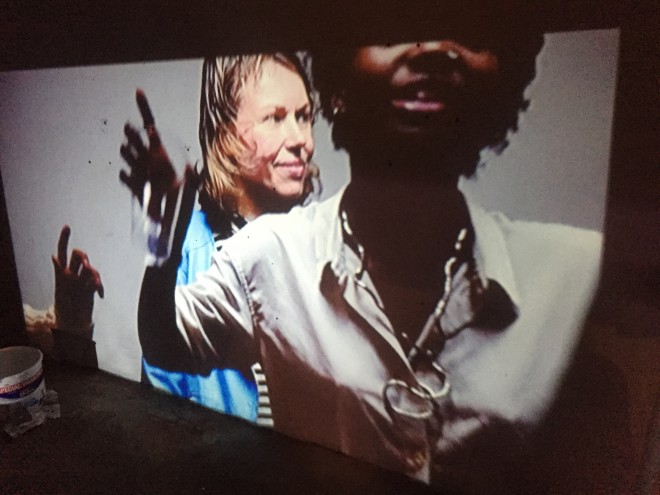
Lotte Andersen: Dance Therapy, Part III
The third and final instalment of Lotte Andersen’s project, Dance Therapy, Part III at V3 Gallery is an immersive exploration of community and the relationship we have we space and our environment.
A champion of youth and club culture, Andersen first made a major impact through ‘MAXILLA’ a cult night and zine which originated as a party for friends, and became a locus of energy for young Londoners everywhere. Since then, Lotte Andersen has enjoyed a fairly explosive career. Whether it’s Art Directing for major names such Stella McCartney x Adidas, organising panels or working on her own projects –the ability to shape, mould, capture and unleash the theatre of human existence in tandem with it actually unfolding renders Lotte a force to be reckoned with.
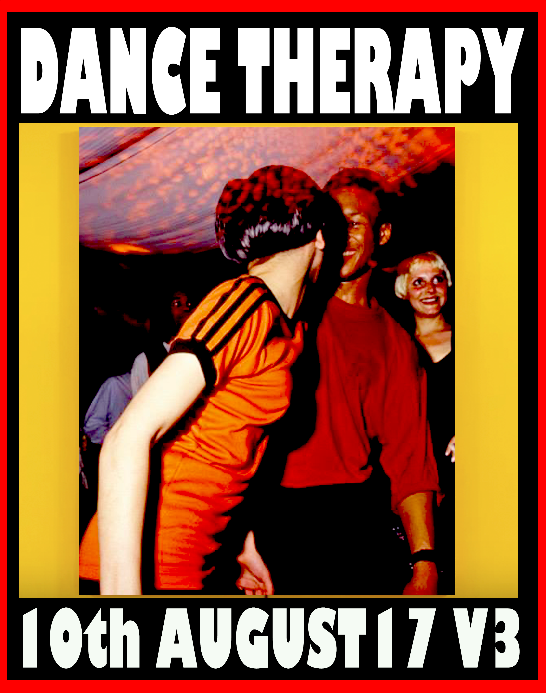
Dance Therapy, Part III is the latest instalment of a project that first began during Cairo Clarke’s curation ‘Touch Sensitive’. Catch this latest evolution until 19th August – a textured, multi-sensory experience in London that you don’t want to miss.
Tags: Lotte Andersen
Disco Ball Soul
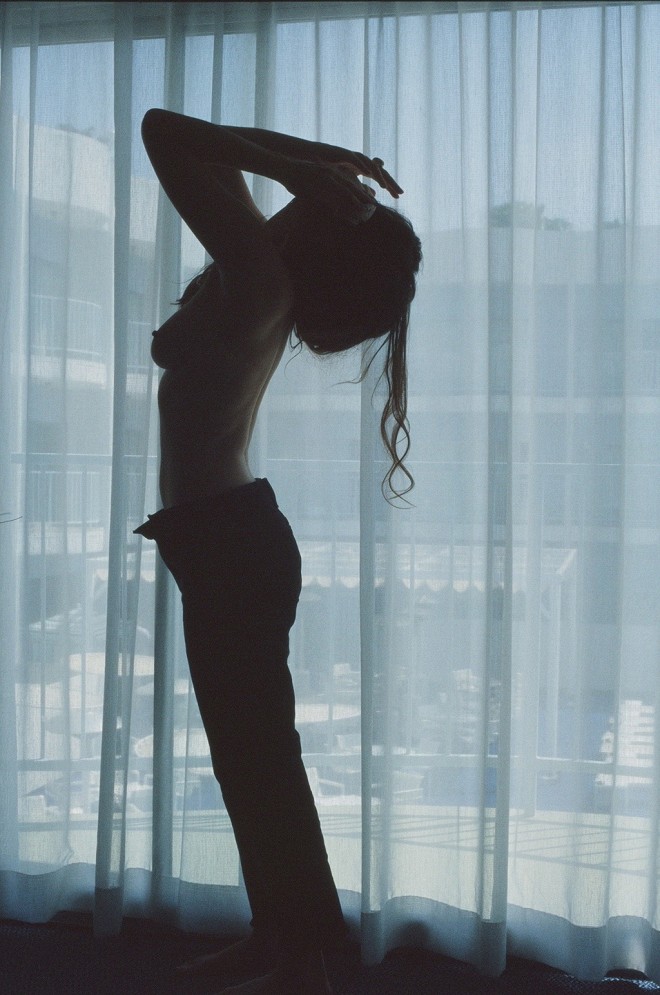
American photographer Emma Elizabeth Tillman comes to London this week with a new exhibition opening in Whitechapel. A long-time Twin favourite, Tillman’s portraits are intimate and watchful; her presence is always felt in the images but it doesn’t intrude.
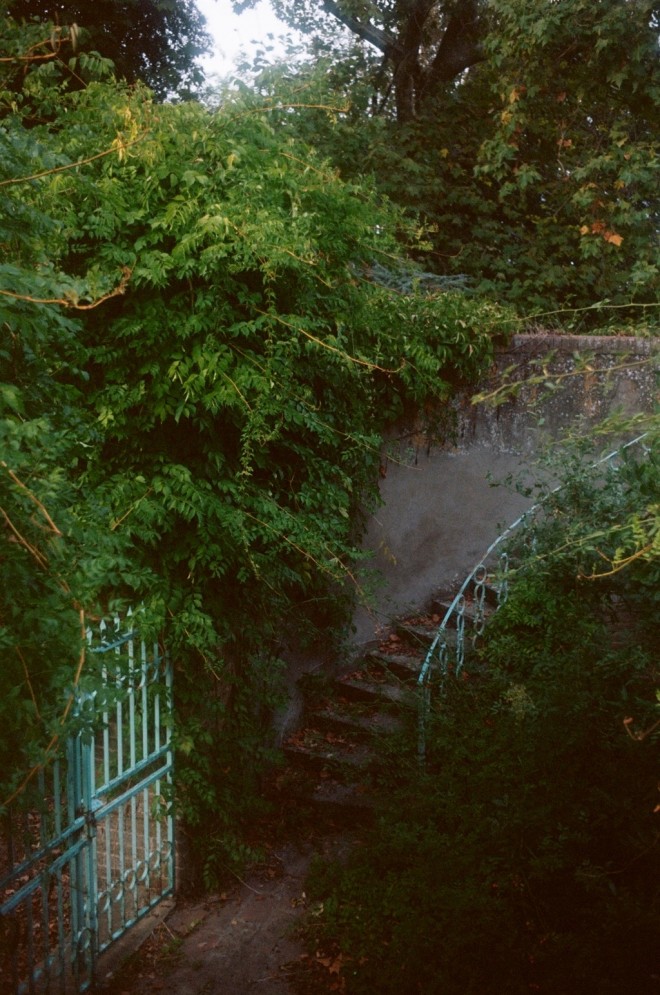
Tuscany, Italy, November 2015 © Emma Elizabeth Tillman, courtesy of the artist
From shots of sprawling nature to candid self portraits, the new exhibition and accompanying book offer an insight into her life over the last ten years with over 90 collages, as well as 14 large scale photographs. Photographs document her journeys through France, Arizona, Iceland and California; images are accompanied by diary extracts, providing in an all a memoir of an artist’s life
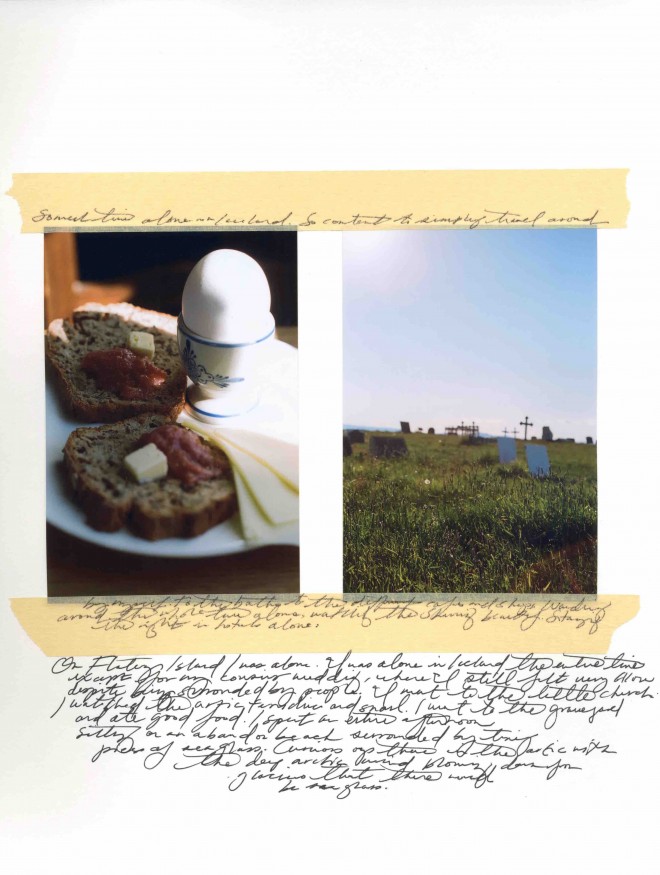
Iceland, 2010 © Emma Elizabeth Tillman, courtesy of the artist
Whether examining her own body, the forms of other women or the natural world around her, throughout Tillman’s work is a sense of working to stave off time, to build something concrete which cuts through the the waves: this new exhibition is a celebration of these moments of meaning, and sets an exciting precedent for Emma Tillman in the decade to come.
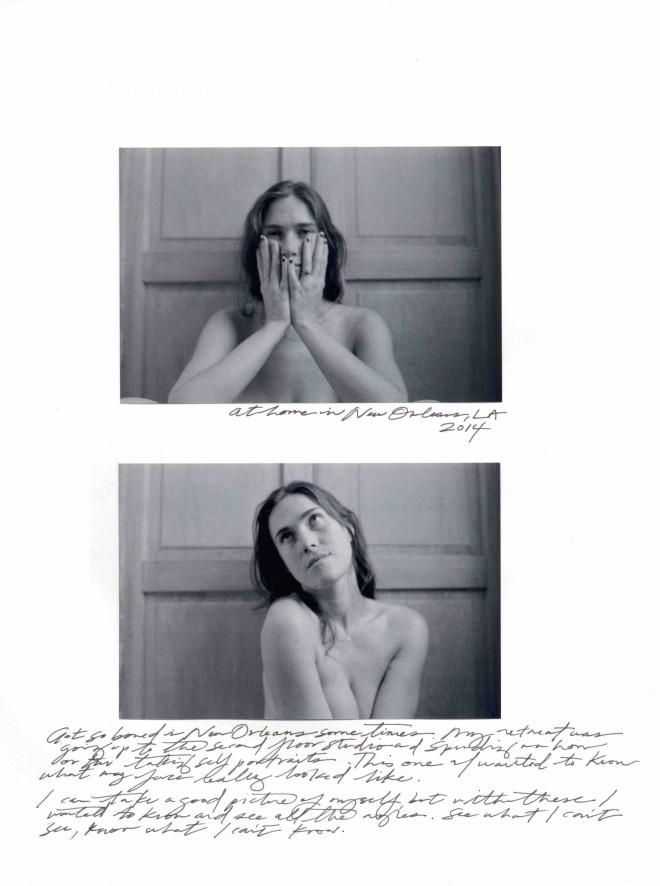
New Orleans, 2014 © Emma Elizabeth Tillman, courtesy of the artist
200 limited-edition signed copies of Disco Ball Soul, published by Dilettante Paper, will be available for purchase at the gallery.
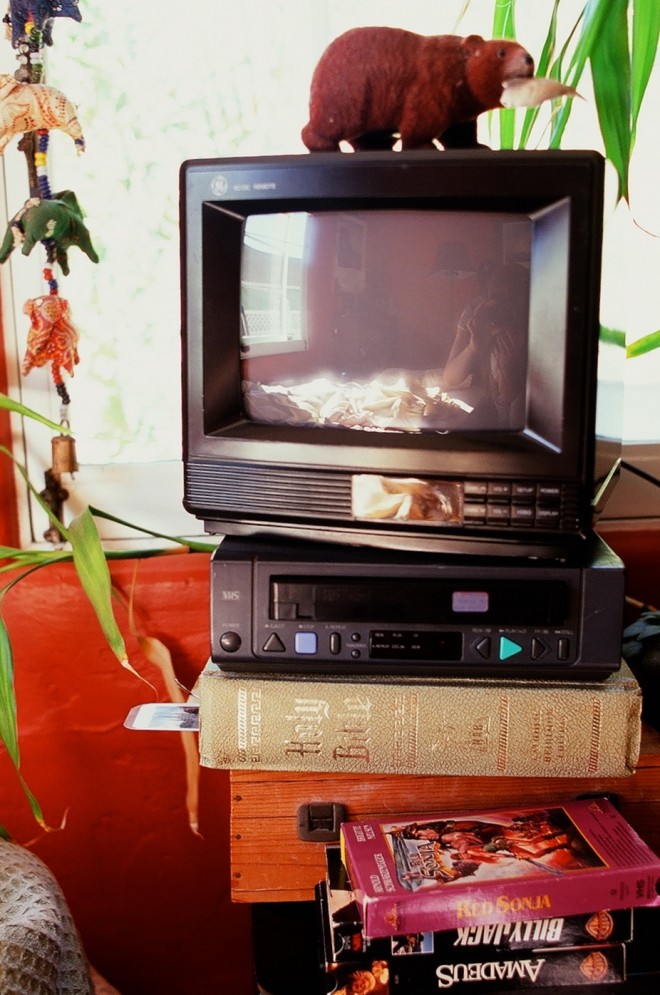
My Father’s Bedroom, 2015 © Emma Elizabeth Tillman, courtesy of the artist
Disco Ball Soul is at Gallery 46, Whitechapel 11th – 31st August 2017
Tags: emma elizabeth Tillman, Feminism, feminist, feminist photographer
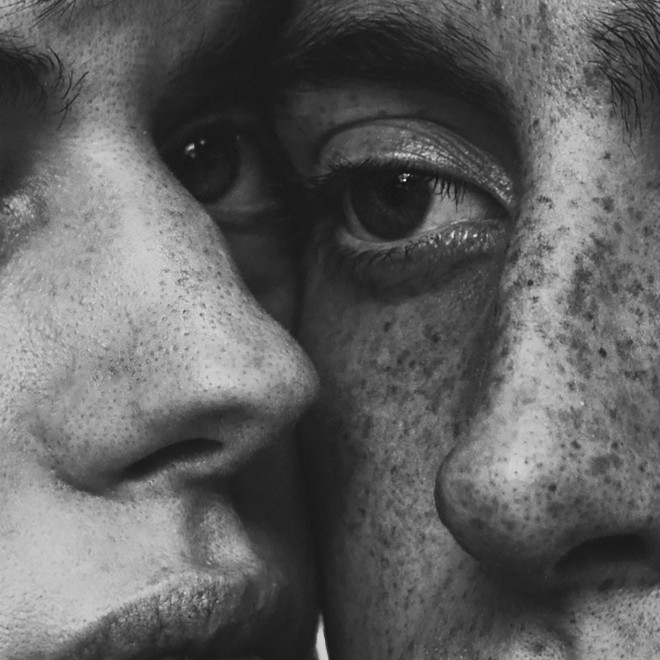
Helping People Feel Beautiful: Twin meets Sequoia Ziff
Born and raised in LA, photographer Sequoia Ziff has a magical way of merging fantasy and ultimate realness. Her photographs present human flaws in a complex light, holding in tension in a combination of vulnerability and spirit in striking, monochrome portraits. Ahead of her opening at Saatchi Gallery in London (where she is now based), Twin catches up with Sequoia to talk photography style and the magic of portraits.
How did you get started in photography and what’s your favourite camera to use?
I have known that I have wanted to be a photographer for as long as I can remember. It has always been my obsession. I worked on shoots through high school, decided not to go to college and have been living for it since. I am pretty low maintenance when it comes to gear, I found what works for me early on and have only made minor changes as my style has evolved. I have always worked with Canons, I started on film and now tend to work with the same camera for every shoot, a Canon 5d Mark 3.
Why black in white over colour?
Taste. A lot of the time, it’s just what I think looks better. It removes a sense of time and place and keeps the focus on connecting with the subject. I do love colour though….in moderation.
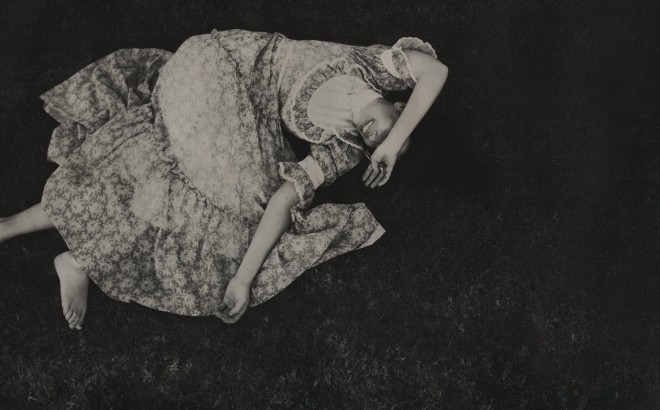
© Sequoia Ziff
Why portraiture?
I love people. Having your photo taken is a vulnerable process, and my job is to soul gaze all day long. That kind of vulnerability can be uncomfortable for people, and I enjoy helping people feel beautiful, just through the process of shooting them.
How did your style develop?
I have always been really specific in what I like aesthetically: old architecture, old movies, vintage clothes and a sense of timelessness. Anything that combines that with some haunted magical realism is always a bonus.
What is a good photograph to you?
One that makes you feel deep empathy and one that allows you to daydream.
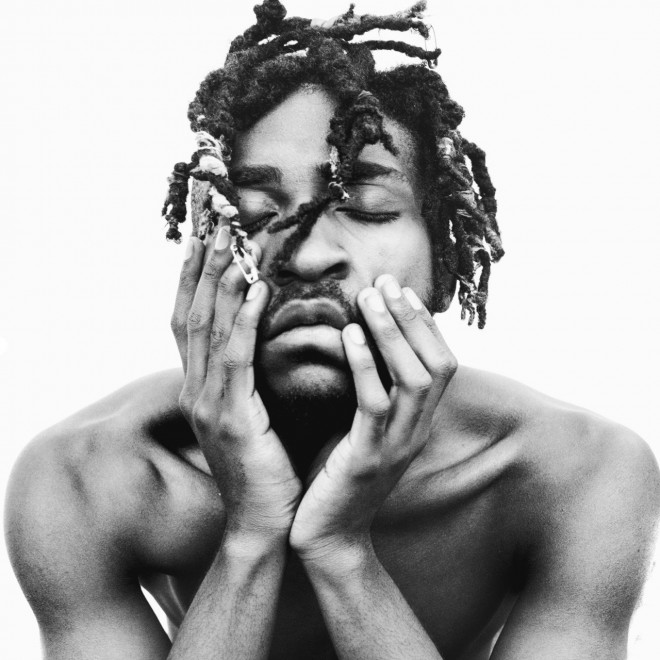
© Sequoia Ziff
Tell us about the worldwide tribe project. How did it come about?
I was the featured artist at Summit at Sea this year, the idea was to humanise the refugee crisis and dismantle the fear by bringing larger than life size portraits to the centre of the ship. I had known about the amazing work that Worldwide Tribe does and contacted them about partnering and ended up working with one of their partners on the ground in Greece documenting portraits and life in the camp. Excited that the show is coming to London next month, and will be featured at the Saatchi from August 9-31st.
Has Instagram helped or hindered the medium of photography?
Both. I think that social media is an amazing tool for photographers, and it has meant that upcoming generations are more invested and interested in photography than ever before. It’s made everyone a photographer. It means that as an artist, you are able to build a network and self promote to a much larger audience, and from anywhere in the world.
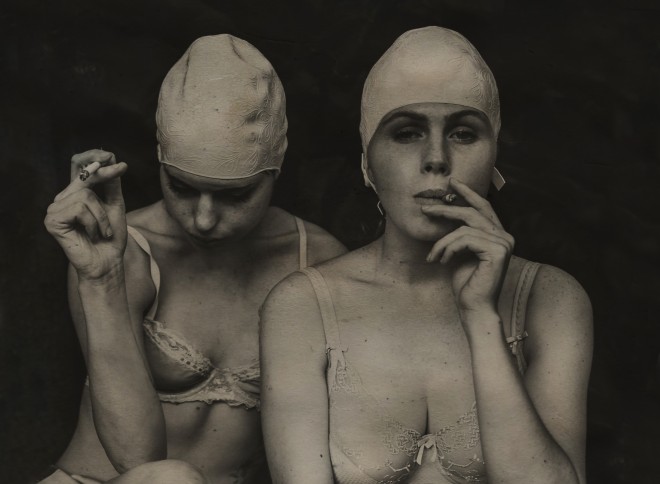
© Sequoia Ziff
As a user of social media, I’m exposed to so many awesome artists that I may not have discovered without platforms like Instagram. That being said, I think that art often doesn’t have the intended impact that it would offscreen and in person. For me, social media is more of a business tool than an artistic one and the more time that I spend off-screen, the more present, inspired, and grounded I feel.
What are your plans for the rest of 2017?
Shooting as usual. Since moving from LA to London, I have been working a lot in the music industry, so will continue to be shooting a bunch of album artwork and press shots for bands.
Worldwide Tribe exhibition is at Saatchi Gallery London, August 9th – 31st 2017
Tags: Feminism, feminism photography, feminist photographer, interview, Twin XVI
‘Our world is a riot of clashing images, sounds and smells’: Twin meets Nicholas Moore
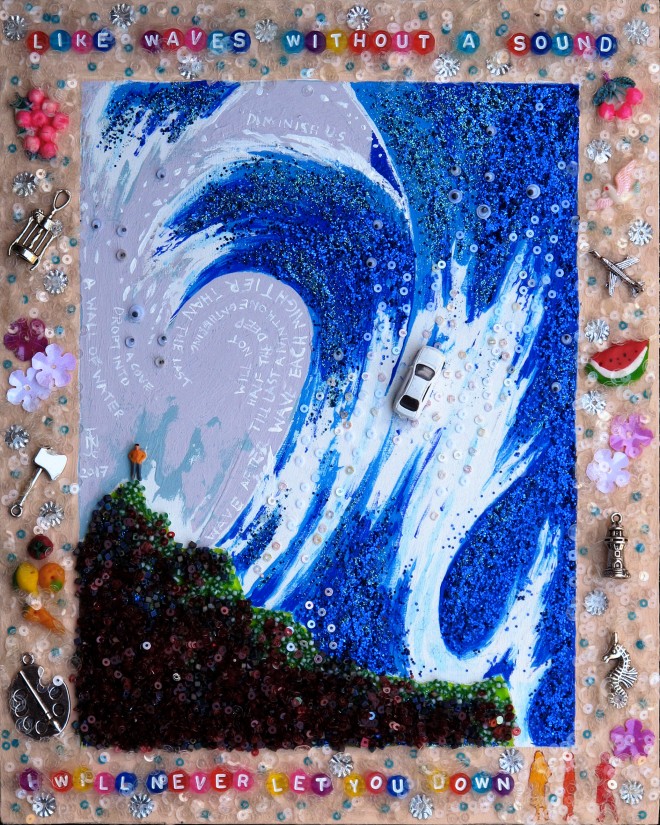
Joy, being a post-bear bearded gay man, Greece and copious sequins: Nicholas Moore is adept at bringing great overarching themes of love and identity and intricate techniques to create artistic works that are unmistakably his; dissecting a whole into independent moments of meaning, then bringing them back together into a final finished piece. Having spent much of his life in Crete, Syros and Athens, the Greek influence is consistently evident in his work, with motifs, soft light and poignant splashes of colour pervading early oil paintings which covered landscapes as well as portraits. Although now London-based, Moore worked from Athens before and during peak times of austerity, witnessing and participating in the artistic revival of the city in spite of the economic crises in the country. The last five years have seen a widening of his approach, working with assemblage and sculpture to offer textured portraits of both individuals and pockets of feeling. As he starts planning solo shows this autumn, Twin caught up with him to discuss ByzantoJapanese Pop, celebrating gay and trans culture and perceptions of masculinity in 2017.
Your work focusses on mythology and also on portraits of people, I’m interested in how you perceive the relationship between the two – do you find that the two feed and influence each other?
Mythology has been an obsession with me since childhood and it is the core to a lot of what I do. There are times where I make obvious allusions to various stories and myths and others where it informs the work subconsciously as it has been part of my life for so long. I also have a huge comic book collection dating back to the 30s. These are modern Myths, their continuing success shows us how important such stories are to us.
The figure is an important part of my work however I am hesitant to use the word portraiture as it conjures up a certain type of work that I don’t aspire too. My work is most definitely representative and I’m commissioned to make portraits, however my work is as much interested in portraying, ideas, stories and myths, as much as character and appearance. When I make a portrait of someone, I surround them with objects relating to them and their life. There will be texts, either quotes from favourite songs etc or a stream of conscious memories and associations I have about them. Sometimes in the bigger works I will also have texts directly relating to mythology.
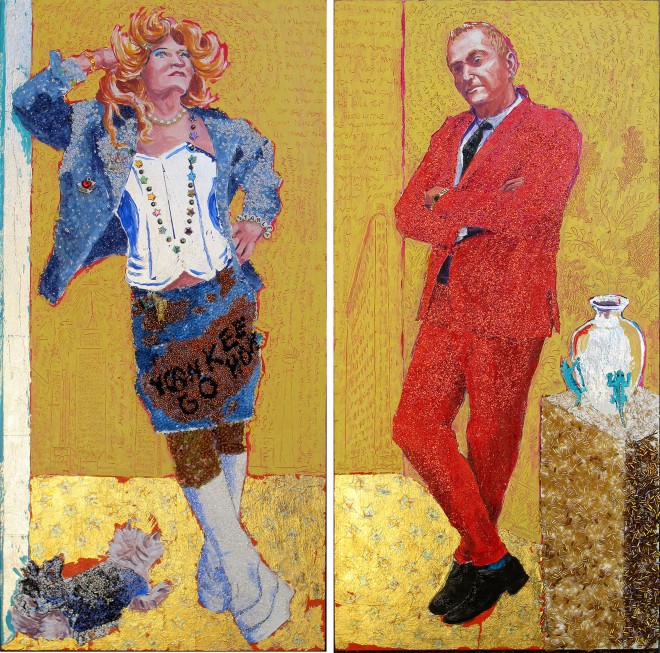
‘Stanley’, 2014 © Nicholas Moore
In this context I’m especially interested in how you depict the male body using mythological motifs. Do you feel that perceptions of masculinity have changed in recent times?
These things shift back and forth: just as you think things are all cool and dandy, someone calls you a poof on the streets – I didn’t expect that in 2017 ! Fluid sexuality, gay marriage, tolerance – all these other good things threaten those poor beleaguered straight men, so they fight back. Maybe in Europe and parts of America these perceptions have become more fragmented, and yet each of those fragments have a longer staying power than they once had. There are lots of different tribes in the gay community, I tend to get shunted into the ‘Bear’ community just by virtue of my beard. I am neither particularly fat nor hairy. It’s ridiculous, I’m Post-Bear! I would say the young (and the young at heart) care less about such things.
For your portraits, you often often focus on couples and dualities within one person. What is it about relationships that interests you as a subject?
I think it is more about the contrast between the two that interests me. I don’t paint these couples on the same panel, each individual has his own space, they then play against the other. The Stanley portrait being a good example of that. On one panel is his more serious business side versus his more playful ‘Hedwig’ role. I hosted a talk in a community collage in NYC about this painting. It was amusing to hear the students coming up with all these stories about who they thought he was. A few students got very involved in imagining his troubled life in the corporate world, and how he would find a release cross dressing at night – I hated to break it to them that, he was in fact a very happy guy, a Mexican silver dealer who just had a large sense of fun and a tad provocative. Who’s to say which version is the truth.
In recent years your focus has moved towards assemblage. What was it about the medium that interested you?
I had made small works using that medium in the 80s, but it wasn’t until my show in Athens in 2008 that I really started showing any. I had seen in the Topkapi museum an Ottoman miniature that was stuck on a page with seemingly random images surrounding it. I liked that, to my uneducated eyes, I could see no connection between the images. At the same time I had my first computer and the overlaying windows of different programs always fascinated me – how more and more disparate images were somehow ok within that context: the screen fixing the random images into one whole.
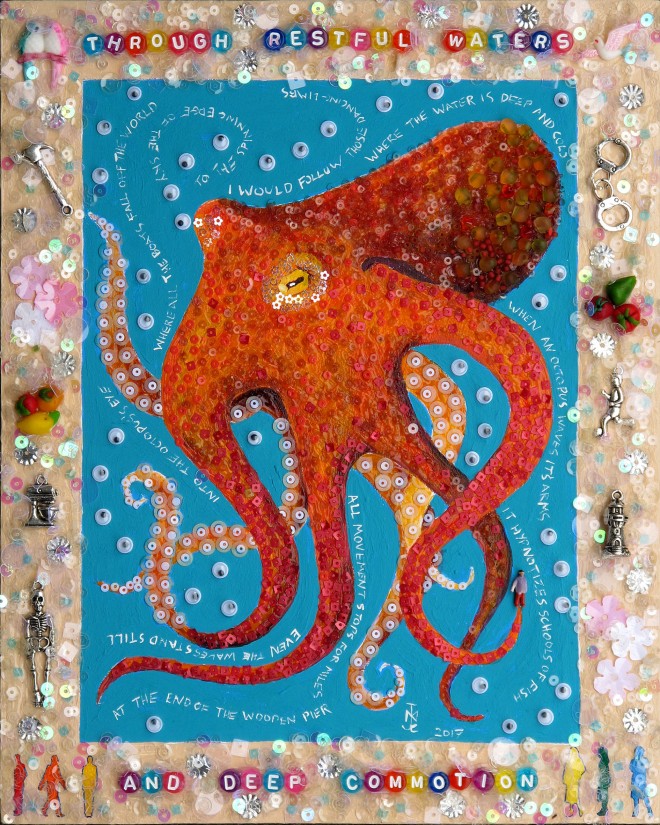
Last year I started to make images that were surrounded by borders that have charms, flowers, alphabet beads, etc. in them. This allows me to join disparate images together as if they were part of one of those cross-stitched samplers children used to make. I can then make larger images, sort of portraits of a person, from lots of seemingly disparate parts. In my series “The Last Lighthouse Keeper” the figure is broken into symbols: a leg is an octopus, an arm is a ray gun, and so on. Our world is not some marvellous minimalist construct but a riot of clashing images sounds and smells.
What are your favourite materials to work with? Do items assume significance once placed within the content of the portrait, or is it because they have significance that you choose them?
I still love working with paint but enjoy combining the different textures of paint, beads, sequins etc., layering different types of colour on top of each other. When I do someone’s portrait I ask them some set questions to get some ideas as to objects I could add, texts I could use, colour. This then governs what materials and objects I choose. In general I am fascinated with the power of objects and the personal history we attach to them. Also the cultural importance objects gain over time.
A previous interview classified your work as ‘Pop art’ – is that a label you feel represents what you do?
I feel ByzantoJapanese Pop is best.
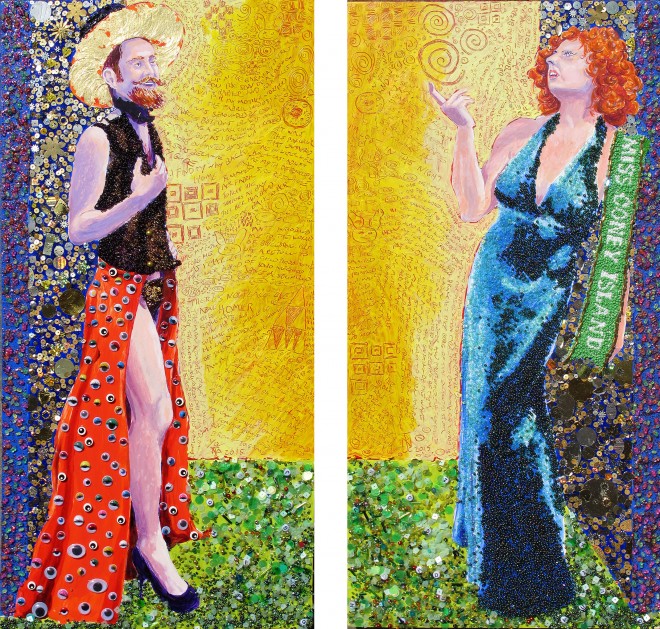
Matt and Lucy, 2015 © Nicholas Moore
More generally speaking, who and what are you influenced by?
Music, Mythology, Matisse, Sex, Humour, Colour and most of all Joy.
You spent a lot of time in Greece over the years, and that’s very present in your work. How would you describe the art scene in Athens at the moment?
Blossoming in adversity: I love Athens. Like everywhere else it’s hard for artists to survive financially. However it’s cheaper than a lot of places to live and work in, assuming of course you are not trying to live off a Greek income. There is the gallery scene which, though abundant, is again like elsewhere – struggling with sales. There is a huge street art scene and a strong sense of political struggle in a lot of the work.
What’s in store for the rest of 2017?
I was just in an exhibition at the Stash GalleryVout-O-Renee’s to raise funds for survivors of Grenfell fire, which has a strong resonance for me as I lost my Mother in a hotel fire. In September I’ll be showing at the Mykonos Biennale and later in September I’m part of a group show in Amherst Massachusetts America. Then I’ll be focussing on upcoming solo shows in Athens and New York.
Nicholas Moore will be on show at the Mykonos Biennale, from 1st September and at Hampden Gallery, Massachusetts from September 10th.
Tags: artist, london, nicholas moore
Jackie Nickerson: On Portraiture
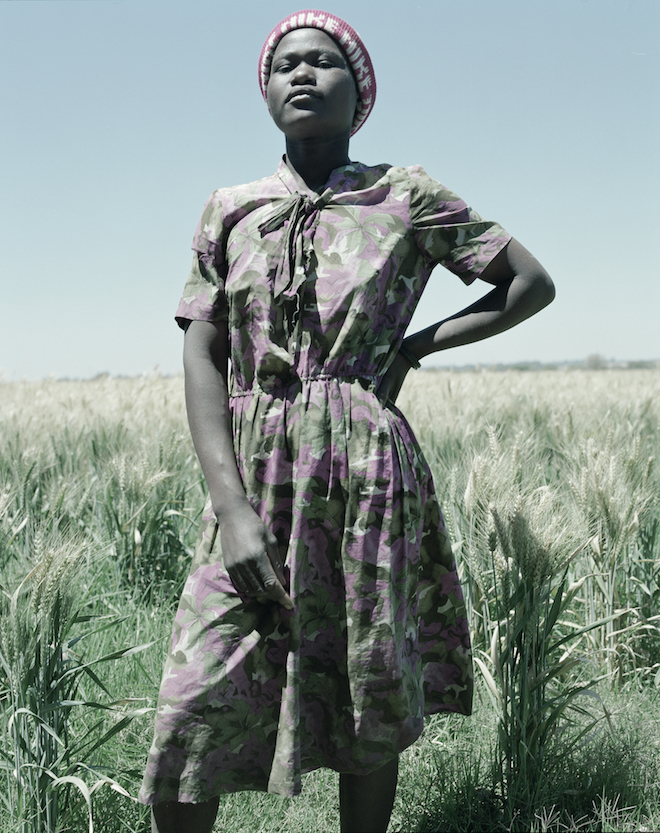
Portraiture has the power to envelop a subject, and the ability to absorb the viewer through one mesmerising shot. The quiet poignancy of the work of Jackie Nickerson aligns these two traits, her photography exploring the spatial relationships of faces to places and expressing the interaction of identity with function and form. Speaking to Twin, Jackie discusses ownership, collaboration and female representation.
What does identity mean to you and how do you try to explore this in your imagery?
Identity is quite a dangerous word. It’s used to create an otherness but I don’t look for otherness – I just look at the person. I want to see the ‘personness’, not the box they fit into. In fact, I want to break them out of the box they’ve been put into. So you are not merely looking at the likeness of someone. I guess for me it’s about having a uniqueness, a selfhood, and a self-possession that transcends the intervention of the artist. In effect, it’s about making the artist invisible and having the sitter take ownership of their own image.
You discuss your work as portraiture: what do you believe a portrait should present to the viewer?
A great portrait should stop you in your tracks and have you spellbound – like a deer in headlights. It should ask all kinds of questions.
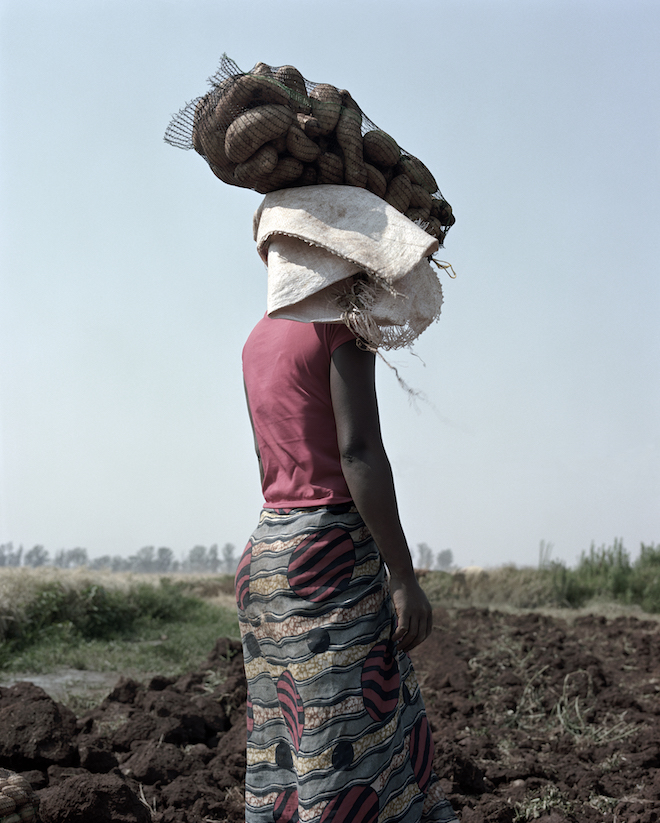
‘Ruth, 2012’ © Jackie Nickerson. Courtesy the artist and Jack Shainman Gallery, New York
Do you have the same desires for the outcome of your personal and commissioned fashion-orientated work?
Fine art and fashion are two totally different applications of photography, so although you’re using the same medium you need to use an entirely different approach. In fashion you have an end use, a specific use and you’re collaborating with a team of people to create this. In fine art you’re working on your own and trying to ask questions.
In your conversation with Brendan Rooney for the UNIFORM exhibition catalogue, you discussed the issues of photographers in art today: they seek inspiration from the real world yet don’t feel comfortable using the real world itself. What role do you think reality has to play in commissioned fashion editorial?
I think we all look for inspiration from things outside our immediate practice so for example a designer might look at architecture or industrial design, painting, sculpture and other art forms. But often they’re not looking for a literal translation of one thing to another, but a kind of wider context of an aesthetic or opinion. So in collaborations we can build up an impression or atmosphere that will help the designer to portray his or her vision. So for me, each collaboration is a separate conversation and working out how we can make images that respect that, and although you need to use an entirely different approach, (we’re talking about two totally different applications of photography) it would be difficult to separate the artist because I think about imagery all the time. I’m obsessed. Its just part of my everyday life.
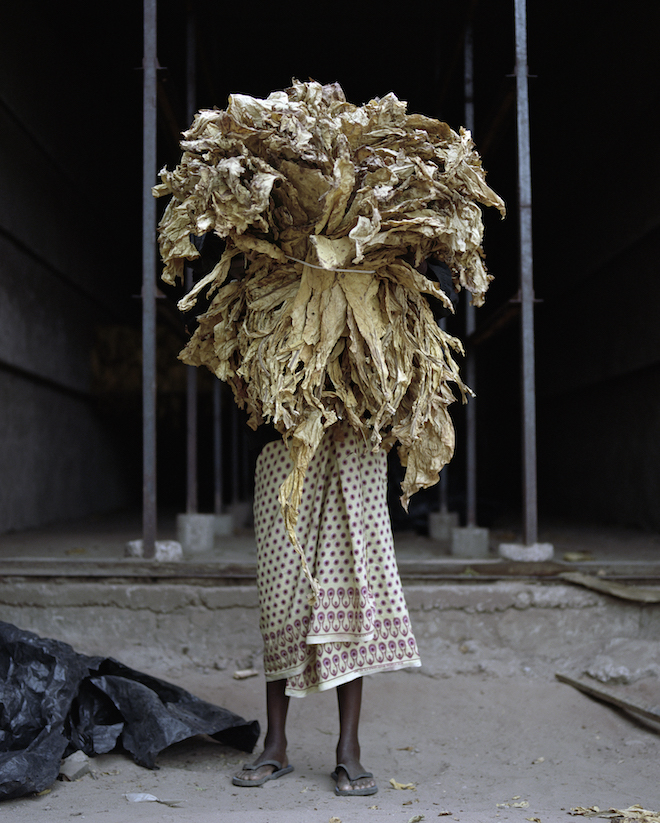
‘Catherine, 2013’ © Jackie Nickerson. Courtesy the artist and Jack Shainman Gallery, New York
What are your views on the representation of females in fashion photography today?
I recently bought a couple of vintage Vogues from the 1950s and apart from the clothes, and apart from a stylistic difference, I don’t think the imagery has, in essence, moved on because
you know we are looking at a commercial application and there’s obviously a formula that works. Saying that, in those old Vogues, there was only one way for a woman to be. Now there’s much wider representation of different types of women and lifestyles. I think the attitude and personality of the model is becoming more important and we are seeing a broader definition of beauty.
Do you hold a particular affinity to the women you photograph?
It depends on who I’m photographing and what I’m photographing them for.
Can the female gaze be reciprocal? Is that the most important link between the female photographer to her subject?
I don’t think of myself as a female photographer. I’m just me.
Communication is the key. When I photograph women I want to show the strength in them. I’m not interested in models flirting with the camera. I really hate that shit.
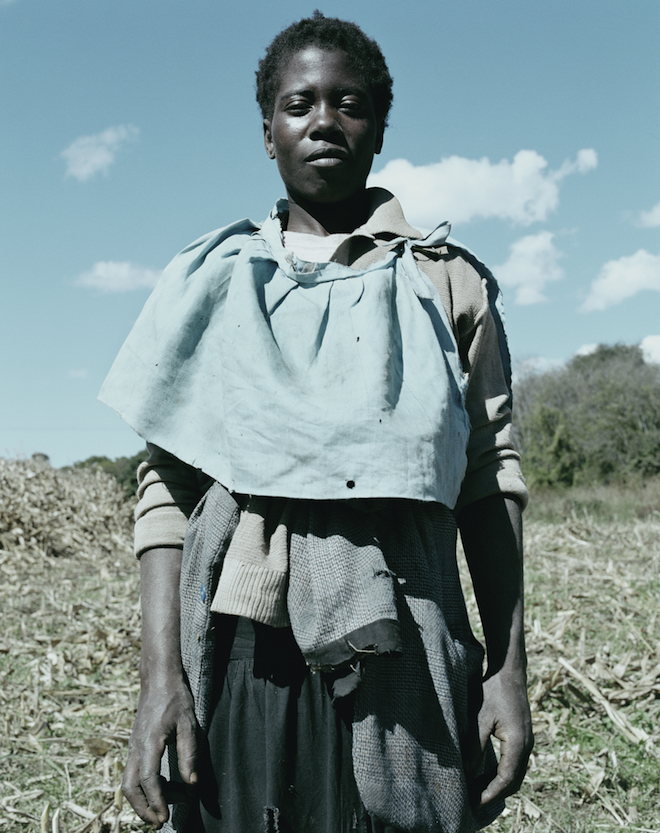
‘Monica 1997’ © Jackie Nickerson. Courtesy the artist and Jack Shainman Gallery, New York
What photographers do you admire, and what traits do you admire about them?
Well there are loads of them but a couple would be Dorothea Lange, Lee Miller, Joseph Koudelka, Cindy Sherman, I love these photographers primarily because they are great photographers but I love them because they all had something to overcome – Lee Miller, Dorothea Lange, Cindy Sherman – women in a man’s world, Koudelka – Czechoslovakia in ’68.
Featured image: ‘Chipo, 1997’ © Jackie Nickerson. Courtesy the artist and Jack Shainman Gallery, New York
Tags: Feminism, Feminism and art, feminist magazine, Jackie Nickerson interview, Twin issue XVI, Twin magazine interview
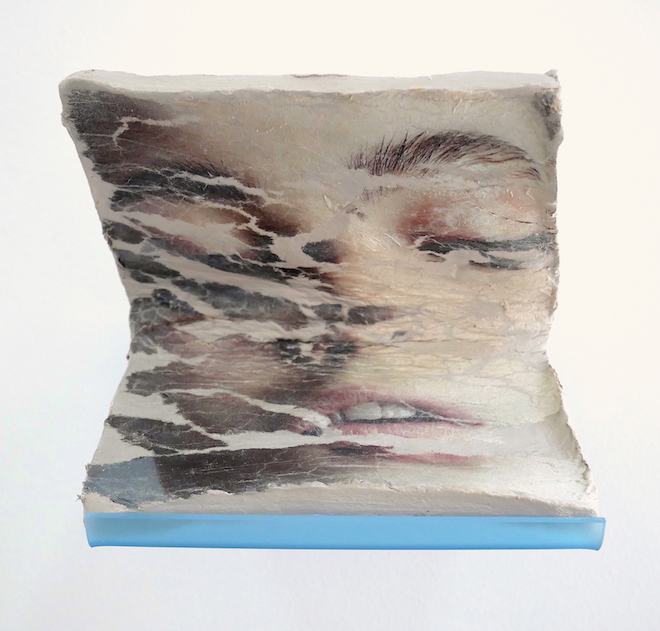
FACIAL RECOGNITION: A two-woman show
Dealing in themes of feminine representation in the media and the body at large, ‘Facial Recognition’ takes the work of two celebrated British-born artists and turns it into a striking visual dialogue. Images from glossy media form the basis of Melissa Jordan and Eve Ackroyd’s work; subjects are warped and reimagined, transported into otherworldly places, where the traditional figurative is given a new freedom of form.
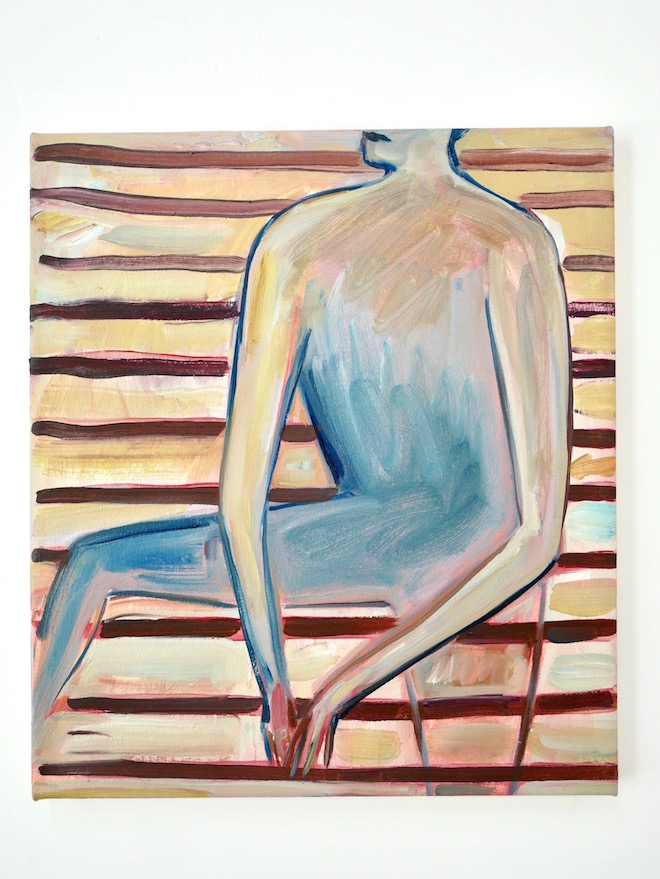
‘Slats’, Eve Ackroyd
Jordan’s work features process-led clay sculptures, Ackroyd is solely a painter; and while in execution their work is very different, the thematic undercurrents and inherent symbolism of their subjects live intuitively in quite a similar space. The artists explain: ‘Trapped in a state of conflict between the visual narratives of their new world and the expressive postures of their past, these paintings and sculptures exist in a remote place, caught in expressions of restlessness and desire’.
The show runs from July 14-22, by appointment at Convoy Projects.
Convoyprojects.com
Main image: ‘Interface 26’, Melissa Jordan
Tags: Art, convoy projects, Eve Ackroyd, exhibition, facial recognition, Melissa Jordan
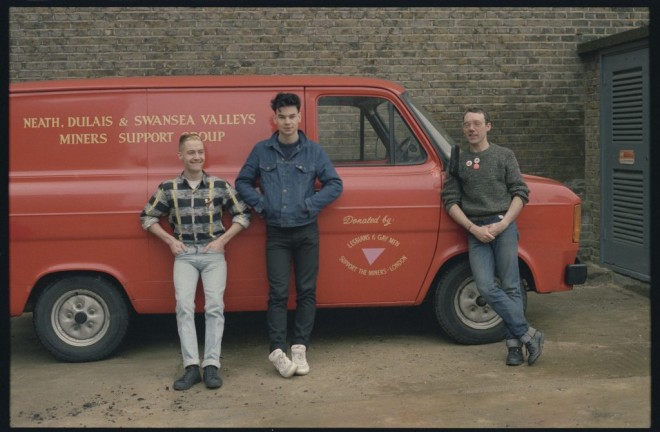
Love Happens Here: celebrating the 50th anniversary of the decriminalization of homosexuality
‘Love Happens Here’ is a commemorative exhibition that celebrates the historic struggle of the LBGTIQI movement. Presented by The Photographer’s Gallery off-site at City Hall, the exhibition displays a range of visual perspectives from London’s LBGTIQI community.
Constructed to mark the 50th anniversary of the decriminalisation of homosexuality in England and Wales, ‘Love Happens Here’ tracks the progression towards equality for the LBGTIQI community, since the milestone legislation was first introduced in 1967.

Emily Rose England, Inside London’s Enduring Queer Club Scene, 2016 | © Emily Rose England. Courtesy the artist
Included in the exhibition are works by prolific arts editor Ian David Baker, who worked for several gay magazines in the 1980s, and who documents early Pride parades through his black and white photographs. Reggie Blennerhassett provides intimate snapshots from the Greater London Council’s Lesbian and Gay Centre, allowing a candid insight into the Labour funded space, which was founded in 1984. Emily Rose England, who is both a photographer and an organiser for club night Sassitude, explores the currency of London’s vibrant clubbing scene.

Ian David Baker, Pride, 1980 | © Ian David Baker. Courtesy the artist
Curated by Karen McQuaid for London Mayor Sadiq Khan, every aspect of the exhibition has been designed to reflect the work of the LBGTIQI community. This includes the font, which is appropriately Gilbert, and commemorates Gilbert Baker, the artist, gay rights activist and designer of the iconic rainbow flag in 1978. Gilbert passed away earlier this year, and the font was created in his honour.
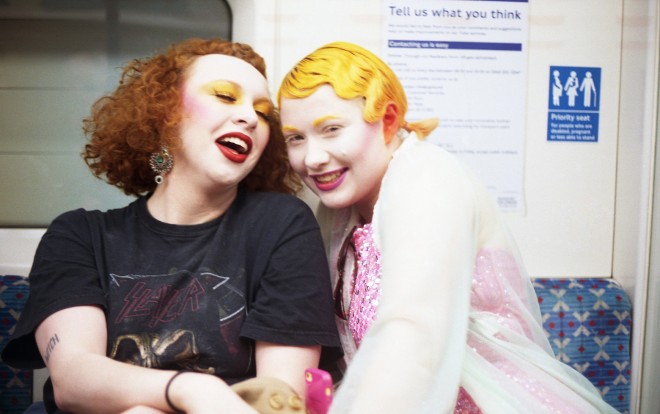
Emily Rose England, Inside London’s Enduring Queer Club Scene, 2016 | © Emily Rose England. Courtesy the artist
Other works on display are portraits by Anthony Luvera, Kate Elliott and Tania Olive, who each address gender, sexual identity and global politics through their studies of Londoners from the LGBTIQI community.
‘Love Happens Here’ will be on display at City Hall until 28th July.
(Title image credit: Reggie Blennerhassett, Outside London Lesbian and Gay Centre, early 1980s | © Reggie Blennerhassett. Courtesy the artist)
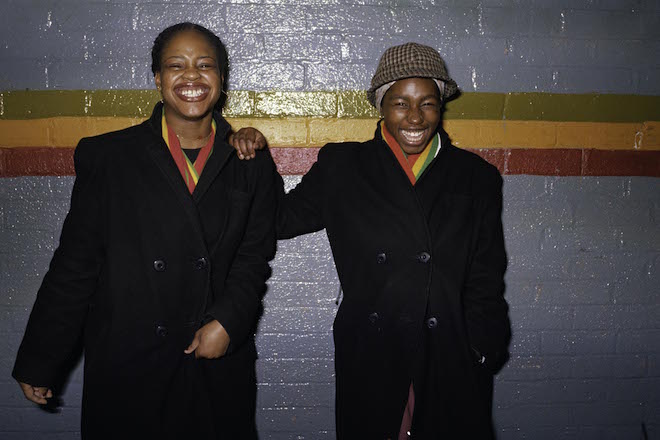
Forging solidarity in Anita Corbin’s ‘Visible Girls: Revisited’
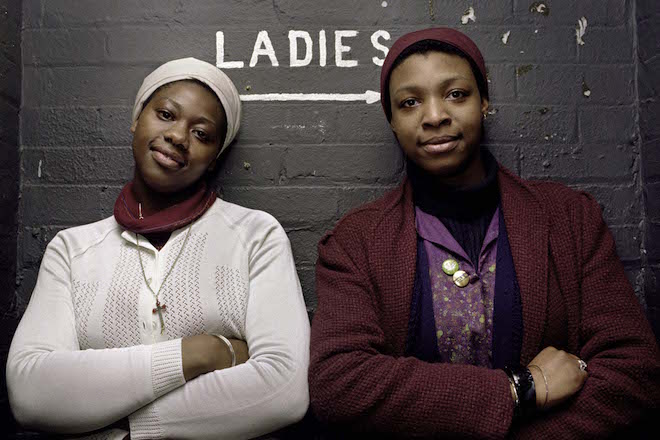
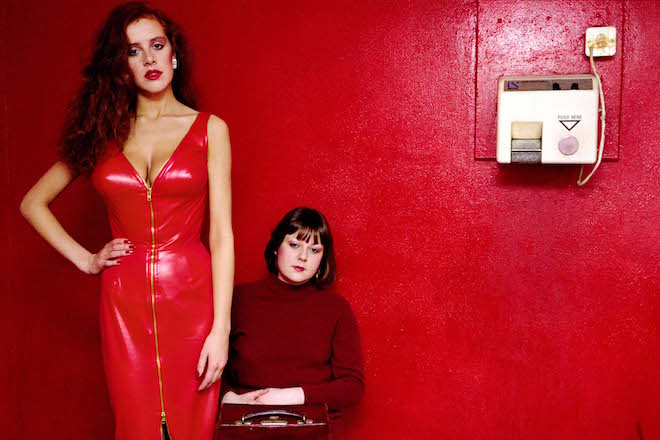
In the early 1980’s 22 year old photographer Anita Corbin captured the lives of women from different subcultures in the UK. Photographed mainly in London, the project documented the power of female friendship and individuality, offering candid portraits of their everyday lives. From mods to new romantics, rockabillies to punks, Corbin (who was just starting her career at the time) told the story of these women in their natural habitats, whether that was at friends house’s or social centres.
The project was called ‘Visible Girls‘ and Corbin’s 28 images toured the UK throughout the 1980’s and 1990’s, garnering acclaim both for her subject matter and for her photography style, which saw her shoot in slow film and with a portable flash.
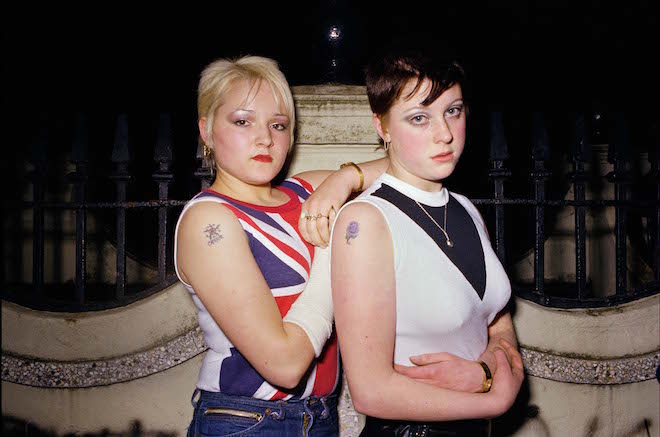
21.tif
36 years later, Anita decided to find the women and offer a new series that centred on who the women have become. Having tracked down over 70% of those she photographed, Visible Girls:Revisited is a radical and vital examination of age and identity; an exhibition which allows individual spirit to transcend time.
The original portraits will be showcased alongside the new series, and audiences can also listen to original tape recordings from interviews in 1981.
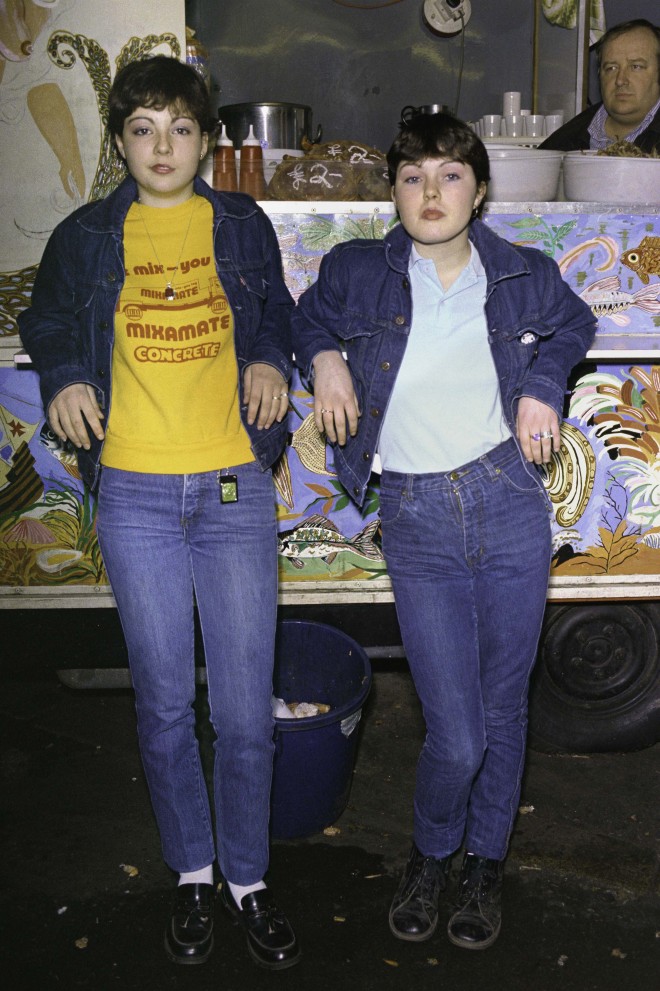
© Anita Corbin
“This exhibition is not only about the powerful bond between women united by subculture, belief and friendship, but about the potential of women coming together across generations.” Says Anita, reflecting on the forthcoming exhibition. “Visible Girls: Revisited, allows the ‘visibility’ of youth to shine a light on the often-disregarded wisdom of the older woman, revealing a unique, cross-generational tribe with the power to provoke and inspire.”
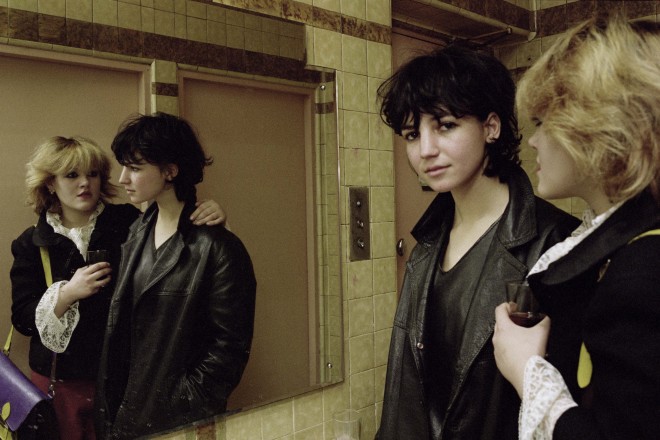
© Anita Corbin
Launching in Hull, the exhibition will tour Norwich, Exeter and Bristol, with other spots to be announced soon. In an age where so much emphasis is placed on the power of a fleeting selfie, this tribute to female friendship, culture and style across decades is, kind of ironically giving the time lapse, offers a fresh approach to how women are depicted today.
“This is an exhibition where mothers and daughters will find mutually provocative ground through which to forge a rare solidarity” adds Anita. “At this point in our history we need [that] more than ever.”
© Anita Corbin
Anita Corbin ‘Visible Women: Revisited’ runs 7th July 2017 – 8th October 2018.
© Anita Corbin
Tags: feminist artist, feminsm, Twin issue XVI
The Female Japanese Photographers to Watch
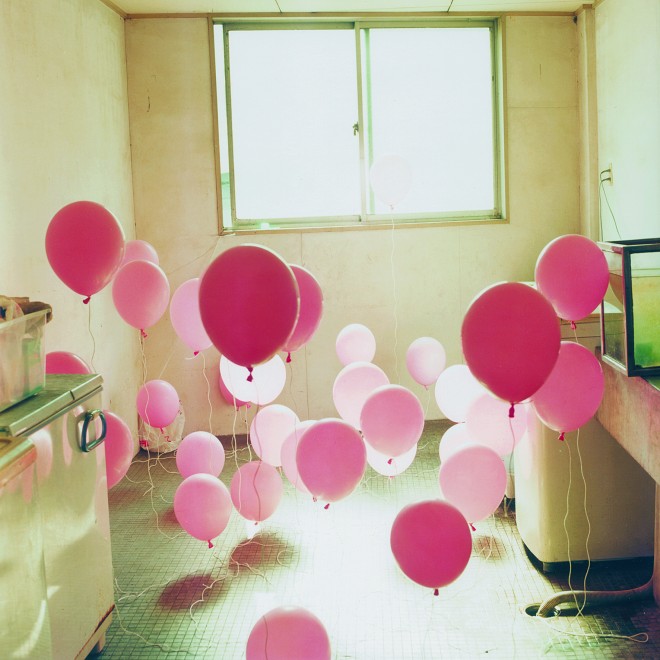
Until early July, IBASHO Gallery in Antwerp will host the works of twelve young female photographers from Japan. IBASHO means ‘a place where you can be yourself’ in Japanese, and the gallery consistently displays stunning Japanese photography in its many forms.
The title of this show is ‘Female Force from Japan’, and it includes photographs from an array of young female artists, with images ranging from the raw and unpolished, to the minimalist and still.
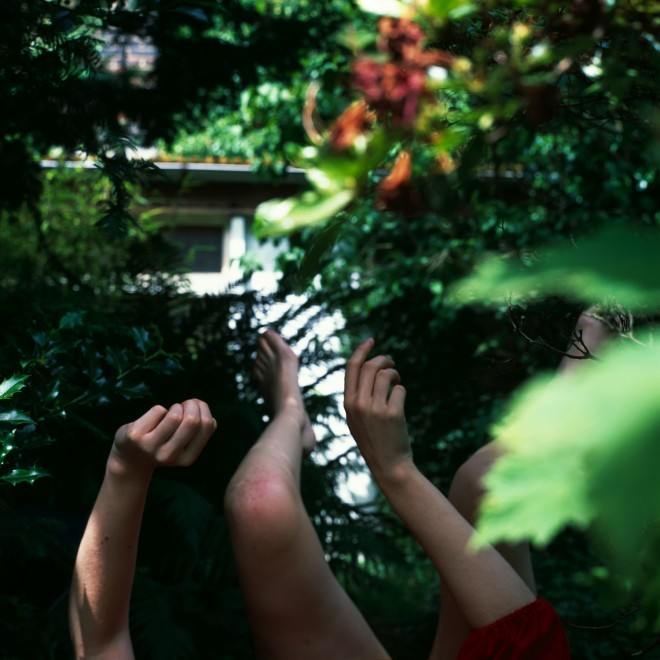
Kumi Oguro, ‘Drift’ 2015
The exhibition will display selected images from artist Yukari Chikura’s series ‘Fluorite Fantasia’, a very personal body of work that deals with the death of her father. Photographer Mikoko Hara presents a selection of her square-formatted photographs, all taken without using a viewfinder, and London-based photographer Akiko Takizawa exhibits images that use the 150-year-old Collotype printing process, which originated in France. Other artists included in the exhibition are Haromi Kakimoto, whose crisp images falter between our everyday lives and our dream worlds, and Mika Nitadori, whose artistic focus is on human interaction.
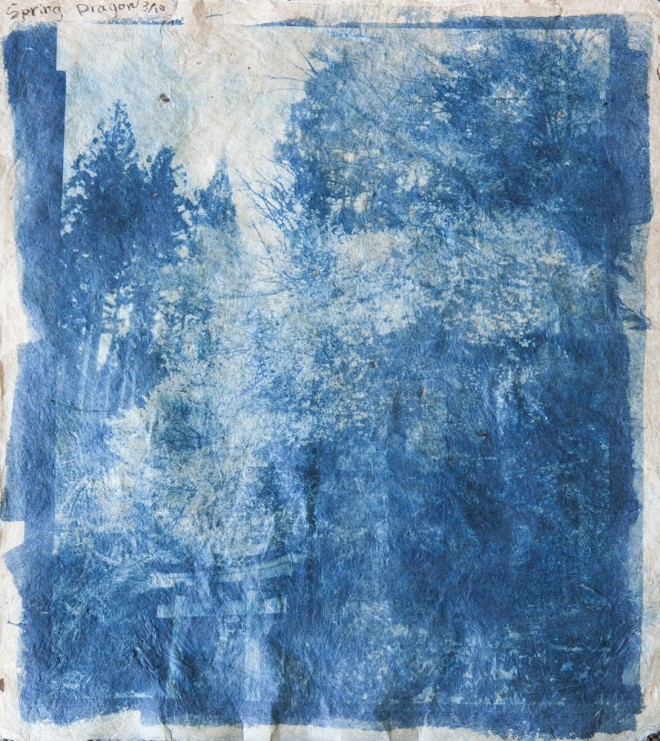
Mika Horie, ‘Spring Dragon’ 2016
The varied and compelling nature of the works are tied together by both the artists’ gender and national identity. And with works by Western photographers who have been inspired by Japan also on display, this exhibition at IBASHO ensures a complete survey of the exciting work coming out of the country, and its wider ramifications for contemporary culture on the international stage.
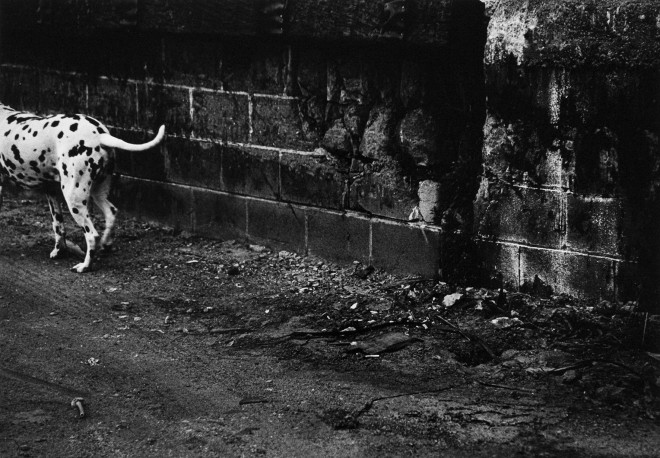
Reiko Imoto, ‘Parallelism’ 2000
‘Female Force from Japan’ will show at IBASHO Gallery in Antwerp until 2nd July
Tags: Female Japanese photographers 2017, Feminist Japanese photographers, Feminist photographers, Japan
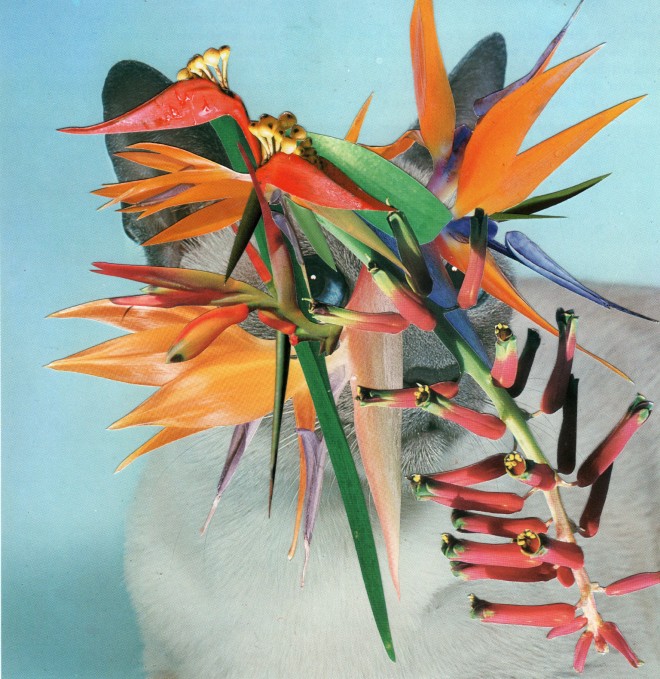
Cats & Plants
As simple as the title suggests, this new book from independent publishing house Zioxla is all of the internet clichés repackaged into something new, fun and fresh.
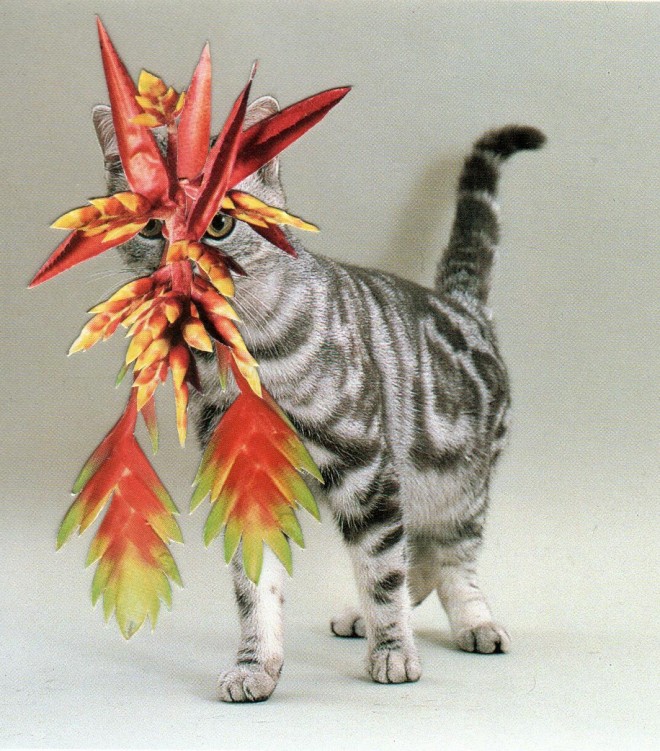
Featuring the work of Chicago-based artist Stephen Eichhorn, the book is a playful ode to one of the most familiar images in contemporary culture. There’s always something interesting about bringing Internet trends offline, and Eichhorn’s work offers a meta-read of what cats have come to stand for, taking what’s familiar and transforming it into something surprising.
While plants have been a constant recurrence in Eichhorn’s work, when he began working on this latest series of collages he decided to pursue images and references from niche publications only. This led to discovering and using images from publications such as Japanese cactus guide books and abstracted parts of Orchids.
Having started the project back in 2009, the 200-page tome is the culmination of years of work, with the honed, stylised graphic quality that has defined other work reflected here too. Cats eyes jump out of shells, blend with cacti and peek from behind coniferous leaves. Its’s funny, light-hearted and smart; we predict ‘Cats & Plants‘ will be your new obsession this summer.


Anne Morris in ‘Form and Volume’
What happens when you take simple objects and turn them into art? Annie Morris’ practice grew out of drawing. Her love of line develop into sculpture, painting and free-hand sewn works that exude joy. She uses everyday objects such as biro pens and clothes pegs to make pieces that brim with a personal visual language full of narrative pleasure.
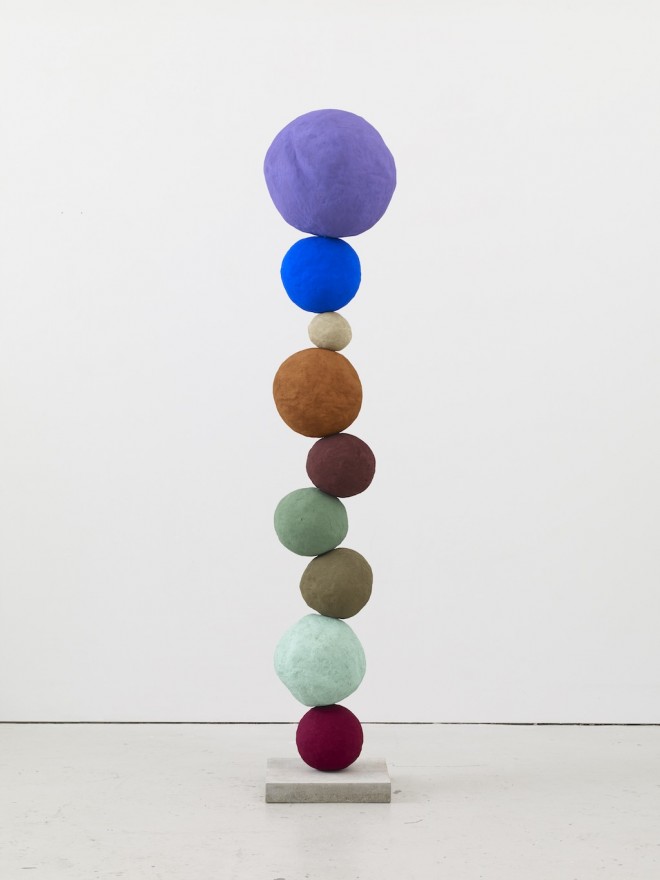
The staking sculptures she has on show in Form and Volume at CF Hill in Stockholm sit firmly between the abstract and figurative. They are often human scale, or larger than life, but seem to echo the vertical stance of the human body. She reduces her forms to shapes that are circular but inanimate. She plays with gravity, creating balls of pigment and colour that seem to defy the laws of nature.
The formal nature of her stacks veer towards the language of painting. She studied with Giuseppe Penone at the Ecole des Beaux Arts in Paris and Phyllida Barlow at the Slade in London – and reflects their sense of solemnity and play, free space and steadiness.
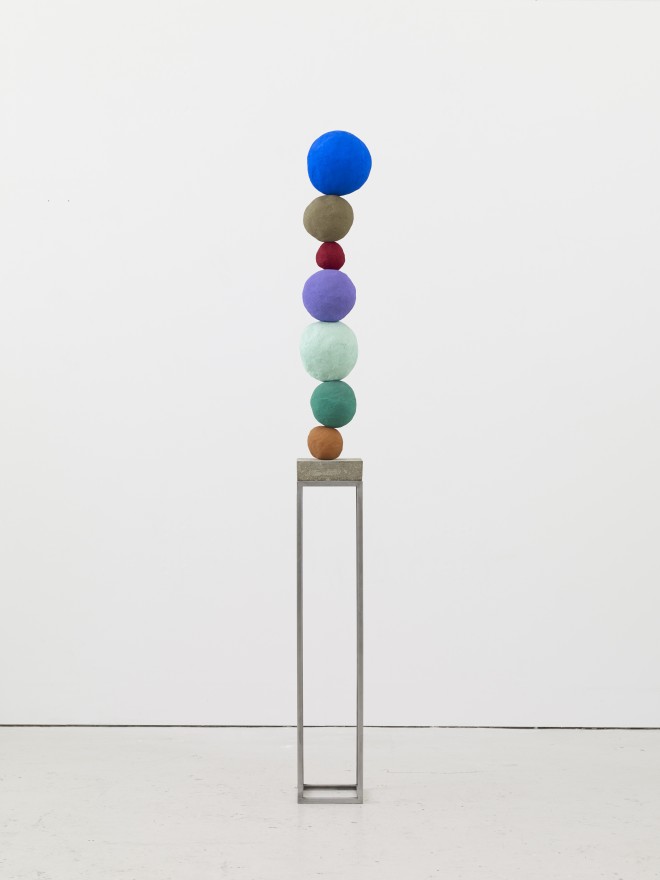
She uses coloured pigment, chalk and watercolour on the surface of her balls, which are intentionally hand made and uneven. Their imperfections give them a feeling joy, lightness and humour. The balls should fall apart, but Morris’ has enabled them to reach upward seemingly through hope and intention as much as anything else.
Each of Morris’ colourful combinations are unique. There is a sense of repetition and exploration in combinations that brings to mind Joseph Albers. She obsessively deconstructs and reconfigures fragments on order to create something harmonious. The stacking series slowly emerged in the wake of her experience of giving birth to a stillborn child, the resulting trauma and the relationship with her desire to have children (she now has two). These are works about hope and harmony in the face of hardship.
Morris has now begun to explore making stack works in metal – experimenting in both bronze and steel. Most recently she has been working with technicians who fabricated work for the iconic British modernist sculptor, Barbara Hepworth. A feminist aesthetic heritage runs throughout Morris’ work, yet her work is not limited by references to gender – her use of line echoes both Jean Cocteau and Louise Bourgeois. This is an artist whose ever-expanding approach is both personal and refreshingly accessible and universal.
Annie Morris is on show in Form and Volume at CF Hill, Stockholm until June 30
Tags: Art, Feminism, Feminism and art
Fashion Flora at SHOWstudio
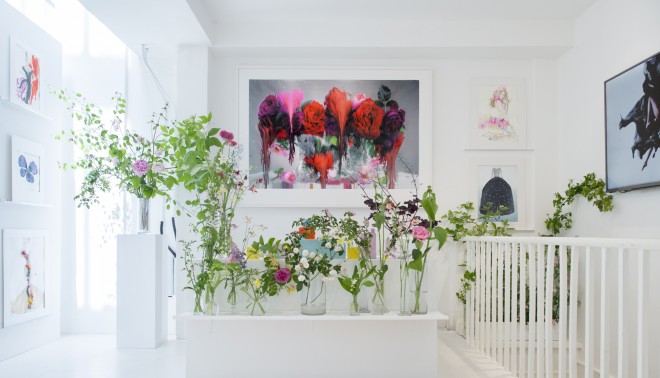
In their latest exhibition, SHOWstudio offers a botanical paradise in which fashion illustrators and flowers combine for a refreshing presentation.
The exhibition brings together an array of works by renowned names including Alexander McQueen, Dries Van Noten and John Galliano. Curated by Flora Starkey, the best seasonal British flowers combine with these works, and films from SHOWstudio’s 17-year archive, to create a summery, fresh space in which audiences can explore the long-standing relationship between fashion and flowers.
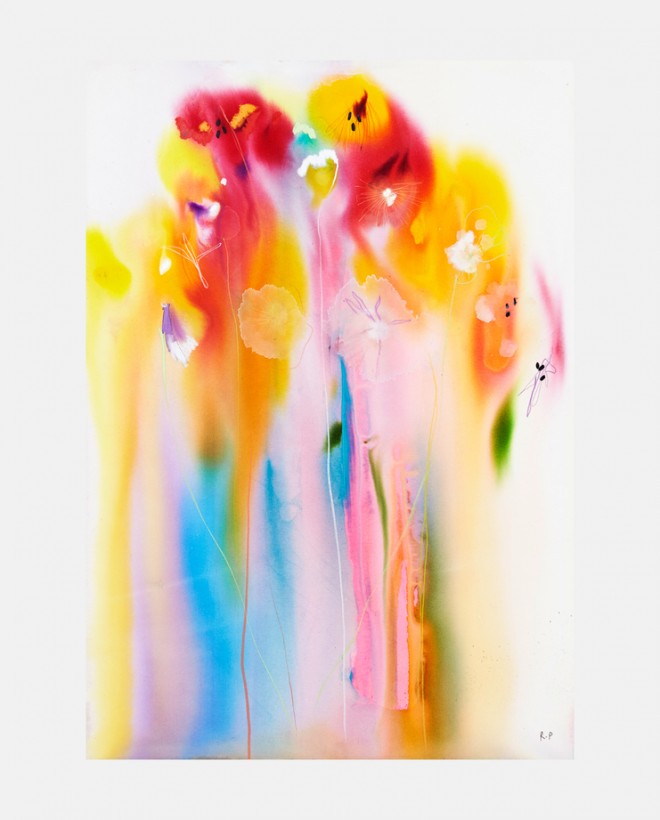
“Flowers have always been a huge influence and inspiration in the art of fashion design as well as a recurring theme throughout my own work.” Commented Nick Knight. “It is with great pleasure that I can announce the latest exhibition at the SHOWstudio Fashion Illustration gallery, ‘Fashion Flora’. The exhibition presents an explorative look at the use of flowers as a motif in fashion throughout the decades, as seen by 40 of the world’s preeminent contemporary fashion illustrators. Curated by Flora Starkey, who is one of the most exciting floral designers working today, the exhibition will also feature Flora’s beautiful flower arrangements.”
Fashion Flora is open at SHOWstudio now.
Celebrating tradition and championing the future: ’31 Women’ is back
In 1943, art collector Peggy Guggenheim hosted the ground-breaking ’31 Women’ exhibition at her New York Gallery, lending a platform to female artists who hailed from the contemporary worlds of surrealism and abstract expressionism. From the 2nd June, Breese Little Gallery will present a sequel to this pioneering exhibition, tracing this group of female artists from the 1940s up to the present day, and including works by successive generations of female surrealists and abstract expressionists.
We spoke to Director Josephine Breese, to find out about the relevance of this exhibition today, and the themes that are highlighted by these dual genres.
What drew you to Peggy Guggenheim’s 1943 exhibition and why did you decide to bring it into the present day?
Our exhibition channels the celebratory spirit of the original concept, at an appropriate moment to revisit the relevance of Guggenheim’s all female show. While the format of 31 women artists was unusual for its time in 1943, the exhibition was presented without extra fanfare, in step with the courage of many of Guggenheim’s avant-garde decisions. This provided a prominent platform for Guggenheim’s circle, incorporating artists such as Dorothea Tanning, Louise Nevelson, Frida Kahlo, Leonora Carrington and Meret Oppenheim.
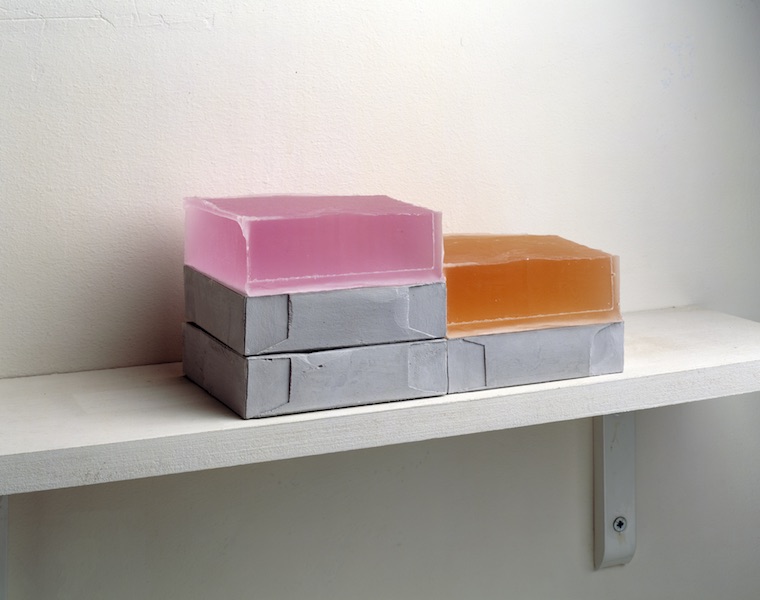
RACHEL WHITEREAD. STEP 2007 | Photo credit: Mike Bruce
How does 31 Women at Breese Little differ from the exhibition at Peggy Guggenheim’s Gallery in 1943?
We adopted a starting point of the dual strands of abstraction and surrealism, in the ascendance of 1940s New York, alongside the additional framework of the British connection that is shared by the participating artists. These themes are developed through subsequent generations, represented by contributions from the 1940s to the present day, from early British modernists to iconic female artists of the 60s and 70s.
What techniques do the artists use to convey these themes?
An advantage of having 31 participating artists is the breadth of different materials used! A brief overview includes ripped canvas, bark, steel, latex, resin, jesmonite, and a handwritten letter by Tracey Emin.
Why did you feel that it was important to put on an exhibition using only female artists?
The benefit of an exclusively female context is that it can be considered from multiple perspectives, and we are particularly drawn to its capacity as an open forum for discussion between the work on show as well as its timing. The exhibition concept met with enthusiasm from artists and galleries involved from its early planning stages, indicating the confidence and place for shows of its kind at this moment.
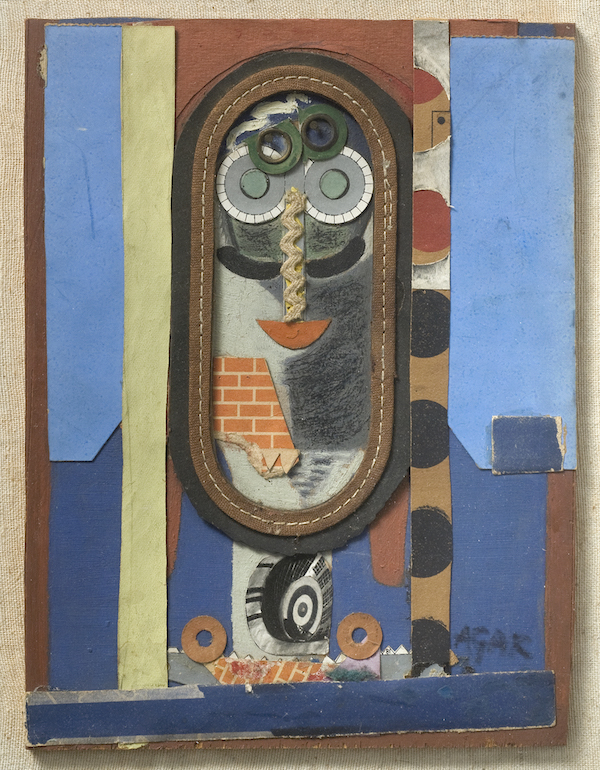
Eileen Agar, Fighter Pilot, 1940
Are there any works in the collection that particularly stand out to you?
31 Women is composed of a wonderful and wide spectrum of contributions, which chart a loose introduction to the timespan and production from the 1930s – 2017. Claude in Gillian’s Shadow (2017) is Gillian Wearing’s testament to this legacy. The small silver gelatin print was made shortly before her exhibition with Claude Cahun at The National Portrait gallery, and revisits a 1938 self-portrait by Cahun. Likewise, Katie Schwab recognises the history of modernist making processes that are often traditionally ascribed to female practitioners. Schwab’s compact ceramic composite from the recent Leftovers series, anticipates the research she is currently undertaking on the Wilhelmina Barns-Graham Residency at Porthmeor Studios in St Ives.
’31 Women’ will be on display at Breese Little Gallery from June 2nd until 31st July 2017.
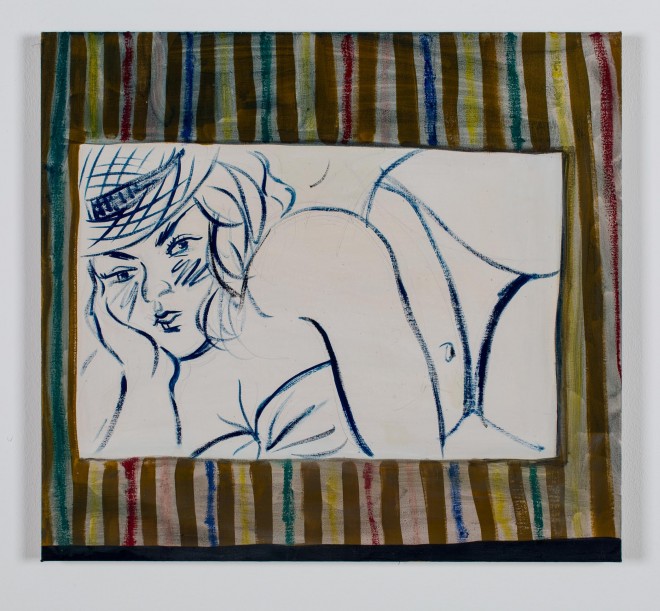
Featured image credit: Ella Kruglyanskaya, Drawing of Lounging Woman in Straw Hat, 2015, Oil on linen, 53.3 x 58.4 cm, Courtesy the artist and Thomas Dane Gallery, London
Opening up to the unknown: Twin meets artist Sarah Braman
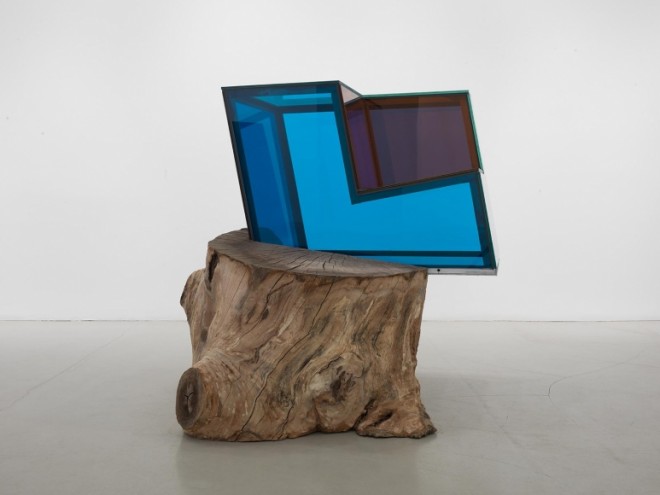
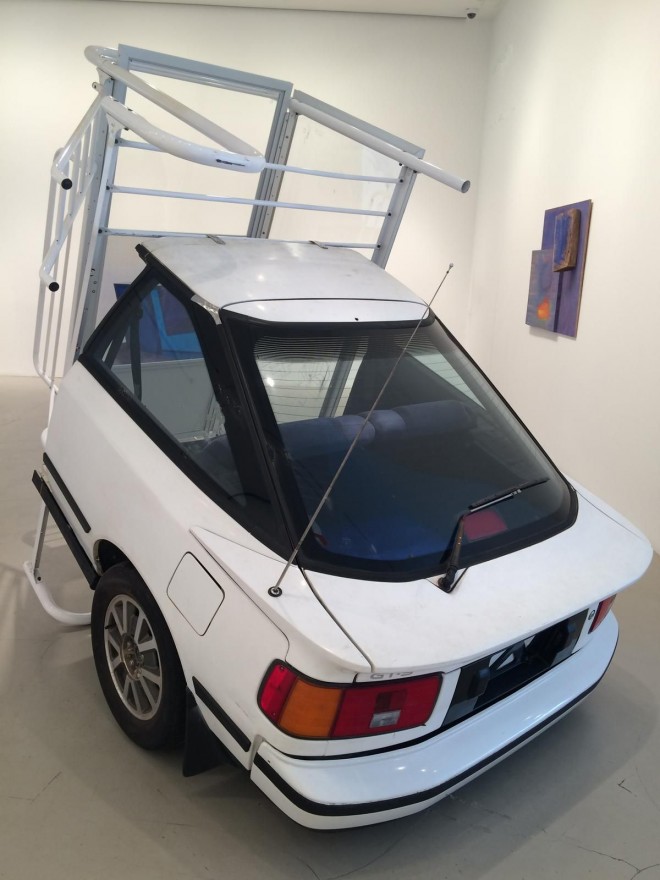
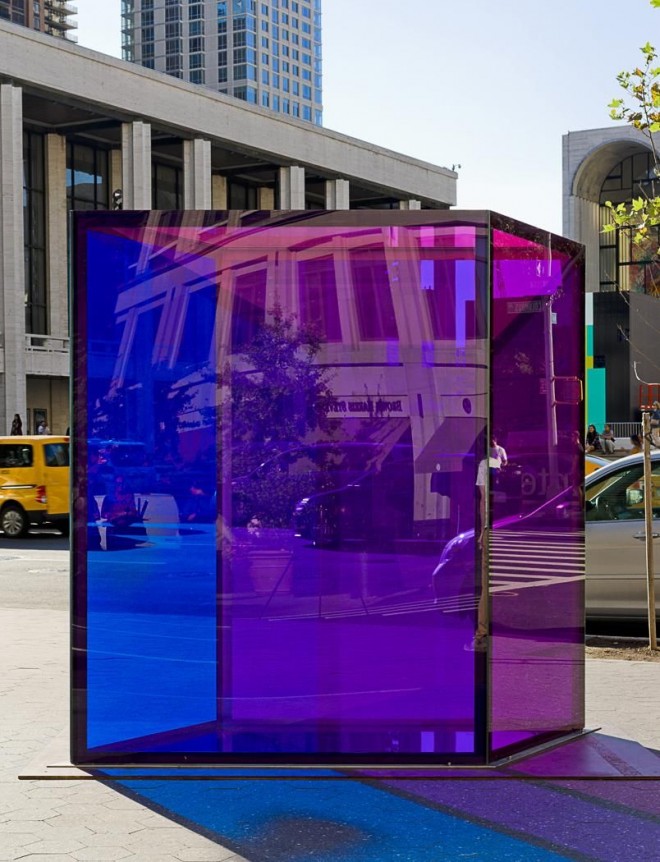
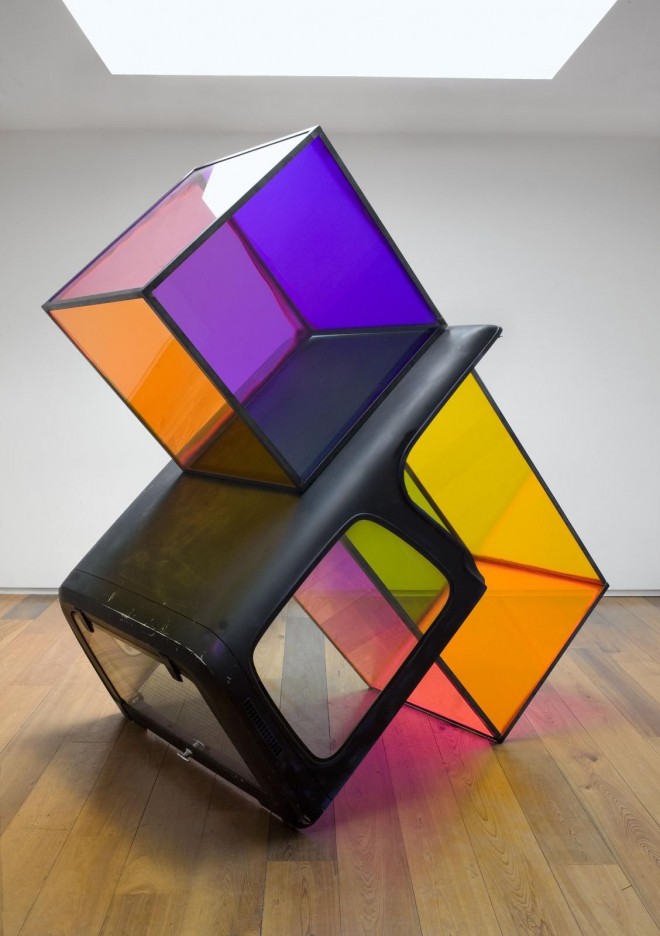
Sarah Braman focusses on large-scale sculptures which interact with their surrounding environments. Born in New York, Braman has cultivated a distinct aesthetic which sees a melange of vibrant colours rendered in various materials – from perspex to scrap metal pieces. The resulting works offer captivating interplays between the private and the public, wherein exhibits invite an engagement with their surrounding space, as well as engendering emotional response. As her first solo show in London comes to a close this week, Twin spoke with Braman about creative spaces and finding the perfect object.
Your work is often large scale, and often involves familiar objects that you render unfamiliar through new juxtapositions – how do you decide what to work with?
I tend to work with what is around me, things I find at home or in the yard or on the road. I am a regular at the town dump and Salvation Army in my town. Sometimes I get a slow burn desire for a specific object and then I open my scanning to a larger periphery to try to find that thing.
Do you feel an instinctive pull towards certain types of materials?
Yes I have always had a love for transparency. I guess light feels like such a gift and always changing and transparent glass or fabric allows that to do its magic. I also love everything about wood. I love its density, it’s colour. I love that when I paint on wood there is already a subject in it’s grain. It is also true that in carving wood every piece is so different from every other. Even out of the same tree the different chunks have such a variety of qualities. And I like furniture and junk form day to day life. I like automotive parts because when they are taken in parts they work as much as pieces of architecture as the do pieces of cars or trucks.
What has most surprised you when working? Do you often pair materials and see them in a wholly new light?
When I use a material or object and it transforms to something I don’t expect that is the best feeling. It doesn’t happen all the time but its part of why I keep making art, trying to get to those moments.
What stories and themes do you most enjoying telling or exploring in your work?
That is a really hard question. I feel like I work best when I am detaching from thoughts about what the work is or should be. But to this same point my friend Pascal said to me recently this is an important time to take ownership of our choices. This also seems true. The truth is that I really don’t know what I am making, but that said; I do have desires and feeling of what I hope the work can be. I really want the sculptures to operate as objects that exist on their own, not as metaphors or symbols or stand-ins for anything else. I hope that the sculptures can lead the viewer into an experience that is truly abstract, that is, one that cant be described by words. I hope that the viewer could some how be ungrounded in this experience and that while they may have feelings or thoughts looking at the piece that they are at the same time unable to tie all this together in a way that they can understand. I guess this is all to say that I hope the work can open people up to the unknown, and more specifically, the unknown that exists in every moment of our lives.
Who have you been most inspired by, for this exhibition and more generally throughout your career?
My mother built our house when I was about five years old. I think the experience of watching her take down an old tabbacco barn and slowly build a house out of it has been one of the most inspirational experience in my life and in my art. For sure being a mother and the inherent imperfection of the day to day of raising children paired with the absolute perfection of the love shared has been a guide for me in the studio. This also is true for my relationship with Phil. With him I think the deepest value is having someone that I feel completely safe with. I think when I can have a place of comfort and faith to go to, it allows me to follow the work to the edge of what I understand, and get to a place that is maybe all wrong and fucked up. After that I would say my involvement with CANADA and the artist that form that extended family. Of course there are many artists from art history and contemporary art that influence and inspire me, but the proximity I have to the artists makes the effect and inspiration that much more intense. I could list a whole lot of artists and works of art if you think that would be helpful and interesting let me know and I will write back with that.
I’m interested in how you reconcile the more rigid space of a gallery with large-scale works. Do you feel that it inhibits the viewer’s ability to interact with them, or is it the reverse?
I hope that it draws people into an experience that is complex. Some people have said that they are intimidated at first by the presence of some of the larger works, but that as they start to walk around the pieces they get comforted by the humanity in the details and start to let down their guard and engage.
What is it about volume and scale that you enjoy? Do you begin each work with a smaller visualisation?
I almost never do small studies or small maquetts. When making large work I usually start directly with the materials/objects or use large sheets of cardboard or plywood if I am trying to work out the planes. I think I am drawn to large scale because of the direct body experience when you are standing next to the sculpture. I like having the opportunity to surrender to the sculpture and I think the large scale helps move me towards that.
You also established your own gallery. Given that you work so much with space and sculpture, did you seek to invest a kind of higher sense of art in the gallery itself, where each exhibitor played into a relationship with the existing space, or do want artists to exhibit independently within the space?
The gallery was really my husband Phil Grauer’s idea. He invited a rag tag group of artists to join him in his vision. I was lucky enough to be in the vicinity at that time so I got swept up into it. It has been one of the great gifts of my life to be able to participate in his vision over the last almost 20 years. Getting back to the question you are asking, we really try to let the artists steer the handling of the space in whatever way that they need/desire. I think if there is a larger creative desire underlying the gallery it has to do with creating a space for a web of artists to be in conversation with each other and who provide support and context for each other.
What are your future projects?
I just finished a large sculpture for a show at The Brant Foundation curated by my colleague, fantastic painter and friend Sadie Laska. It’s a small shack type structure that was made for a group of friends to play music in. It’s also filled with books I have collected from the town dump.
I am just starting to work on a few outdoor sculptures. One is for an exhibition organised by artist Matthew Day Jackson and is taking place in Jackson Hole Wyoming in time for the solar eclipse happening at the end of Aug. Matthew has generously offered to fabricate the piece out there. It is basically a glazed shipping container that is stuck in the ground at a slight angle. It will also be a vehicle for music performance and makeshift reading room. The other outdoor piece is for an exhibition of public sculpture at UMASS Amherst which is especially exciting for me because my son is in his final year of college there studying computer science. And lastly I am working on a solo show for the fall for a wonderful dealer Linn Lehn in Dusseldorf Germany.
Sarah Braman is at Marlborough Contemporary, 27 Apr 2017 – 27 May 2017
Tags: Feminism, Feminism and art
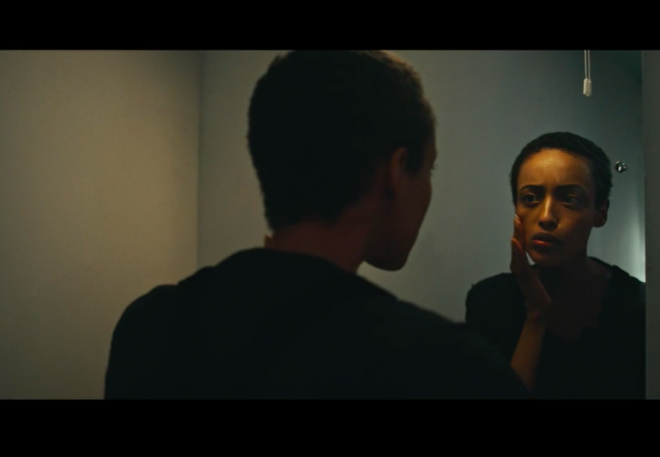
Politics, fashion, feminism and everything in-between: Twin meets Jade Jackman
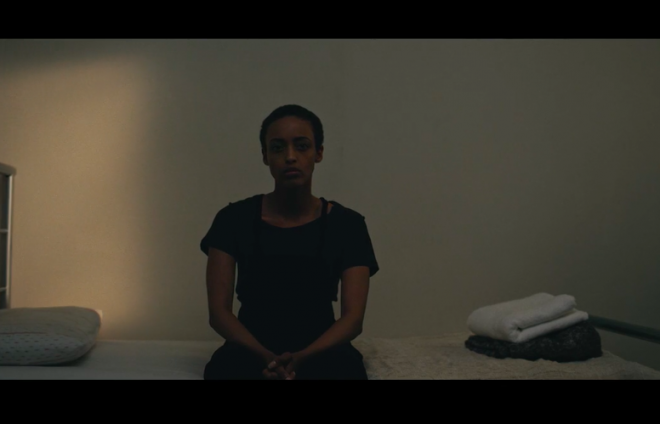
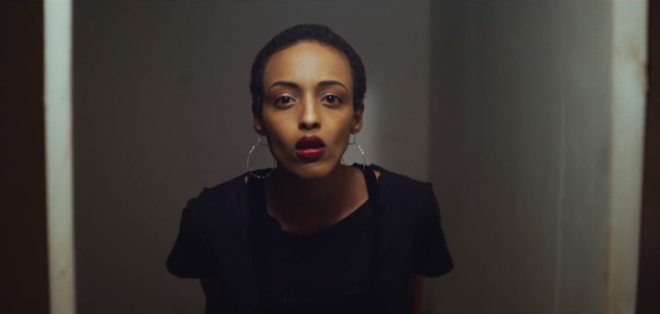
Female filmmaker Jade Jackman and I speak over Skype, from her apartment in Madrid – a city which she has just moved to as a result of what she refers to as “the monumental cost of living in London” and of course, Brexit. She’s recently returned from Afghanistan where she was teaching film to Afghan women reporters so they could tell their own stories and also released a short creative documentary on Yarl’s Wood – a women’s detention centre in the UK – earlier this year. Not only this but Jackman is also spearheading a project named ‘Eye Want Change’, teaching young people how to make documentaries about issues that matter to them using just their smartphones. Needless to say she is one smart, endlessly creative and inspiring woman who Twin have been eager to speak with for some time now. Jade and I Skype-d for over an hour, from East London to Madrid about protests, politics, fashion, feminism and everything in-between.
As a woman, why do you feel like it’s important to support other women in the creative industries?
It’s incredibly important — someone doing well doesn’t mean you are going to do badly. I think there needs to be more of a conscious effort for women to support other women. It is starting to happen slowly… I think it’s about getting different voices out there. One thing that’s been amazing about the digital age / internet is that women have been able to get their voices out there talking about what is important to them. It’s about making sure our voices and the way we’re presenting ourselves is seen as legitimate. I think it’s a really exciting time because we’ve got more ways to put our opinion across than ever… I guess we’ve got to wait and see with this kind of movement whether millennials (or whatever people like to call us) will pierce the glass ceiling.
Hopefully!
I think so, I think it’s unstoppable!
How have you found being a female filmmaker? How has it impacted your journey?
I’d say for me personally it has informed what I want to talk about more than having had a negative impact career wise. I think it’s taught me or shown me the things I’m interested in. In some ways as well being a woman isn’t always negative — like I wouldn’t have been able to make the film about Yarl’s Wood in the way that I made it if I was a man, and I wouldn’t have got so close to women in Afghanistan if I had been a man. There are lots of positives I think to being a woman, it’s just making sure your ideas don’t get sidelined or focus with a soft or feminine angle all the time. But then sometimes that’s what I’m interested in; I am interested in working with women and with some of the topics I do cover it is to give a different perspective, like a gender perspective because I think it’s necessary.

I remember when I first heard about Yarl’s Wood and what happened there I was horrified and felt powerless. How did this film come about?
I studied law at LSE at university and wanted to be a lawyer originally. It was around the time of the legal aid cuts and I wanted to use my law experience to help in some way. So during that I was planning a dossier of sexual abuse cases that were happening in Yarl’s Wood – women reporting cases of sexual assault from the guards. At the time I was quite young, I was nineteen, I hadn’t really thought about being a filmmaker then I wasn’t quite sure how to put that into film. Then I started to think about it more and more. In one of the interviews a woman calls them the invisible women and I guess I had an urge to put some visibility on them and make these women really visible as women — that’s how it started. As you can imagine trying to make a film somewhere you can’t film where video recording is illegal is almost impossible. I got a grant from Sheffield Documentary Festival in 2015 and that then I cut down on all these four hour phone conversations I’d had with women detained there and that’s how I started thinking about it. I was aware that I wanted it to look quite different visually to most documentaries. I think its because for the past two years I’ve been seeing a lot in lots of newspapers where I’ve felt really bombarded with the imagery of what refugees drowning look like and all these images of people in Calais and refugee camps are really important and valuable in some way but for me it didn’t feel real: it was like showing people in their lowest state ever and I felt like those images were almost so bad that we couldn’t associate with them. In my background I’m really influenced by music videos and fashion films and art films and I think today we are so used to seeing high quality video content and I think people are fed up of getting information from conventional news sources… it’s important to speak to people in a visually different way. If you think of Trump and Brexit the old ways of telling people information are not working, they’re failing to engage people…
I think that gives more scope for finding something in the work to connect to, which makes resonate more and have more value. Let’s talk a bit about Great Women Artists the Instagram account that champions female artists on the social media platform, how did you get involved with them?
I’m always looking to work with women who are doing something they are passionate about. I think it makes for interesting projects and collaborations. I got in contact with them and they were saying they were doing a collaboration for International Women’s Day and I was like okay cool let’s do a video for that and explain why what you are doing is connected. Talking about this mass produced culture and imagery of women that isn’t by or for women. We couldn’t actually say we didn’t see images of women — we do, women are used to sell pretty much everything but in the same way that there’s lots of clothes and lots of brands being sold to us all the time, but those things aren’t the same, they want to collaborate with female artists because they are creating something unique by hand, more genuine imagery of something that is made by a female. That’s what got my interest. I think that I liked that they chose Frida Kahlo and Louise Bougeois who were open about being crazy and not being these ‘respectable’ women. I really admired that because there’s a certain image of a woman we have to aspire to or look to be like…That’s why I was keen to get involved with them. I really like they are planning to work with other young female artists to come. It’s out of a conventional gallery setting it’s really clever.
Definitely, and if you consider that Instagram is a platform where a lot more art is shared and consumed now, you’re more likely to see work on Instagram even if it is in galleries. You go to a lot of protests, what’s your opinion on protesting?
I am interested in politics as I’m a documentary filmmaker and I want my work to talk about things that I care about — that’s the most important thing to me. For example the next thing I want to make a documentary about is gender based violence and sexual assault. Even if I am taking a more creative approach to them I really want to talk about these issues. So, I guess protests if it is something that you’re interested in are something visual and political protests are a natural thing to end up covering because they’re energetic and visual and they also need to be documented — especially now in the digital age. A lot of what goes on online is shared through social media — a lot of the imagery we see is coming through social media of being at the protest. The kind of people you are protesting against probably aren’t going to be at the protest so someone needs to be documenting it… I guess that’s something I enjoy. Also it’s a great way for people to get together from all sorts of different places and feel connected to each other and to causes they care about.
I think too it’s important to feel heard, to have a belief that you have rights and that bleeds into the rest of your life and how you approach that what’s happening in the world.
I think what I find most important is the protests they do outside Yarl’s Wood. What’s great about a protest is the power people make. You can’t really hide from it because here are people there.
You studied Law, how did you then move from Law into documentary and filmmaking….
I studied anthropology with it and I think I always wanted to be a documentary maker but I didn’t know how because I didn’t want to make TV documentaries… so, I wasn’t sure if what I wanted to make existed I knew I didn’t want to do just fashion but I like to make things that look like fashion films so I was kind of confused when I was younger what I was interested in. For example I interned for a couple of fashion magazines whilst I was at university and I was always really interested in Pam Hogg not because I wanted to talk about the fashion or the craftsmanship but I wanted to talk about the politics — I think I’ve always understood images more than I understand anything else. I always am seeing something.
Watch Jade Jackman’s Yarl’s Wood documentary, ‘Calling Home’ here.
Tags: Feminism and art, feminist, feminist film
The female artists at Venice Biennale 2017 you need to know
Bored of yet another long list of old white male artists? Fear not. There are many women on show at the Venice Biennale this year making thoughtful, complex and deeply considered work. These are ten of most exciting names at Venice Biennale 2017.
Tracey Moffatt
Australia’s acclaimed filmmaker and photographer Tracey Moffatt will be showing a new body of work entitled My Horizon. Expect a discussion of global issues around what is legal and illegal, fictive and real, lost and remembered.
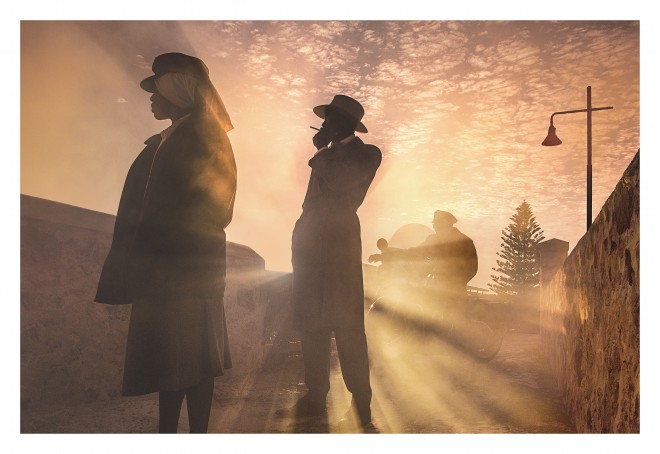
Hell (Passage Series) Tracey Moffatt Venice Biennale 2017
Kirstine Roepstorff
Scandinavia always has to share a pavilion at Venice, but a stand out should be the wild and weird collage based works of Kirstine Roepstorff. It’s hard not to enjoy the way the Danish artist transform our image and information saturated existence into inventive collage and montage work.
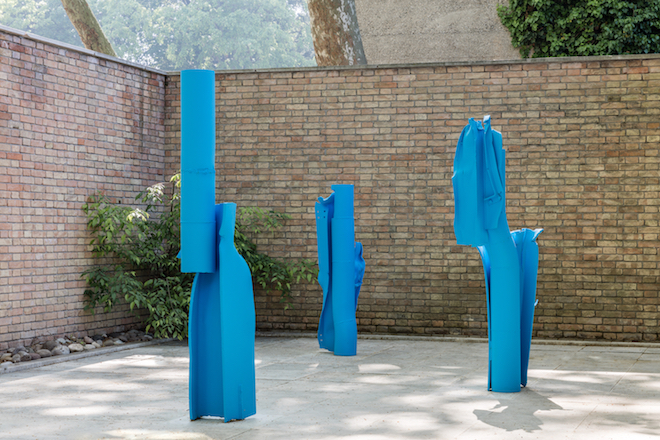
Carol Bove
Carol Bove, alongside duo Teresa Hubbard/Alexander Birchler, has created a pavilion which examines why Alberto Giacometti, despite being asked numerous times, refused to show in the Swiss pavilion Venice. The American artist’s sculptures and assemblages should make a great starting point for this instructional critique.
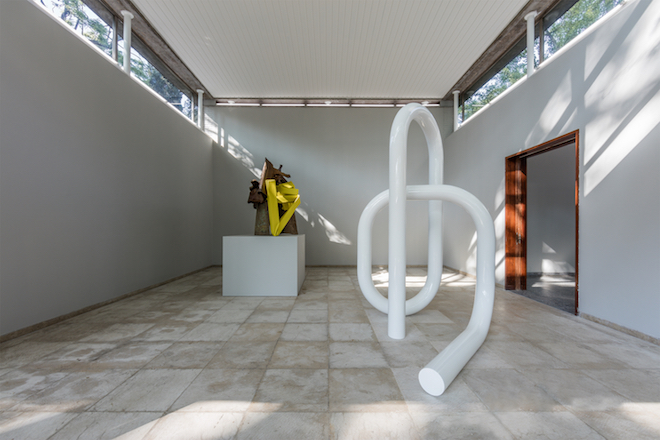
Carol Bove at Venice Biennale 2017
Geta Brătescu
This brilliant, entirely individual older artist is exhibiting her work for Romania (Londoners should go to Camden Arts Centre to see some incredible work by her from the 1970s). She can do anything from performance to abstract painting, embroidery to sculpture Proof that artist work truly gets better with age.
Phyllida Barlow
Finally another woman is getting a chance to take over the British pavilion! No one could fill it better than Barlow, with her painted, chaotic, building sized installations and sculptures. Barlow, who taught artists like Rachel Whiteread at the Slade, really hit it big after she ‘retired’. About time too.
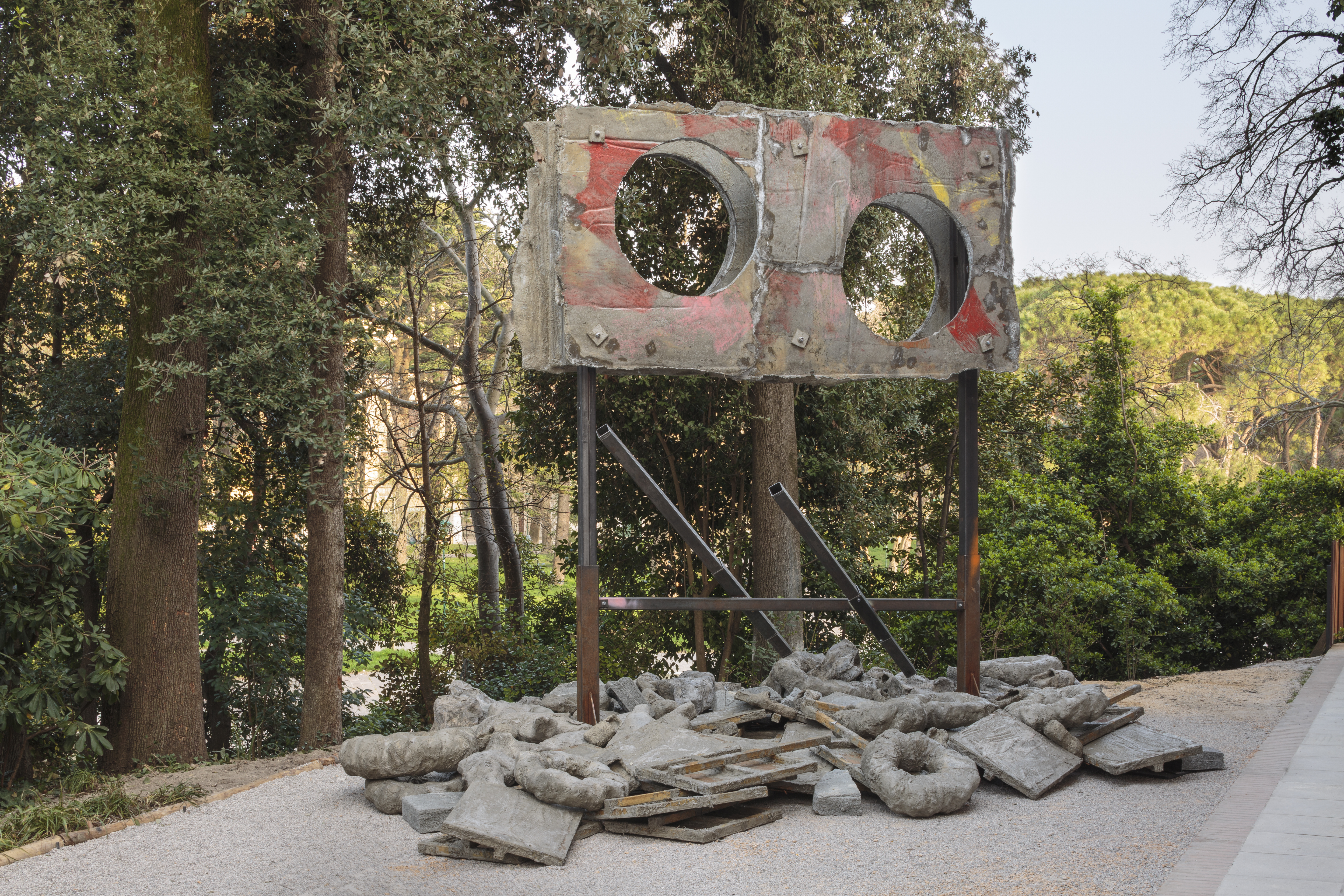
Installation view, folly, Phyllida Barlow, British Pavilion, Venice, 2017. Photo: Ruth Clark © British Council. Courtesy the artist and Hauser & Wirth
Candice Breitz
Breitz’s film installations just keep getting bigger and better. Following a killer show at KOW in Berlin starring Alec Baldwin, and a huge project at KW Berlin with Tilda Swinton last year, Breitz is taking on the South Africa pavilion with what is sure to be brilliant work on representation and identity.
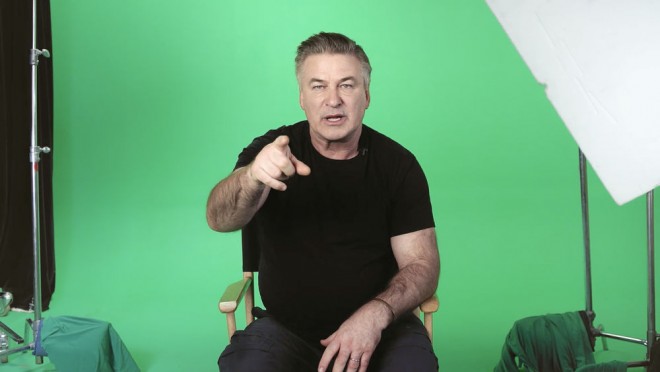
Candice Breitz, Love Story, 2016. Featuring Alec Baldwin and Julianne Moore
Martine Syms
LA artist Syms just keeps making good work. On the eve her of first solo show and feature length film at MoMA in NYC, she is also one of the finalists for the Future Generation Prize for work that takes on the structures of media and representation of Blackness.
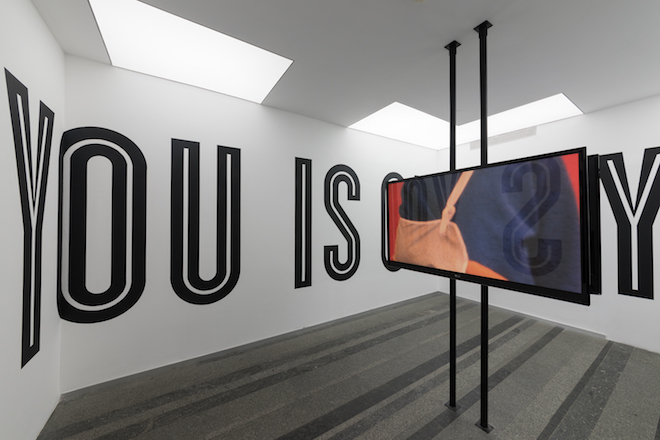
artine Syms (United States) Lessons I-LXXV, 2014-2017 Series of 0’ 30’’ videos. Courtesy of the artist and Bridget Donahue Gallery
Lisa Reihana
New Zealand representative Lisa Reihana’s paintings feel as if the could have been made in the 18th century as much as today. The main focus of her work is a wallpaper installation based on Captain Cook’s voyages using digital audio visual animation to explore the European fetishisation of the Pacific.
![Lisa Reihana, in Pursuit of Venus [infected] 2015, HD video (detail), Auckland Art Gallery Toi o Tāmaki, gift of the Patrons of Auckland Art Gallery.](https://www.twinfactory.co.uk/wp-content/uploads/2017/05/In_Pursuit_of_Venus_3.jpg)
Lisa Reihana, in Pursuit of Venus [infected] 2015, HD video (detail), Auckland Art Gallery Toi o Tāmaki, gift of the Patrons of Auckland Art Gallery.
Barbara Walker is one of 40 artists in this brilliant exhibition of emerging artist, curator and mentors being launched by Nicolas Serota, the Diaspora pavilion. Based in Birmingham, her drawings and paintings look at class, power and cultural difference.
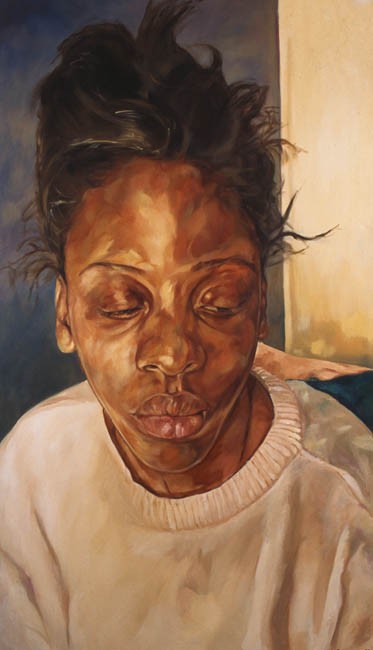
Barbara Walker, ‘Private Face ‘, exhibited at Midland Arts Centre, Birmingham, May – July 2002.
Dawn Kasper
Dawn Kasper is one of the women the central (female) curators the biennale has included in the main exhibition. A performance artist based in NYC, she studied under Chris Burden and Catherine Opie in LA, and make installation based projects about fear and panic – timely for our current emotional fall out then…
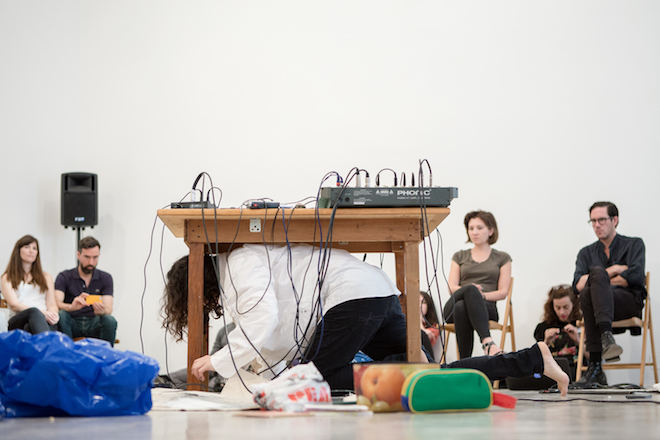
Dawn Kasper, ‘On Desire or the Method’, 2016
Tags: Feminism and art, Feminist art, feminist artists, Venice Biennale 2017

 PREVIOUS

 Twitter
 Tumblr
 YouTube
 Facebook
 Instagram
